City Library
City Archives
CastleGeislingen
Geislingen Castle
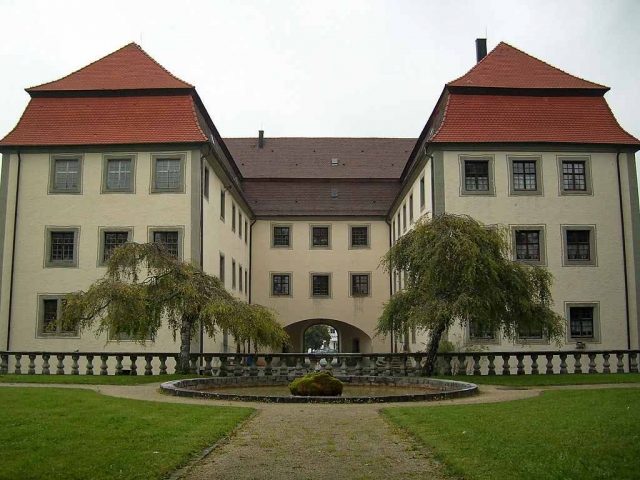
The Lords of Bubenhofen, who were then the most significant knightly family in the Geislingen area, chose Geislingen as their new center of power in the first half of the 14th century, after having established their ancestral seat in the Rosenfeld Valley between Binsdorf and Rosenfeld around 1200 ("Bubenhofer Tal"). Wolf 'the Elder', Heinrich I's son, built the castle in Geislingen in 1426 next to the old lordly castle, the original structure of today's northwest wing. This castle was known in 1464 as a 'water castle with two moats by the pond'. The old castle was henceforth called 'old castle seat by the town hall' and now served as accommodation for the castellan.
After Hans von Bubenhofen reached the peak of his noble family's intellectual and political development in the second half of the 15th century, Wolf 'the Younger' plunged it deeper and deeper into debt at the beginning of the 16th century due to his inclination for lavish display. Hans von Weitingen, a relative of the insolvent Wolf the Younger, ceded his rights as his main guarantor after the Peasants' War in 1527, when Hans von Stotzingen acquired the castle and village of Geislingen, along with the surrounding Bubenhofen property.
The 'Stotzingen Castle', as it was called in the divided town after the Stotzingen's inheritance division in 1598, passed after the Thirty Years' War, during which the Lords of Stotzingen became impoverished, to General Schütz von Pürschütz, who purchased it in 1666. After his indebtedness, it passed through various of his heirs and finally, on April 24, 1698, was acquired by the five sons of Schenk Wolf Friedrich von Stauffenberg, from the Lautlingen branch of the Wilflingen line. The five brothers divided their property on October 28, 1698, and Johann Wilhelm – by then, like his brothers, elevated to the rank of Imperial Baron by Emperor Leopold I – became the owner of the Geislingen knightly estate, which he considerably enlarged.
According to an inventory list from 1726, the 'residential castle consisted of an old and a new building with a well in the courtyard', to which further lordly buildings belonged.
Again, through various descendants and relatives, the Geislingen lordship passed to Baron Anton Damian Friedrich Hugo von Stauffenberg in 1762. He enlarged Geislingen Castle by adding the southeastern wing, creating a massive, three-story building with a stepped hip roof. It acquired its current shape and size, a typical moated castle, originally surrounded by two moats.
The Stauffenberg-Kageneck marital coat of arms (his wife was 'Baroness Marie Antonie von Kageneck') above the castle portal still testifies to the building activity of Baron Anton Damian Fr.H., and the Roman numerals MDCCLXXXIII commemorate the construction year 1783. He created the park facilities around 1789.
On August 15, 1791, Emperor Leopold II elevated the baronial family of Anton Damian Friedrich Hugo von Stauffenberg to the rank of count.
After Baron von Stauffenberg's death on November 30, 1803, his son Count Klemens Wenzeslaus received the lordship as the last Stauffenberg imperial immediate lord of Geislingen.
On November 28, 1805, Elector Friedrich of Württemberg placed the town under Württemberg sovereignty, to which the Count had to submit. The immediate Imperial Knighthood was dissolved, but the ties to the local lordship remained.
On July 2, 1833, the unmarried Count Klemens Wenzeslaus died. Baron Friedrich Schenk von Stauffenberg from the Amerdingen line – not elevated to the rank of count – took possession of the Geislingen estate.
On July 15, 1866, Baron Dr. h.c. Franz August von Stauffenberg moved into the castle with his wife Ida von Geldern and their two children. After 33 years, the castle was once again inhabited and renovated by the lord.
In 1901, Baron Dr. h.c. Franz August von Stauffenberg died, and his son Dr. h.c. Franz Wilhelm von Stauffenberg took over his estates.
From October 22, 1904, to September 17, 1905, the castle served as accommodation for about 60 children from Binsdorf who had become homeless there due to the town fire on September 17, 1904. Teacher Högerle from Binsdorf lived with them in the castle, taught them there, and managed the administration. Four nuns from Reute cared for the children, and a few women from Binsdorf provided kitchen service.
On December 29, 1925, the municipality of Geislingen concluded an exchange agreement with Baron von Stauffenberg for the acquisition of the castle; the transfer took place on July 22, 1927. Thus, the castle, along with five other buildings and the castle garden with the pond (today's outdoor swimming pool) and the surrounding properties, passed into the possession of the municipality. Classrooms for the school were set up in the southeastern part of the castle. In the old part, two teacher's apartments and a caretaker's apartment were created.
After World War II, school lessons could resume from May 1946. The municipal administration also moved into the castle in 1946 and remained there until 1963, as homeless people found shelter in the previous and current town hall building.
After the new school building was constructed in 1965, club rooms were gradually created in the southeastern wing, which became home to various active clubs that maintain their premises in their own interest. The northwestern half partly remained as living space and gained further cultural significance with the relocation of the city library. Furthermore, this part now serves the city archive.
Through comprehensive exterior renovation in the 1970s, which was only possible with appropriate state funds, Geislingen Castle received its current appearance and thus remains preserved as a landmark of the municipality.
Take Mobile History with you
You are reading this text for free. Premium adds what matters on the road: descriptions read aloud, sites found through your camera, whole regions taken offline.
- Every description, including the ~17,700 Premium sites
- Audio guide: have descriptions read to you on location
- AR finder: see sites through your camera, with distance and bearing
- Unlimited saved sites
14 days free, then from €2.99 a month. Cancel anytime.
Source: Wikipedia · Licence: CC BY-SA 4.0
This description draws on the facts documented in the linked Wikipedia article; Wikipedia content is licensed under CC BY-SA 4.0. Wording and editing: Mobile History.
Location: 48.2858, 8.8122