To be privately owned
CastleGartow
Gatow Castle
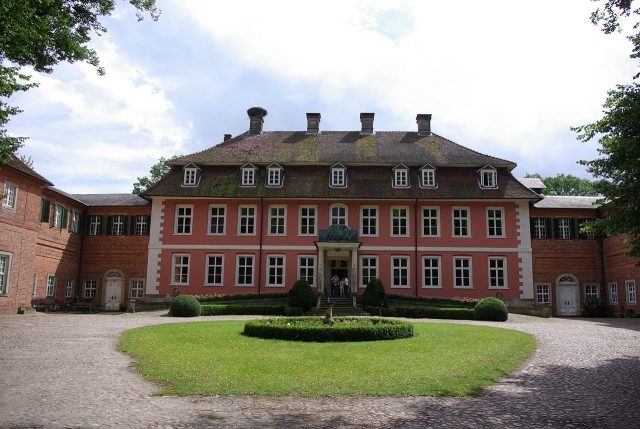
In Gartow, there was likely a defensive castle as early as 1225, intended to counter Slavic ambitions to gain influence here. In this year, a Conrad von Gartow was also first mentioned in documents. The Lords of Gartow were endowed with several possessions located in the immediate and wider vicinity of Gartow. The former Gartow Castle consisted of an outer and main bailey and was surrounded by a moat.
At that time, Gartow, along with several surrounding villages, was within the sphere of influence of the Margraviate of Brandenburg. The Principality of Lüneburg also laid claim to this territory, but neither of the two feudal powers could prevent its sale to the Order of St. John in 1360. When the Order sold Gartow to the Dannenberger knights von Bülow in 1483, Brandenburg again asserted its claims. For more than a century, the von Bülows managed to exploit the conflicting feudal interests of the Welf and Ascania princely houses to their own advantage and to round off their possessions through skillful purchase and pledge policies. But they could not hold it indefinitely.
Andreas Gottlieb von Bernstorff bought the heavily dilapidated and neglected Bülow estate in 1694, after he, as a minister of the Brunswick-Lüneburg prince, had enforced the former renunciation of all claims by the House of Brandenburg. He led the town of Gartow to economic prosperity and thereby the entire surrounding rural area, which increasingly oriented itself towards Gartow.
In 1721 and 1764, Gartow was ravaged by major fires. After the first major fire in 1721, Gartow was completely redesigned. In 1724, the St. Georg Church was built in Baroque style, and from 1710 to 1727, Gartow Castle was rebuilt.
In terms of administrative policy, von Bernstorff succeeded in 1720 in establishing a so-called "Closed Noble Court of Gartow". The administration and jurisdiction over Gartow and 24 villages were carried out from Gartow, where the von Bernstorff family had all administrative tasks performed in accordance with state laws. Previously, the villages of Holtorf, Kapern, and Gummern were ceded to the Electorate of Hanover and placed under the administration of the "Closed Court of Gartow".
Following political decisions, the separation of administration and justice was carried out in 1850, and at the same time, a new administrative order was proclaimed, according to which all previous noble courts had to be dissolved, including that of Gartow. On July 15, 1850, a new Gartow district office was founded. The former Schnackenburg district office had ceased to exist.
With this change, the influence of the Bernstorff family significantly diminished. In addition, there was the legally enforced detachment from obligations towards the House of Gartow, which had been in effect since 1831. The only remaining source of income was their own agriculture and forestry. The estate, one of the largest forest estates in Lower Saxony, is still managed by the Counts Bernstorff. Fried Graf von Bernstorff is a business economist. Like his father Andreas Graf von Bernstorff, he is an opponent of the planned nuclear waste repository in Gorleben.
Take Mobile History with you
You are reading this text for free. Premium adds what matters on the road: descriptions read aloud, sites found through your camera, whole regions taken offline.
- Every description, including the ~17,700 Premium sites
- Audio guide: have descriptions read to you on location
- AR finder: see sites through your camera, with distance and bearing
- Unlimited saved sites
14 days free, then from €2.99 a month. Cancel anytime.
Location: 53.0224, 11.4684