To be privately owned
CastleKrefeld
Gastendonk Castle (Krefeld)
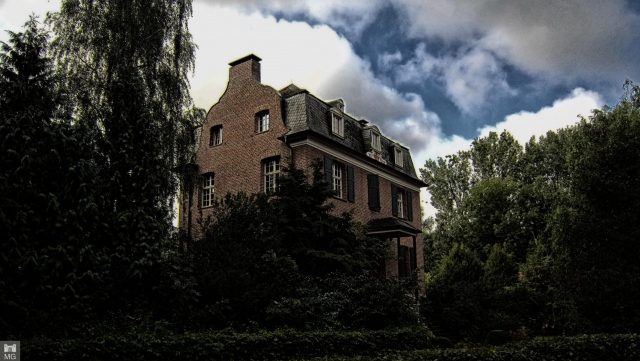
The building is said to have been erected around the year 1000 on a hill (dune), as the suffix Donk indicates, as discovered by the city archivist Paul Günter Schulte. In the High Middle Ages, the fortified manor was moved to its current location. The first Lords of Ganstendonk are mentioned in 1274. This interpretation of the name likely refers to an owner's name, Gasto, in connection with Donk. From 1449 to 1651, the von Eyll family owned Gastendonk; they belonged to a branch of the knightly or dynastic Clevesippe on the Niers, and their coat of arms can still be seen in the gatehouse today. It was not until 1627 that the Electorate of Cologne's bailiff, Konstantin von Nyvenheim, whose grave has been in Kempen's parish church since 1657, had the outer bailey, damaged by several plundering raids, restored. He also had a mill built – the Fennersmühle – which secured large incomes for the family. The mill collapsed on February 20, 1913.
The current manor house was built in 1759 as Haus Gastendonk in the Rococo style. It served as a summer residence for the Cologne cathedral canons during their hunting excursions. During this time, a chapel was also built on the east side of the outer bailey, which then fell victim to a fire in 1922 and was not renewed.
Since 1713, the Franken-Siersdorf family has been named as the owners of the moated castle. They had no descendants, and when the Siersdorf line died out, a nephew of the last Siersdorf, Maximilian Clemens von Bouhaben, became the sole owner in 1842. He had the park, unfortunately destroyed today, laid out by the Rhenish landscape architect Maximilian von der Wyhe. During the inflation, the family was forced to sell the castle. The new owner in 1923 was the farmer and horse dealer Bongartz, who "gutted" Gastendonk by having the forest and park cleared, thus creating a field of devastation.
When the Prussian State took over the estate in 1927 and declared it a domain, the aim was to create jobs for agricultural workers and improve nutrition for low-income families. Later, the Dahlhoff family, originally from Nettelstaed-Menzel in Westphalia, became tenants on the manor. In 1953, in the course of the land reform, the state parliament of North Rhine-Westphalia approved the sale of the domain to the settlement association "Rheinisches Heim" in Bonn, to establish settler plots there. In 1956, 18 settler plots of one acre each and one settler farm of 64 acres were established. The municipality of Hüls bought 17 acres of land to preserve the Landwehr, and another part was also exchanged by the municipality for building land. The considerable remainder remained in the possession of the Dahlhoff family. The changing ownership conditions are taken from the Westdeutsche Zeitung of August 25, 1988.
Take Mobile History with you
You are reading this text for free. Premium adds what matters on the road: descriptions read aloud, sites found through your camera, whole regions taken offline.
- Every description, including the ~17,700 Premium sites
- Audio guide: have descriptions read to you on location
- AR finder: see sites through your camera, with distance and bearing
- Unlimited saved sites
14 days free, then from €2.99 a month. Cancel anytime.
Source: Wikipedia · Licence: CC BY-SA 4.0
This description draws on the facts documented in the linked Wikipedia article; Wikipedia content is licensed under CC BY-SA 4.0. Wording and editing: Mobile History.
Location: 51.3917, 6.4799