Brewery
Restaurant
CastleGangkofen
Gangkofen Castle
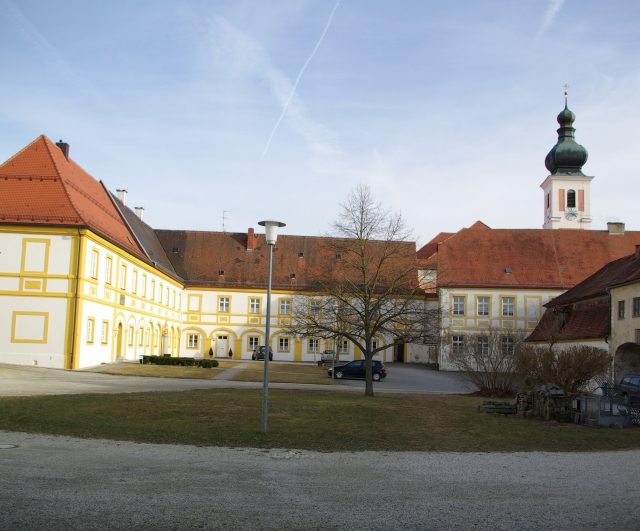
The castle was built in 1278/79 by Count Wernhard II von Leonberg. He founded a commandery of the Teutonic Order, one of the southernmost settlements of this spiritual knightly order north of the Alps. The power structure in the market town and its wide rural surroundings was decisively shaped by this order house, which, like the monasteries, appeared outwardly through manorial sovereignty based on numerous endowments, administered by a commander from the knighthood, the Komtur, and in parish life by the order clergy assigned to the order house.
According to tradition, the settlement of this knightly order in Gangkofen came about due to Wernhard II's participation in a crusade and the connection he apparently forged with the Teutonic Order, which was actually based in Prussia and Lithuania, at its founding site in Akkon in Palestine. The estates, which were endowed to the order house primarily in the 13th and 14th centuries, extended far into the Rottal and the Gäuboden. The Gangkofen commandery is spatially very close to the market center. It was destroyed in 1599 by a devastating fire along with half of the market town, while during another damaging event in 1666, which completely claimed the entire market, it was only attacked. Thus, today the observer sees a vast architectural complex from the early 17th century, united with the parish church "St. Mariä Himmelfahrt" (St. Mary's Assumption), built according to the plans of the Teutonic Order master builder Franz Keller of the superior Landkomturei Ellingen in Franconia. It was precisely this design influence and the order's own architectural style that created a church interior that is incomparable in its layout and design to the church buildings in the wider surroundings. Numerous smaller parish or filial churches belonged to the order house and were under its spiritual patronage, including the former pilgrimage church "St. Salvator" in Heiligenstadt outside the gates of Gangkofen, first mentioned in a document in 1279 as "capella nova" and since about 1830 also a cemetery church. This church interior houses in the choir one of the most significant Gothic creations in the southeast Bavarian region, a Gothic shrine altar from the year 1480, donated by the Teutonic Order Komtur Perchtold von Sachsenheim.
Approximately two kilometers north of Gangkofen, another spiritual center emerged in 1255, a Wilhelmite monastery, founded by the Regensburg Archdeacon Henricus Seman von Mangern. As part of the union of hermit congregations promoted by Rome during this founding period, the monastery was ultimately transformed into a convent of Augustinian Hermits, confirmed by document in 1267. This convent was endowed with extensive estates in the following two centuries and also received numerous privileges from dukes and emperors. The monastery building, which originated from the former Pöllnkofen Castle, was rebuilt several times, especially in the 15th and 17th centuries, but gave way to a fundamental new construction of the entire complex, initiated by Prior Angelus Höggmair, between 1712 and 1715. With the secularization, the Augustinian Hermit monastery of Seemannshausen was finally dissolved in 1803, and the Teutonic Order commandery of Gangkofen in 1805/06. While the Gangkofen commandery was almost completely preserved due to its central and immediate location next to the still existing parish church, the essential structural parts of the Seemannshausen monastery were lost forever after the auction, and with them also invaluable furnishings of the church, about whose interior all information is completely lost. Today, the west and north wings of the monastery building still stand in Seemannshausen. For over 150 years, it has housed a private brewery, entirely in the spirit of the previously cultivated monastic brewing art. According to its own recipes, in addition to commercially available beer types, a cloudy beer with high original gravity is produced here, which, like the appealing architectural complex with its cozy beer garden, attracts many visitors annually.
Take Mobile History with you
You are reading this text for free. Premium adds what matters on the road: descriptions read aloud, sites found through your camera, whole regions taken offline.
- Every description, including the ~17,700 Premium sites
- Audio guide: have descriptions read to you on location
- AR finder: see sites through your camera, with distance and bearing
- Unlimited saved sites
14 days free, then from €2.99 a month. Cancel anytime.
Source: Wikipedia · Licence: CC BY-SA 4.0
This description draws on the facts documented in the linked Wikipedia article; Wikipedia content is licensed under CC BY-SA 4.0. Wording and editing: Mobile History.
Location: 48.4371, 12.5617