To be privately owned
CastleDohna - Gamig
Gamig Castle
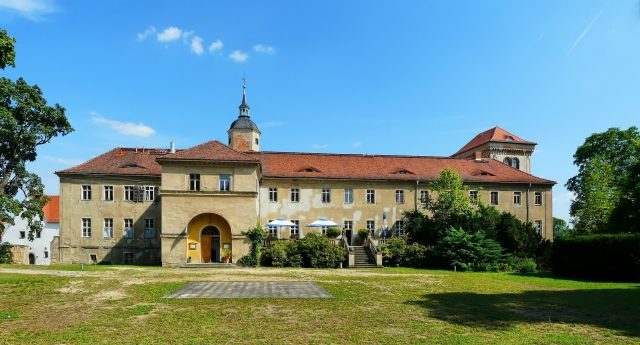
Gamig is located a good kilometer northwest of Dohna's old town. The district of Gamig consists of a large single estate with several outbuildings.
The original form of the place name, which comes from Old Sorbian, was probably *Kameńk. The place name Gamig, like e.g. Chemnitz and Kamenz, thus goes back to the word *kameń, German for stone, and therefore means "settlement in a stony area". This interpretation is consistent with the location of the place on a rocky hill. The place was first mentioned in 1411 as "Kamenig". In the following centuries, numerous other spellings were in use, including "Camegk", "Camen", "Kamig", "Gamigk" and "Gamich".
It is uncertain whether Gamig originated as an outpost of the Burgraves of Dohna and later belonged to Altzella Monastery. However, it is documented that in 1445/47 there was an outwork in Gamig, from which a knight's estate had developed by 1512 at the latest. Its owners exercised manorial rights in the surrounding villages, including the present-day deserted village of Blochwitz, in Bosewitz, Gommern and Meuscha, as well as in the present-day Dresden districts of Niedersedlitz and Zschieren. Gamig was and still is parished to Dohna in the Marienkirche. In the 16th century, the knight's estate was owned by the Lords of Schönberg (Frauenstein line). They had the castle built around 1575. In the 17th century, ownership changed frequently; the lords of the manor included members of the families von Bärenstein, von Hofkirchen and von Hanau. The chapel was consecrated in 1656.
In 1664, Privy Councillor von Heinicke (Hünicke) bought the knight's estate, which remained in family ownership until 1720. Even at this time, the large, essentially still existing building stock of the estate was present. It then consisted of the centrally located residential building (today's castle), the brewery, various stables and barns, and the chapel. From 1720, the estate was under the control of the Counts of Bose (including Carl Graf Bose) for about a century, and from about 1830, the Counts of Vitzthum. They had the knight's estate redesigned. In 1834/1835, the architect Woldemar Hermann drew up plans for the castle's renovation on the estate of Chamberlain von Lüttichau. With the participation of the architect Gottfried Semper, known for the Dresden Semperoper, the residential tower, now known as the Semperturm, was extended at the same time. Around 1840, the castle was given a late-classical appearance, and the chapel Romanesque touches. On the basis of the rural community order of 1838, Bosewitz gained independence as a rural community, which also included the district of Gamig, which thus never existed as an independent municipality.
The block of land surrounding the manor hamlet had an area of 173 hectares in 1842. In 1875, Gamig had 66 inhabitants, in 1900 there were ten inhabited buildings and 57 inhabitants. Around 1900, the Dresden manufacturer Höntsch acquired the estate, which remained in his family's possession until the forced expropriation and expulsion by the communists in 1945. After the Second World War, parts of the estate were demolished; the knight's estate first became a supply estate for the Red Army, then a state-owned farm. As part of the municipality of Bosewitz, Gamig was incorporated into Gorknitz on July 1, 1950, and from 1952 belonged to the Pirna district. In 1980, VEG Obstproduktion Borthen had the interiors and the castle park redesigned. The Semperturm served as a silo and, after a renovation from 1985, as a residential tower. Until 1990, the Gamig estate was used for agriculture.
The community of heirs of the Höntsch family withdrew from their claim for restitution after the fall of the Berlin Wall. In 1991, the Free State of Saxony bought the estate buildings with the approximately 170 hectares of land and made the complex available to the Gut Gamig e. V. association. This established a meeting place and rehabilitation facility in Gamig for the treatment of mentally ill people. At the end of 1998, the stable buildings were demolished and rebuilt. On January 1, 1993, the municipality of Gorknitz, to which Gamig also belonged, merged with Borthen and Röhrsdorf to form the new municipality of Röhrsdorf. Since its incorporation into the city of Dohna on January 1, 1999, Gamig has belonged to Dohna. The estate is now managed organically and produces agricultural and handcrafted products. An old barn now serves as a club and workshop building. In addition, the estate has the Renaissance House, a sheepfold, the chapel, and the socio-therapeutic residential facility "Haus an der Kapelle".
Take Mobile History with you
You are reading this text for free. Premium adds what matters on the road: descriptions read aloud, sites found through your camera, whole regions taken offline.
- Every description, including the ~17,700 Premium sites
- Audio guide: have descriptions read to you on location
- AR finder: see sites through your camera, with distance and bearing
- Unlimited saved sites
14 days free, then from €2.99 a month. Cancel anytime.
Source: Wikipedia · Licence: CC BY-SA 4.0 · Image: Thomas Eichler
This description draws on the facts documented in the linked Wikipedia article; Wikipedia content is licensed under CC BY-SA 4.0. Wording and editing: Mobile History.
Location: 50.9616, 13.8417