College
CastleGaienhofen
Gaienhofen Castle
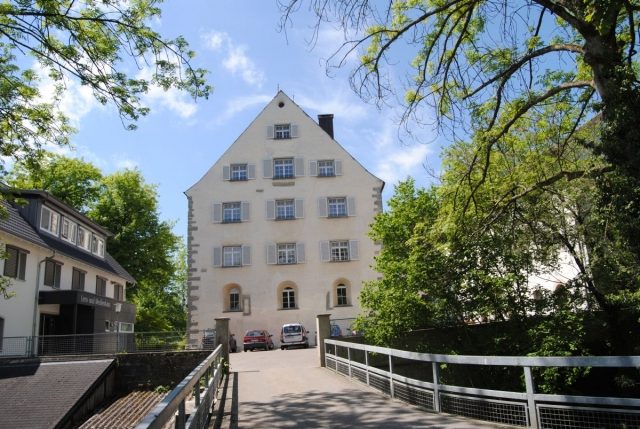
Gaienhofen Castle is a High Medieval castle in Gaienhofen in the district of Konstanz in Baden-Württemberg. From 1946 to 2013, it housed a boarding school, today the Schloss Gaienhofen School Center – Evangelical School on Lake Constance. The castle was built on the Höri peninsula on the shore of Lake Constance. The location was strategically chosen directly on the Untersee, where the Rhine widens into Lake Constance.
The castle was built as a hunting estate for the Bishop of Constance, Gebhard III of Zähringen (1085-1110). A documentary mention dates back to 1295, when Albrecht von Klingenberg, Imperial Vogt in Constance, handed over the castle and village with the vogtei and other possessions to his brother Bishop Heinrich II. At this time, the castle, like most nearby, was owned by the Lords of Klingenberg. In 1311, Albrecht von Klingenberg sold it to the Diocese of Constance, which often pledged it until the 16th century. In the 15th century, the castle became the seat of episcopal vogts and chief vogts. The lordship was pledged, among others, to Bishop Konrad von Freisingen, von Klingenberg, von Reischach, and von Heuberg.
Since 1412, Konrad von Reischach, who was married to Isabella, daughter of King James III of Mallorca, resided at Gaienhofen Castle. A son, Michael, was born from the marriage with the king's daughter. In connection with the Council of Constance (1414-1418), father and son hosted a feast at Gaienhofen Castle. Following this feast, Michael was murdered by two guests, Heinrich von Randegg and Hans von Stuben, for unknown reasons, at the ninth hour of the night on St. Bartholomew's Day 1417 on the castle stairs. His father died a year later without descendants.
The castle was repeatedly the scene of military actions. In 1499, during the Swabian War, it was occupied by Confederates. In the German Peasants' War of 1524/25, it was rebellious peasants, and in the Thirty Years' War (1618-48), Swedish troops who occupied the castle and plundered the surrounding area. In 1632, a naval battle between Imperial and Swedish forces took place in front of the castle walls (see Naval Warfare on Lake Constance 1632–1648).
Around 1700, the castle was expanded into a baroque palace under Prince-Bishop Marquard Rudolf von Rodt (1689-1704). The castle was called the "Castle of the Nine Towers," although only eight could be located. Through secularization, the castle fell to the Margraviate of Baden in 1803. In 1821, the Baden captain Wilhelm Reinhard von Weiterdingen bought it. In 1854, the last tower was demolished.
In 1903, Gaienhofen Castle was leased to Georg von Petersenn, professor at the Berlin University of Music. The German Landerziehungsheim for Girls (D.L.E.H.f.M.), founded in 1900 in Stolpe am Wannsee, which was conceptually based on the principles of the reform educator Hermann Lietz, was relocated to Gaienhofen in 1904. The founding by Bertha von Petersenn was based on the idea of enabling girls to achieve independence and professional activity through a versatile education. The D.L.E.H.f.M. was directed by her daughter Jutta von Petersenn. In 1906, Georg von Petersenn bought the castle, and in 1911, his daughter married Hermann Lietz. Under the direction of Alfred Andreesen, the relations of the D.L.E.H.f.M. with the Landerziehungsheim for Girls in Gaienhofen increasingly diminished. On June 8, 1925, a severe fire broke out in the castle. The burnt-out Landerziehungsheim was then rebuilt and continued until 1944 after being sold to Elisabeth Müller from Flensburg. Only in 1933 was the first boy admitted to the boarding school, which had previously been attended only by girls. In the turmoil of World War II, there was no regular school instruction.
In 1946, one year after the end of the war, through the efforts of the Constance pastor Hermann Senges and the Constance dean Friedrich Mono, the school association of the Evangelical Boarding School (today the School Foundation of the Evangelical Church in Baden) was asked to take over the sponsorship and responsibility for the boarding school - the Evangelical Boarding School Schloss Gaienhofen was founded. In 1952, the Evangelical Church acquired the castle. The castle, which was modified several times for this purpose and supplemented with new buildings, served the Evangelical Boarding School as a boarding house for girls. The boarding school was closed in the summer of 2013.
Current Use+
The castle houses multi-functional rooms that are used by the school and its administration.
Gaienhofen Castle and the shoreline are not publicly accessible.
Take Mobile History with you
You are reading this text for free. Premium adds what matters on the road: descriptions read aloud, sites found through your camera, whole regions taken offline.
- Every description, including the ~17,700 Premium sites
- Audio guide: have descriptions read to you on location
- AR finder: see sites through your camera, with distance and bearing
- Unlimited saved sites
14 days free, then from €2.99 a month. Cancel anytime.
Source: Wikipedia · Licence: CC BY-SA 4.0 · Image: http://schloesserrundschau.de/bawue/schloesser/konstanz29.html
This description draws on the facts documented in the linked Wikipedia article; Wikipedia content is licensed under CC BY-SA 4.0. Wording and editing: Mobile History.
Location: 47.6797, 8.9813