Nursing home
CastleFurth
Furth Castle
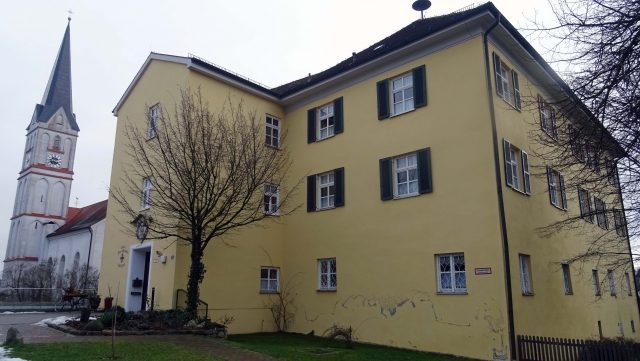
After the extinction of the Knights of Furte around the middle of the 13th century, the Kärgl family held dominion in Furth. Under them, who were lords of Furth until the beginning of the 17th century, the castle must have been built at its current location, a moated castle in the middle of Furth. It was built of masonry, with three gables, fortified by crenellated walls and strong towers, and surrounded by a wide moated ditch, accessible via a bridge through the mighty gate tower, while a brewery and economic buildings were built sideways around a large courtyard. With the death of Karl Kärgl (1615), the over three-century-long rule of this family over the Hofmark Furth ended.
The castle passed to Karl's daughter, Margaretha, who had married Christoph von Reitzenstein zu Wildenau in 1602. Margaretha died in 1637 amidst the turmoil of the Thirty Years' War, which severely afflicted the land around Furth. Reitzenstein married Maria Anna von Flizing in a second marriage, who, after Christoph's death in 1640, married the Imperial Count Franz Anton von und zu Lodron. Under the Counts of Lodron, a lively building activity began. The castle was restored to its old splendor, the part facing the church bridge was rebuilt, and the economic buildings were expanded. In 1723, the castle still stood with a crenellated curtain wall, high tower, and moat.
In 1753, the Altötting Chapel was built under Georg Anton von Lodron, who died in 1755. Josef Anton von Lodron died in 1775, his son Hieronymus showed no interest in Furth, and in 1781, the property passed by purchase to Ferdinand Baron von Wadenspann, who died in 1796. Wadenspann's daughter was married to Max Freiherr von Hornstein, and their daughter Franziska Freiin von Hornstein married Count Sigismund von Buttler. The marriage remained childless, so in 1818, the younger brother of the Baroness, Ferdinand Anton von Hornstein, received the Furth property by contract. Major renovations gave the castle a new appearance, with large halls, bright rooms, simple facades, and a glass-covered inner courtyard with thick pillars.
On February 21, 1875, Ferdinand Anton died, and his son Matthäus took over Furth. The elevated ground floor, once an office space, was converted into living quarters, the castle moat was filled in, and the walls and towers were demolished. Matthäus had married Philomena Rauchenecker, a brewer's daughter from Hohenthann, in 1878, who managed the properties after her husband's death in 1901.
By will dated April 16, 1936, she bequeathed the castle to the Episcopal See of Regensburg. Bishop Michael could only take up the inheritance in 1945. In 1946, the castle was leased to the Caritas Association for the Diocese of Regensburg, which initially used it as a retirement home for displaced persons and refugees.
The house was purchased in 1970 by the Episcopal Foundation Administration through the Caritas Association under the chairmanship of Cathedral Dean Prelate Hermann Grötsch and Diocesan Caritas Director Walter Siegert.
The subsequent renovation work in 1977 and an associated extension were completed in 1979, and their ecclesiastical blessing by His Excellency the Most Reverend Auxiliary Bishop Karl B. Flügel, the chairman of the Caritas Association for the Diocese of Regensburg, took place on December 8, 1979.
Take Mobile History with you
You are reading this text for free. Premium adds what matters on the road: descriptions read aloud, sites found through your camera, whole regions taken offline.
- Every description, including the ~17,700 Premium sites
- Audio guide: have descriptions read to you on location
- AR finder: see sites through your camera, with distance and bearing
- Unlimited saved sites
14 days free, then from €2.99 a month. Cancel anytime.
Location: 48.5901, 12.0245