To be privately owned
CastleFürstenberg
Fürstenberg Castle
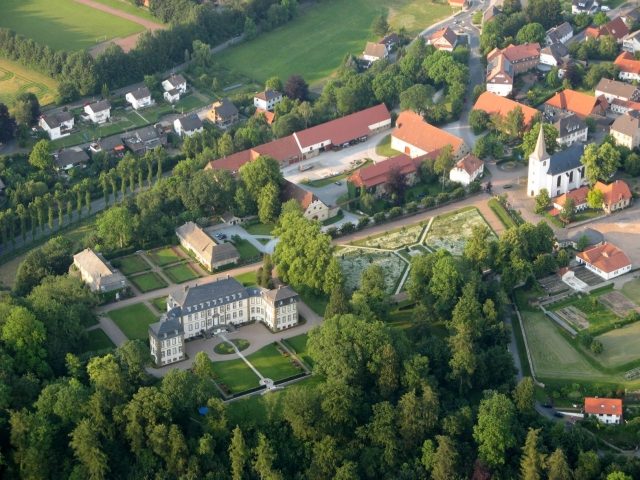
Fürstenberg Castle, in today's municipality of Bad Wünnenberg, dates back to the medieval Vorstenburg. The current building was constructed in the 18th century.
Time as a Castle
The origin of the current castle was Fürstenberg Castle or Vorstenburg. It is not to be confused with Fürstenberg Castle near Neheim. Nor is it identical with Fürstenberg Castle on the Weser.
The builder was Bishop Bernhard V of Paderborn around 1321/25. The purpose of the castle was to prevent the advance of the noble lords of Büren. The castle was built above the Karpke on the southwestern edge of the Sindfeld. Shortly after its construction, the castle was pledged by the bishops. Subsequently, the castle changed hands several times and was eventually destroyed. Since 1446, the area was owned by the von Westphalen family. Parts of the lineage are also referred to as Westphalen zu Fürstenberg. They built a new complex in place of the old castle. The northeast tower and cellars with vaults are preserved from this.
Castle Construction
Friedrich Wilhelm von Westphalen, Bishop of Hildesheim and later also of Paderborn, had a castle built on the foundations of the demolished old castle in the 1780s. The mountain plateau was leveled with considerable effort and secured by strong retaining walls. The castle was intended to serve as a summer residence for the bishop. The architect was the Hessian court architect Simon Louis du Ry. The style is sometimes described as Rococo, sometimes as Late Baroque and Early Classicism.
The castle is two-story. The main building has nine axes and a mansard roof. To the south, two large square side pavilions are connected to the main building by curved structures. In addition to the main building, a stable, a coach house, and large farm buildings were erected to the north and northeast. This also includes a house for the patrimonial judge from the beginning of the 18th century.
Around 1800, during the time of Clemens August von Westphalen, a landscape garden with various tree species was laid out on the formerly barren mountain plateau and on the south and west slopes of the mountain. A lime tree avenue was located at the main entrance. In the immediate vicinity of the castle, the garden was designed with flower beds. The geometric garden to the north was probably only laid out in the 20th century. Little remains of the original landscape garden.
Further History
After the end of the Prince-Bishopric of Paderborn and its transition to Prussia, the only patrimonial district court in the area of the former Prince-Bishopric of Paderborn was established in Fürstenberg in 1818. It was responsible for the possessions of the Lords von Westphalen, von Brenken, and von Impsen.
At the beginning of the Revolution of 1848, the castle, abandoned by its inhabitants, was plundered by rebellious farmers, the interior was destroyed, and the archives burned. The castle and the adjacent village were occupied by Prussian troops, and criminal proceedings were initiated against those involved in the looting. In 1849, the patrimonial court was abolished.
The castle is still privately owned by the von Westphalen family and is not accessible.
Take Mobile History with you
You are reading this text for free. Premium adds what matters on the road: descriptions read aloud, sites found through your camera, whole regions taken offline.
- Every description, including the ~17,700 Premium sites
- Audio guide: have descriptions read to you on location
- AR finder: see sites through your camera, with distance and bearing
- Unlimited saved sites
14 days free, then from €2.99 a month. Cancel anytime.
Source: Wikipedia · Licence: CC BY-SA 4.0
This description draws on the facts documented in the linked Wikipedia article; Wikipedia content is licensed under CC BY-SA 4.0. Wording and editing: Mobile History.
Location: 51.5156, 8.7368