Museum
CastleFrohburg
Frohburg Castle
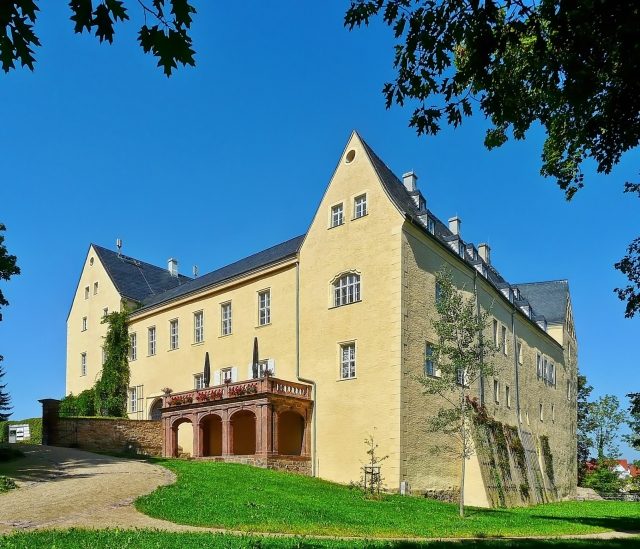
Frohburg Castle, which rises on a hill above the Wyhra on the northwestern edge of the town, was built in the 16th century in place of a previous castle. The massive, simple four-wing complex embodies the type of feudal country castles of the early Renaissance.
Only speculation can be made about the appearance of the medieval castle. The overbuilding with the Renaissance castle makes it impossible to obtain a well-founded picture of the earlier castle. The castle buildings have removed all remains of the former castle. Only the spur location and the still irregular building form of the castle provide clues to the earlier building situation.
It is to be assumed that a neck ditch - which was filled in at the time of the castle's construction - sealed off the spur tip. An outer bailey to the south and a tower - for which, however, there are no indications - are also conceivable. Access to the castle in the Middle Ages was probably located to the south.
The year 1544 and the coat of arms of the von Techwitz family document the beginning of the castle's construction, which was repeatedly interrupted by wars and indebtedness. Through its classical decorations from the beginning of the 19th century, the castle gained fame beyond the borders of Saxony.
Frohburg is located in the immediate vicinity of the castles of Kohren and Gnandstein. This concentration is certainly related to the border location between the Imperial Land of Pleißen and the Margraviate of Meissen. The Imperial Land of Pleißen was developed at the end of the 12th century by the Burgraves of Altenburg. They also regularly stayed in Frohburg. Thus, in 1198, an Albertus de Vroburg - a member of the Altenburg Burgrave family - was mentioned for the first time. Like Kohren and Gnandstein, Frohburg Castle also had the task of protecting the road running from Leipzig through the Wyhra valley via Chemnitz to Prague.
Early on, Gnandstein was connected to Frohburg not only by its territorial location. Events were also increasingly influenced by the Marshals of Gnandstein. After the extinction of the Burgraves of Altenburg at the beginning of the 14th century, the Marshals settled in Frohburg. Around 1300, Frederick the Brave, as Margrave of Meissen, gained the Pleißenland and was thus also lord over Frohburg. He handed over the administration to a Vogt, later to the Marshals.
By the middle of the 14th century, the Frohburg dominion was already divided into a margravial and a non-margravial part. After the Marshals were driven out of Frohburg in 1408, further fragmentation of the property occurred. Only with the reunification of the parts in the 16th century did plans for the construction of a new castle emerge.
The history of the castle's owners is as varied as its building history. In 1544, Nickel von Techwitz began building the castle on the site of the old fortress. In 1549, however, he had to sell the commenced new building due to over-indebtedness to Melchior von Kreutzen, who completed the castle by 1554. The trapezoidal shape of the castle is due to the utilization of almost the entire spur tip. Simple buildings enclose the irregular rectangular courtyard. During the construction work, a defortification was carried out simultaneously, and the presumed keep was removed.
The von Kreutzen family resided in Frohburg until 1649. Then the owners changed several times. Finally, in 1681, a second construction phase began under Friedrich von Born, in which the west and south wings received their current appearance. With the acquisition by the Blümner family in 1777, continuity in the succession of owners began. In 1853, the castle came into the possession of Baron von Falkenstein through marriage and later, also through marriage, to the Saxon Lieutenant General Carl Krug von Nidda. The Krug von Nidda and von Falkenstein family was dispossessed by the communists in 1945.
Until 1945, Frohburg, with approx. 1,000 ha, was one of the largest knightly estates in Saxony. After 1945, the town received the castle as property. A museum founded in 1917 has been located in its rooms since 1974 and today houses the permanent exhibition of the ceramist Kurt Feuerriegel, well-known in this region, with about 8,000 works, as well as a collection of historical toys.
Take Mobile History with you
You are reading this text for free. Premium adds what matters on the road: descriptions read aloud, sites found through your camera, whole regions taken offline.
- Every description, including the ~17,700 Premium sites
- Audio guide: have descriptions read to you on location
- AR finder: see sites through your camera, with distance and bearing
- Unlimited saved sites
14 days free, then from €2.99 a month. Cancel anytime.
Source: Wikipedia · Licence: CC BY-SA 4.0 · Image: Thomas Eichler
This description draws on the facts documented in the linked Wikipedia article; Wikipedia content is licensed under CC BY-SA 4.0. Wording and editing: Mobile History.
Location: 51.0540, 12.5582