Administration of the zoo Berlin
CastleBerlin-Friedrichsfelde
Friedrichsfelde Castle
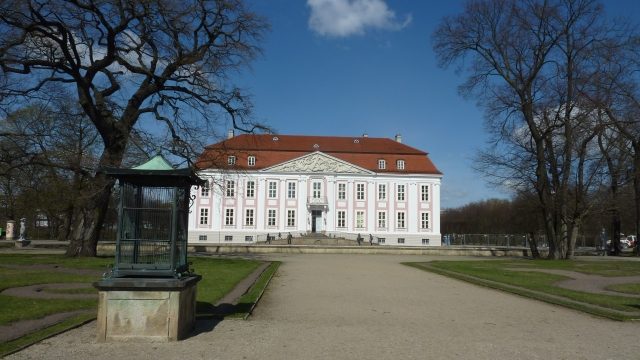
Friedrichsfelde Palace is a palace designed in the early classical architectural style, located in Tierpark Berlin in the Friedrichsfelde district of Berlin.
It was built in 1695 as Rosenfelde Palace by Benjamin Raule, the Electorate of Brandenburg's General Director of Marine Affairs. This first five-axis building was probably constructed according to plans by Johann Arnold Nering in the Dutch country house style. In 1698, Benjamin Raule fell out of favor, was imprisoned, and dispossessed. The palace fell to the Prussian king and was renamed Friedrichsfelde.
In 1717, the property was transferred to Margrave Albrecht Friedrich of Brandenburg-Schwedt and in 1719, court architect Martin Heinrich Böhme extended it by three axes to the east and west to its current width and added a three-winged baroque oak staircase. After his death in 1731, his son Karl inherited the palace. In 1762, the palace came into the hands of Prince Ferdinand of Prussia, a brother of Frederick the Great. In 1772, Louis Ferdinand of Prussia was born there. Prince August Ferdinand had grand plans for the palace; it was to become as magnificent as Rheinsberg Palace through renovations by Carl von Gontard. However, he decided otherwise and moved into Bellevue Palace in 1785.
Later, the palace was sold several times: in 1785 to the Duke of Courland, in 1799 to the court printer Georg Jakob Decker, and in 1800 to Duchess Katharina of Holstein-Beck, who lived there until her death in 1811. The facade was redesigned in the early classical style. The palace acquired its current form in 1800. The Duchess hosted large festivals in the park and palace with theatrical performances, pastoral plays, and fairground festivities, which the residents of the village of Friedrichsfelde could attend.
For a few days, Friedrichsfelde Palace also served as the headquarters for Field Marshal Davoust, who was in Napoleon's service, during the European campaigns.
From July 1814 to February 1815, King Frederick August I of Saxony was imprisoned at the palace because he had been condemned for his loyalty to Napoleon. Finally, in 1816, the palace was bought by Carl von Treskow (1787–1846), who operated an estate farm on the property. The garden, still recognizable today, was laid out in 1821 by Peter Joseph Lenné.
The palace survived World War II relatively undamaged. After expropriation as part of the land reform, both the building and the surrounding palace park fell into disrepair. When the decision was made in 1954 to establish a separate zoo for East Berlin, the palace served for several years as the seat of the organizers for the garden's redesign, and parts of the building were used as stables for the zoo. It was only between 1970 and 1981 that the palace was renovated on the initiative of Tierpark Berlin. The then zoo director Heinrich Dathe, in particular, strongly advocated for the preservation of the palace and prevented plans for its demolition.
Today, the palace once again belongs to Tierpark Berlin. In addition to the original staircase and frescoes in the ballroom, fine and applied art from the 18th and 19th centuries can be seen there, including a painting by Karl Friedrich Schinkel, numerous noble portraits, four rooms with wall hangings (painted fabric wallpapers), and cast-iron furniture as well as pieces of jewelry.
An exhibition on Berlin's zoological history is planned for the future.
The library, archive, and parts of the Tierpark's administration are to move in here after extensive renovation measures (estimated costs: four million euros); however, the date is not yet fixed. Friedrichsfelde Palace is accessible on weekends, public holidays, and Tuesdays and Thursdays from 10:30 AM to 3:30 PM. Additionally, guided tours can be arranged. The palace is managed voluntarily by the Friends of Tierpark Berlin and Zoo Berlin e. V., whose chairman is Thomas Ziolko. The Friends also organize the concerts at the palace, which have been taking place regularly again since November 2008.
Take Mobile History with you
You are reading this text for free. Premium adds what matters on the road: descriptions read aloud, sites found through your camera, whole regions taken offline.
- Every description, including the ~17,700 Premium sites
- Audio guide: have descriptions read to you on location
- AR finder: see sites through your camera, with distance and bearing
- Unlimited saved sites
14 days free, then from €2.99 a month. Cancel anytime.
Source: Wikipedia · Licence: CC BY-SA 4.0 · Image: Joachim Schneeleopard
This description draws on the facts documented in the linked Wikipedia article; Wikipedia content is licensed under CC BY-SA 4.0. Wording and editing: Mobile History.
Location: 52.5047, 13.5237