To be privately owned
CastleOber-Grafendorf-Fridau
Fridau Castle
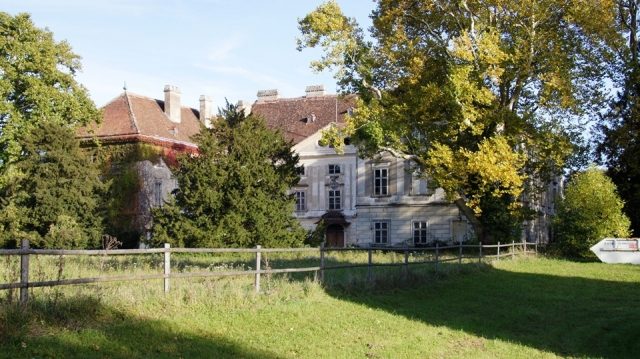
The "Haus zu Fridau", as the former castle was usually called in the Middle Ages, was built relatively late. It was first mentioned in a document in 1299. At that time, it was owned by Dietrich von Weißenberg. The Weißenburgers were vassals of Melk Abbey and the builders of the first castle.
In 1336, Konrad Feyertager acquired the Fridau fief. In 1367, the feudal lordship passed from Melk to St. Pölten Abbey. The new feoffee was Trausel von Trautmannsdorf. However, he had to give up the fief again in 1370. From 1388, the knightly family Feuchter owned Fridau Castle, first as a pledge and then as a fief, for 100 years. In 1476, under Erasmus Feuchter, it underwent extensive reconstruction into a Renaissance moated castle.
The next lord of the castle was Stephan Uttendorfer von Goldegg, who was related by marriage to the Feuchter family and took over the lordship in 1490. In 1497, Reinprecht von Sinzendorf acquired the property. In 1708, Count Karl Ludwig von Sinzendorf sold Fridau to Ercole Giuseppe Ludovico Turinetti, Marchese de Prié. His son Johann Anton was forced in 1750 to sell the already heavily indebted lordship to Johann Georg von Grechtler. He had the current castle built by 1755.
In 1779, Grechtler handed over all his possessions to his son Georg Anton. He died in 1788 and bequeathed the property to Baroness Antonia von Waldstätten, who married Don Tomaso, Prince of Corsini, in 1805. When Don Tomaso died in 1856, Gustav Adolf Reichsgraf von Bentinck bought the properties in the Pielachtal. In 1869, Fridau was sold again. This time to Ferdinand Graf Trauttmansdorff-Weinsberg, who had the castle thoroughly renovated.
Until 1910, the lordship belonged to the Counts Trauttmansdorff-Weinsberg, then for three years to Prince Johann II von und zu Liechtenstein. Through the next owner, Rudolf Freiherr von Isbary, Fridau passed by inheritance in 1932 to his daughter Elsa Baronin Musulin and then to her son-in-law Anton Graf Tacoli. Towards the end of the Second World War, the castle was used as a German field hospital and finally defended against the advancing Russian troops, which caused severe devastation. During the occupation, a Russian commandant's office was housed in the castle.
Since a renovation by the family was no longer possible, the building was sold to the Province of Lower Austria in 1974. However, the province also did not carry out any renovation and finally sold it in 2000 to the company Bioinnova. A renovation of the building, which was placed under monument protection in 1950, is planned.
Take Mobile History with you
You are reading this text for free. Premium adds what matters on the road: descriptions read aloud, sites found through your camera, whole regions taken offline.
- Every description, including the ~17,700 Premium sites
- Audio guide: have descriptions read to you on location
- AR finder: see sites through your camera, with distance and bearing
- Unlimited saved sites
14 days free, then from €2.99 a month. Cancel anytime.
Source: Wikipedia · Licence: CC BY-SA 4.0 · Image: http://www.wehrbauten.at/noe/niederoesterreich.html
This description draws on the facts documented in the linked Wikipedia article; Wikipedia content is licensed under CC BY-SA 4.0. Wording and editing: Mobile History.
Location: 48.1496, 15.5561