To be privately owned
CastleHollfeld - Freienfels
Freienfels Castle
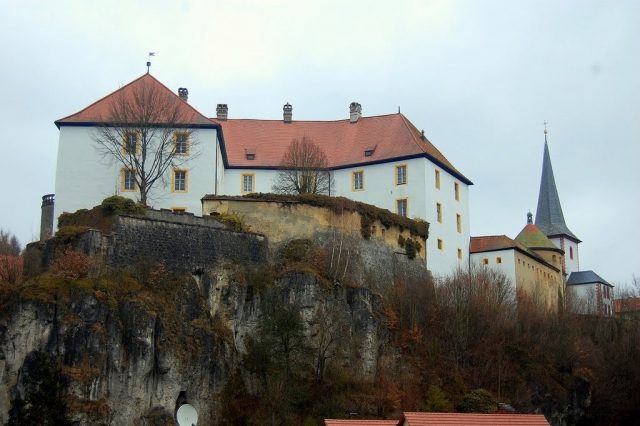
Freienfels Castle is a castle complex on the Wiesent in the Freienfels district of Hollfeld, built by the Knights of Aufseß and first mentioned in 1342. The name indicates its special status: the castle stood on free ground, on a free rock, and was subject only to the Emperor and the Empire. The castle also included a large park, which, however, became increasingly overgrown. Today, Freienfels Castle is privately owned and cannot be visited, but the former park is freely accessible.
Beginnings
The original Freienfels Castle was built around the year 1300. According to tradition, it was built by Knight Otto von Aufseß (1296–1338), in the early 14th century. Another source states that the sale in 1867 ended an almost 587-year, almost uninterrupted family ownership, which means an origin as early as 1280. The castle held a special position among the knightly seats of the Wiesent valley, as it stood on free ground and was directly subject to the Empire. The first documented mention of the castle was in 1342.
The Medieval Castle
During the Peasants' War (spring 1525), the rebellious peasants destroyed the castle and burned it down. Afterwards, Knight Pankraz von Aufseß rebuilt it. During the Thirty Years' War, in 1628, Jakob Siegmund von Schaumburg and the Hollfeld bailiff Eppenau stormed the castle under the pretext of feudal escheat. Four years later, Redwitz's preceptor Heberer took the castle and handed it over to a Swedish commissioner. Until the end of the 30-year war, it was alternately occupied by Swedes and Bambergers. After decades of family feuds among the von Aufseß, the Prince-Bishopric of Bamberg took possession of Freienfels Castle and manor in 1672. In 1681, the sons of Hans Wilhelm von Aufseß sold Wüstenstein Castle to the Margrave, redeemed Freienfels for it, and were enfeoffed with this castle by the Bishop of Bamberg.
Origin of the Present Castle
Carl Siegmund, Baron von Aufseß and Canon of Bamberg and Würzburg, bought the castle in 1690. He demolished the heavily dilapidated complex to erect the present Baroque castle on the foundations of the medieval castle between 1693 and 1701. In the former castle chapel, now the Catholic parish church, Baroque stucco work with the Aufseß coat of arms and tomb monuments adorned with coats of arms are worth seeing.
History of the Castle from 1867 to 1966
In 1867, the von Aufseß family sold the approximately 120 Tagwerk (approx. 30 hectares) estate to the Counts of Giech, without the castle, which they, however, sold in the same year with three Tagwerk of wasteland and the Kreuzerwinkel field to Gustav Rewald from Halle for 1500 Gulden. This sale was followed by eleven more changes of ownership until 1966.
After Rewald's death, his wife sold the castle in 1871 to Gustav Toepke from Magdeburg for 26,000 Gulden, who, only three years later, in 1874, sold it to Oskar Leonhard Hesse from Loschwitz for 135,000 Marks. Dr. jur. Wendler, Provost of Leipzig Cathedral, acquired the castle in 1876 for 120,000 Marks, and finally, in 1887, Hermann Freiherr von Aufseß's wife Ernestine bought it as a Christmas present for 25,000 Marks. After her death in 1911, Eckardt Freiherr von und zu Aufseß took over the property in Freienfels after an inheritance settlement procedure; in 1912, he had the northern park wall demolished and sold the mill with its associated water rights. This deprived the castle of its most valuable part and the entire property became an unproductive appendage. Thus, on October 31, 1918, it was sold to Dr. Arno Scheunert from Munich, who already on July 8, 1920, resold it to Joseph Ferdinand Graf von Spreti and his wife Paula.
Von Spreti sold the property on April 21, 1921, to the manufacturer and Privy Councillor of Commerce Edmund Meinel von Tannenberg from Tannenbergsthal in the Saxon Vogtland. He had the castle restored between 1921 and 1926 and furnished it with "historic" furniture. In 1930, Edmund Meinel-Tannenberg, a member of the Saxon State Parliament and a supporter of Gustav Stresemann, had a Stresemann monument erected in the park of Freienfels Castle. It bore a plaque with Stresemann's likeness and the following inscription:
TO THE REICH FOREIGN MINISTER // AND PIONEER // OF GERMAN FREEDOM // DR. GUSTAV STRESEMANN // * 1878 BERLIN - †1929 // IN GRATEFUL MEMORY. // 10.5.1930 MEINEL - TANNENBERG
The monument was probably removed after the next sale in 1941. For a price of 350,000 Marks, the seriously ill owner sold the castle in that year to the asset management of the Deutsche Arbeitsfront GmbH Berlin. However, the price was never paid, as the purchase contract stipulated that the amount would be settled with Reich Treasury bills after a victorious end to the war. The new owner established a training center for political Wehrmacht recruits, a so-called Gau school.
After the end of the war in 1945, American military personnel took up residence in the castle. An incomplete list of losses from May 27, 1947, contains the marginal note: "Buddha figure in the library was used as a target by American soldiers."
Shortly thereafter, the state of Bavaria became the owner of many state properties located in its territory through legal succession, including Freienfels Castle on March 2, 1949. The Meinel-Tannenberg heirs hoped for the re-transfer of the castle, as payment according to the 1941 contract had not been made, but the six-year legal dispute was won by the Bavarian State Asset Management.
The Free State sold the castle in 1966 to the current owners, the Roß family. Before the sale of the castle, the state removed the painting "Tower of Babel" by the Dutch painter Paul Bril from 1595, acquired by Meinel-Tannenberg, which is now located at Veste Marienberg in Würzburg.
Take Mobile History with you
You are reading this text for free. Premium adds what matters on the road: descriptions read aloud, sites found through your camera, whole regions taken offline.
- Every description, including the ~17,700 Premium sites
- Audio guide: have descriptions read to you on location
- AR finder: see sites through your camera, with distance and bearing
- Unlimited saved sites
14 days free, then from €2.99 a month. Cancel anytime.
Source: Wikipedia · Licence: CC BY-SA 4.0 · Image: Maciek Wegrzyn
This description draws on the facts documented in the linked Wikipedia article; Wikipedia content is licensed under CC BY-SA 4.0. Wording and editing: Mobile History.
Location: 49.9603, 11.2547