The Castle can be visited
CastleFraubrunnen
Fraubrunnen Castle
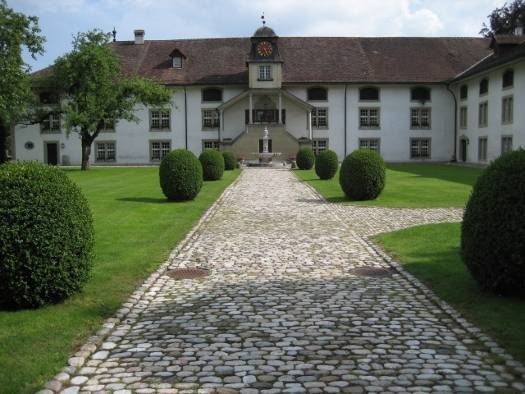
Fraubrunnen Castle is a former Cistercian convent in Fraubrunnen, in the Swiss canton of Bern, about 16 km north-northeast of the city of Bern. It is the seat of the district administration and a historical monument of regional importance.
Counts Hartmann IV the Elder and Hartmann V the Younger of Kyburg ceded their territory in the area of the then settlement of Mülinen to the Cistercian Order, which founded the women's monastery Fons beatae Mariae (Fountain of the Blessed Mary) in 1246. Through various donations and acquisitions, the monastery quickly acquired rich landholdings. The Kyburgs served as the monastery's castellans, from whom Fraubrunnen adopted its coat of arms.
As early as 1280, the monastery buildings were devastated by a fire. After its reconstruction, Fraubrunnen Monastery experienced a cultural and economic heyday and rose (alongside Königsfelden) to become the most important and richest women's monastery in the Swiss Central Plateau. The monastery's estates included the surrounding villages of Grafenried, Zauggenried, Büren zum Hof, Limpach, and Bittwil (near Rapperswil (BE)). In addition, the monastery owned vineyards on Lake Biel, various other estates, and houses in the cities of Burgdorf, Bern, and Solothurn. Most of the nuns also came from these cities.
In 1375, Fraubrunnen Monastery was attacked by the Guglers, who temporarily quartered themselves there. On December 26 of the same year, a Bernese troop attacked the Guglers, defeated them on the Tafelenfeld north of the village, and drove them out of Fraubrunnen. However, the monastery and parts of the village went up in flames during this battle. One of the earliest inscribed monuments in the Canton of Bern, created in 1475, commemorates the event. Subsequently, the monastery recovered only slowly from the damage. In 1420, after the extinction of the Kyburgs, it came under the dependency of Bern, which tried to introduce reforms of monastic life, especially towards the end of the 15th century.
With the introduction of the Reformation, the monastery was secularized in 1528. The former monastery estates were transformed into the Fraubrunnen bailiwick, which was subordinate to the Zollikofen district court. Part of the monastery buildings, including the church, was demolished in 1535, creating the current distinctive L-shape from the south and west wings. The remaining part with the cloister was converted into a castle and thereafter served as the seat of the bailiff until the castle was plundered in 1798 after the defeat against the French.
Today, two wings of the former monastery are preserved. They still show the basic structure of the monastery rebuilt after the fire of 1280, but were converted into a castle in the 16th century and underwent further transformation in the 18th century into the current Baroque castle building. Today, Fraubrunnen represents a grown, Baroque-overlaid monument on a monastic-medieval basic structure. It contains numerous particularly valuable elements such as early Gothic windows, medieval brick bonds and roof trusses, and good furnishings from the 17th and 18th centuries.
Take Mobile History with you
You are reading this text for free. Premium adds what matters on the road: descriptions read aloud, sites found through your camera, whole regions taken offline.
- Every description, including the ~17,700 Premium sites
- Audio guide: have descriptions read to you on location
- AR finder: see sites through your camera, with distance and bearing
- Unlimited saved sites
14 days free, then from €2.99 a month. Cancel anytime.
Source: Wikipedia · Licence: CC BY-SA 4.0
This description draws on the facts documented in the linked Wikipedia article; Wikipedia content is licensed under CC BY-SA 4.0. Wording and editing: Mobile History.
Location: 47.0849, 7.5267