Hotel
CastleGöhren-Lebbin
Fleesensee Castle
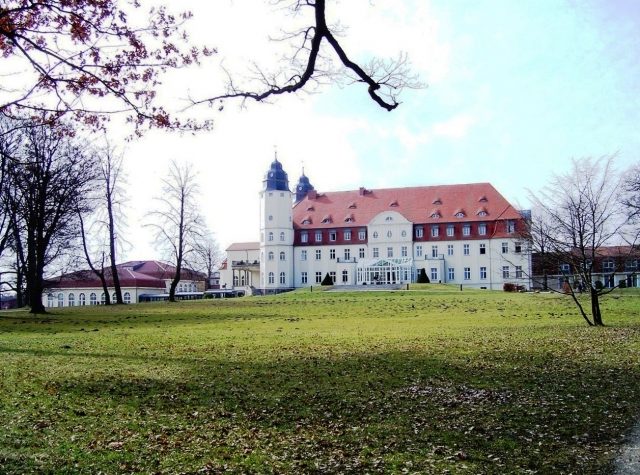
Schloss Fleesensee (also Schloss Blücher) is a manor house in Göhren-Lebbin, Mecklenburg-Vorpommern. It was built in 1842 as Blücherschloss and rebuilt in 1912 in Neo-Baroque style after a fire. Today, the manor house hosts a hotel of the Radisson Blu hotel chain.
In 1842, Count Ludwig II von Blücher had a house built outside the former estate in the district of Lebbin. A magnificent manor house with clay half-timbering and towers, to which an almost eight-hectare landscape park belonged.
In 1871, Baron Hubert von Tiele-Winckler bought the property. He had earned a lot of money in coal mining as well as in the iron and steel industry, among other things, and invested it in various estates in Mecklenburg. After his death in 1893, Walter von Tiele-Winckler inherited the manor house. He had a winter garden and three more towers added, among other things. He also ensured that electric lamps lit up in the house as early as 1889. In 1909, he died of a heart attack. His half-brother Raban and his mother Rose inherited the property.
In 1912, the manor house burned down completely. Raban Tiele Winckler built a new representative castle on the foundations of the burned-down manor house. He commissioned the German architect Ernst Paulus and the Norwegian Olaf Lilloe, who ran a joint office in Berlin and were sought-after builders in the German Empire. They had designed numerous noble villas, churches, castles, and manor houses. Their projects include the Erlöserkirche and the Reformationskirche in Berlin-Moabit, as well as the addition of a side wing to Schloss Klink in Renaissance style and the Künstlerkolonie Berlin.
The architects designed a manor house with Neo-Baroque elements, but its furnishings were significantly more modern than was customary for the time. The castle had over 100 rooms and a 170 square meter ballroom and already featured central heating, a dumbwaiter and a passenger elevator, as well as a central vacuum cleaner system. The strikingly winding and magnificent staircase still characterizes the entrance hall of the castle today. Bright towers were erected on the east gable. The new building is said to have cost about 640,000 marks - without architect's fees and terrace.
In 1934, Raban Tiele Winckler sold the castle. During the Second World War, part of the house served as a school. After the war, the Red Army initially used the manor house as a hospital, later refugees lived there. During the GDR era, the residents of Göhren-Lebbin could shop in the castle, be treated in a doctor's office, handle formalities in the municipal administration, or bring their eggs to the so-called egg collection point. A kindergarten also used rooms in the manor house.
With the acquisition of the property by Kohlekontor Berlin in 1973, the renovation of the castle began, which was later continued by the state-owned Kombinat Sekundärrohstofferfassung Berlin, or SERO for short. In 1986, SERO opened a holiday home.
After the political change, the Hotel Schloss Blücher was then open to all seeking recreation. From 1997, it was thoroughly renovated again in connection with the construction of the "Land Fleesensee" holiday and leisure complex.
Take Mobile History with you
You are reading this text for free. Premium adds what matters on the road: descriptions read aloud, sites found through your camera, whole regions taken offline.
- Every description, including the ~17,700 Premium sites
- Audio guide: have descriptions read to you on location
- AR finder: see sites through your camera, with distance and bearing
- Unlimited saved sites
14 days free, then from €2.99 a month. Cancel anytime.
Source: Wikipedia · Licence: CC BY-SA 4.0 · Image: http://www.werner-conrad.de/schloss-bluecher.html
This description draws on the facts documented in the linked Wikipedia article; Wikipedia content is licensed under CC BY-SA 4.0. Wording and editing: Mobile History.
Location: 53.4788, 12.5139