To be privately owned
CastleKlagenfurt am Wörthersee-Annabichl
Falkenberg Castle
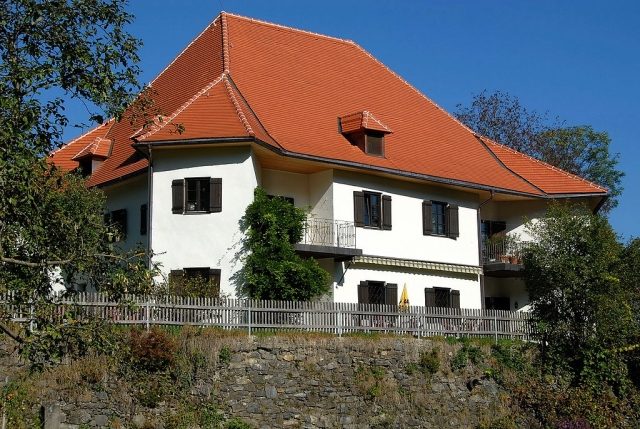
Falkenberg Castle is a former noble residence in Falkenberg, a district of the municipality of Wabern in the Schwalm-Eder district in North Hesse. It is located on the southeastern edge of the village, below the Schlossberg, amidst an extensive estate, the former Falkenberg manor.
The Complex+
The present castle mainly dates from the years 1560 to 1778. It is a mighty, irregularly shaped building with two half-timbered floors in post-and-lintel construction on a massive basement, with a half-hipped roof and a tower that significantly overtops the building. The main wing is approx. 27 m long and 12 m wide; the eastern, courtyard-side facade protrudes almost one meter in its northern part. On the west side, facing the castle park with pond and fountain, the square stair tower is integrated into the main wing in the northern part. The seven-story stone tower rises two stories above the castle's ridge. It ends with a wooden eighth story with an open viewing platform under a wooden tent roof. At the north end of the main wing, a side wing of equal height with an approximate footprint of 12 x 12 m adjoins at a right angle to the east. At the south end, there is a side risalit, also facing east, protruding about 1.5 m. On the park side, in the southern part, almost centrally, a magnificent extension about 7 m wide, resting on wooden pillars, with a half-timbered gable, protrudes about 3 m to the west over its full height.
The baroque garden sculptures of the four seasons date from around 1760, the fountain figure of Neptune probably from 1616.
The castle courtyard to the east and south is surrounded by outbuildings, some of which are now stables and some residential buildings.
The castle, or a predecessor building thereof, the so-called Lower Castle, was built between 1513 and 1516 by the last Lord of Hebel, with whose death in 1521 his lineage died out in the male line. The castle was square with a large vaulted cellar and a round stair tower. The Lords of Falkenberg, from whom the von Hebel family branched off in the middle of the 13th century, inherited the Lower Castle and moved from their old, repeatedly destroyed and rebuilt Falkenberg Castle, the so-called Upper Castle on the conical hill above the village, down to the new castle. The Upper Castle was abandoned, soon fell into disrepair, and was demolished after 1621.
The Falkenbergs expanded the Lower Castle into a spacious castle in 1560. The northeast wing was added at a right angle to the existing residential castle, giving it an L-shaped floor plan, and the round stair tower was demolished and replaced by the square stone tower on the park side. The large rooms on three floors with beamed ceilings on wooden columns and the fireplace on the ground floor date from this expansion phase. At the same time, the castle was fortified with extensive bastions, remnants of which are still partly visible in the south or are built into the stables there.
The Falkenbergs died out in the male line in 1613, and their possessions, including Falkenberg Castle, reverted to Landgrave Moritz of Hesse-Kassel as an escheated fief. He had the castle extended to the south and the beautiful fireplaces installed on the 1st and 2nd upper floors. The bastions were partly removed again. In 1616, Moritz gave the two villages of Falkenberg and Rockshausen and Falkenberg Castle to his second wife Juliane and his youngest son Moritz (1614–1633).
In 1631, General Tilly, and in 1637 Johann von Werth, are said to have ravaged Falkenberg, and in 1640, the village and castle were set on fire by imperial troops.
After the early death of Moritz the Younger in 1633, Falkenberg Castle and village passed to his elder brother, Hermann, regent of the semi-sovereign Landgraviate of Hesse-Rotenburg, created by Landgrave Moritz in 1627. The castle remained the property of the Landgraves of Hesse-Rotenburg for almost 200 years thereafter. It was severely damaged a second time in 1762, during the Seven Years' War, and a third time by a fire in 1771. Between 1775 and 1778, a new extension was added in the form of the stately half-timbered annex on wooden pillars on the park side.
The last Landgrave of Hesse-Rotenburg, Victor Amadeus, ceded (or sold) the castle with the estates of Falkenberg and Rockshausen in 1829 to his half-brother, Chief Forester Ernst von Blumenstein (1796–1875). Ernst von Blumenstein sold Falkenberg Castle and estate in 1872, three years before his death, to the musician and estate owner Johann Ludwig Gebhard von Alvensleben. Between 1899 and 1910, the owner changed six times. From 1910 to 1919, Baron Franz Werner von Droste-Hülshoff was the owner. He was followed from 1919 to 1933 by Privy Councillor von Oswald zu Burgwedel, who had the property thoroughly renovated. In 1933, the castle and manor came into the possession of the Kassel industrialist Oscar Robert Henschel. The Henschel family lived in the castle after the devastating air raid on Kassel on October 22, 1943, until the end of the 1950s. In 1960, the settlement company Hessische Heimat acquired the property. In 1967, two full farmsteads were created from the estate, and the castle was sold and converted by the new owner into the hotel and restaurant "Schloß Falkenberg". However, the castle gastronomy only lasted until 1978.
Since 1978, the association "Hoffnung für Dich" (Hope for You) with its diaconal institutions has owned the castle and the surrounding farm complex.
Take Mobile History with you
You are reading this text for free. Premium adds what matters on the road: descriptions read aloud, sites found through your camera, whole regions taken offline.
- Every description, including the ~17,700 Premium sites
- Audio guide: have descriptions read to you on location
- AR finder: see sites through your camera, with distance and bearing
- Unlimited saved sites
14 days free, then from €2.99 a month. Cancel anytime.
Source: Wikipedia · Licence: CC BY-SA 4.0 · Image: http://commons.wikimedia.org/wiki/File:Klagenfurt_Schloss_Falkenberg_10102006_06.jpg
This description draws on the facts documented in the linked Wikipedia article; Wikipedia content is licensed under CC BY-SA 4.0. Wording and editing: Mobile History.
Location: 46.6403, 14.2630