Restaurant
CastleEysölden
Eysölden Castle
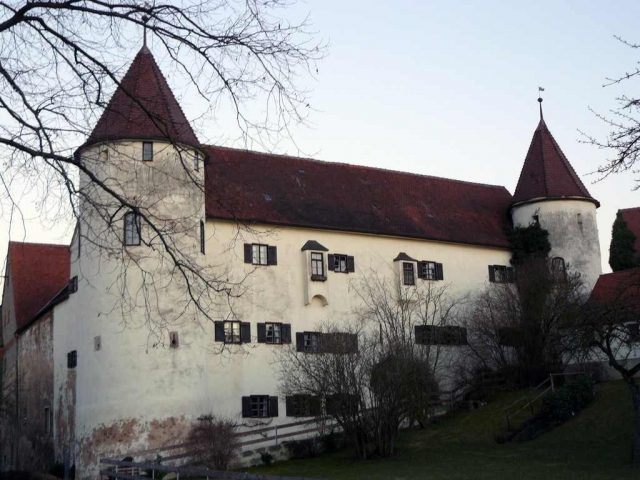
The castle is first mentioned in documents in the 12th century. The Lords of Stein probably entrusted one of their relatives with a "Sölde" here in the 10th century. This was a dwelling, a house or castle, where the Lords of Hilpoltstein had to be accommodated free of charge when hunting or traveling. The village and parish of Eysölden developed around this "Sölde". Three old documents name provosts or ministerials of the Lords of Stein as lords of the castle:
- 1147 Herrmann von Hisselden
- 1266 Berthold, called Isolt
- 1275 Ullrich zu Isolden
In 1279, the castle passed to Heinrich von Schmoll. Under his heirs, it was expanded, fortified, and provided with round towers at the four corners. The Schmoll family exercised the vogtial jurisdiction over their local subjects. The castle estate was at that time subject to tithes to the Eysölden parish. The Schmolls delivered eight Metzen of grain and four Metzen of oats annually. After the extinction of the Schmoll family, the castle passed into the possession of a Ulrich von Knöringen, who was bailiff in Stauf from 1490 to 1525. In 1537, his son and heir died.
In 1539, the Margraves Georg and Albrecht von Brandenburg acquired the castle for 3187 fl. 2 Ort (fl. = Florin = Gulden:Ort = ¼ Fl). At that time, the castle included estates in Eysölden, Alfershausen, Landersdorf, Steindl, and Thalmässing.
For 300 fl., the castle passed in 1618 to the bailiff Ernst Karl von Birkholz zu Stauf. A condition of sale was not to sell the castle to the Nuremberg residents. At that time, the castle only included a few fields, plots, and the right to keep livestock.
The bailiff's widow sold this property in 1632 to the chief bailiff Christoph Sebastian von Jaxtheim in Ansbach, whose son Jobst Wilhelm von Jaxtheim was born in Eysölden. He was bailiff in Stauf from 1654 to 1672. The latter's son, Hanns von Jaxtheim, exchanged the castle in 1685 with Hans Haidt. The regional lord granted him the tavern rights.
The successor, Hanns Hanger, gave the castle to the farmer Georg Thomas Emmerling around 1750. It remained in his family's possession for four generations.
In 1972, Gesine Schiele acquired the castle from Michael Foistner, who had taken it over in 1959. On December 29, 1973, the castle tavern was opened. Since May 2011, Gesine Schiele's daughter has continued to run the castle.
Take Mobile History with you
You are reading this text for free. Premium adds what matters on the road: descriptions read aloud, sites found through your camera, whole regions taken offline.
- Every description, including the ~17,700 Premium sites
- Audio guide: have descriptions read to you on location
- AR finder: see sites through your camera, with distance and bearing
- Unlimited saved sites
14 days free, then from €2.99 a month. Cancel anytime.
Source: Wikipedia · Licence: CC BY-SA 4.0
This description draws on the facts documented in the linked Wikipedia article; Wikipedia content is licensed under CC BY-SA 4.0. Wording and editing: Mobile History.
Location: 49.1307, 11.2136