To be privately owned
CastleJork - Moorende
Esteburg Castle
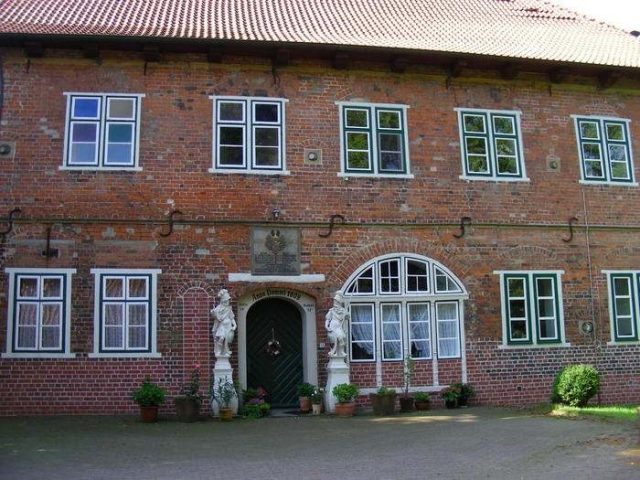
The Esteburg in the Jork district of Moorende in northern Lower Saxony originated from a late Renaissance moated castle. The complex was owned by the Schulte burgraves, who also resided at Horneburg and the castle in Sittensen, among other places.
Construction Description
The so-called castle was, by its size and function, actually a manor house, but the designation as a castle or palace has been established for centuries. Construction of the current building began in 1607. The foundation work proved so complex due to the marshy, boggy soil that it ultimately cost as much as the actual construction itself. The builder Diederich Schulte is said to have burned the invoices after the completion of the Esteburg in 1611 so that his descendants would not learn of these costs. The castle was built as a limited defensive structure on an island surrounded by moats in the immediate vicinity of the Este river; the entrance area is still protected by a gatehouse today.
The building consists of two main sections: the actual main house and an attached utility wing. The cubic residential building is a two-story brick structure covered by a high half-hipped roof. The early 17th-century building contains typical design elements of the Weser Renaissance, making it one of its northernmost works. Striking is the repeated depiction of sculpted field snakes, whose muzzles protrude multiple times from the facades, giving the building an apparent defensiveness. The manor house was rebuilt several times over the centuries, as evidenced by traces in the masonry. The current portal with two warrior statues and an inscription plate dates from 1722. An east-facing utility wing, designed in the style of Altländer farmhouses and featuring a deep thatched roof, adjoins the main house. The eastern, concluding half-timbered facade was richly decorated and faced a farmyard. This wing was demolished after 1967 and replaced by a more modern utility wing, whose dimensions are based on the predecessor building.
Present Day
The Esteburg is inhabited and privately owned. It is not open to visitors, but the building can be partially viewed from public paths. On the grounds of the former estate is the so-called Esteburg Experimental Station of the Lower Saxony Chamber of Agriculture, which is dedicated to the breeding and refinement of stone and pome fruit.
Take Mobile History with you
You are reading this text for free. Premium adds what matters on the road: descriptions read aloud, sites found through your camera, whole regions taken offline.
- Every description, including the ~17,700 Premium sites
- Audio guide: have descriptions read to you on location
- AR finder: see sites through your camera, with distance and bearing
- Unlimited saved sites
14 days free, then from €2.99 a month. Cancel anytime.
Source: Wikipedia · Licence: CC BY-SA 4.0 · Image: http://www.wehrbauten.de/thread.php?threadid=609
This description draws on the facts documented in the linked Wikipedia article; Wikipedia content is licensed under CC BY-SA 4.0. Wording and editing: Mobile History.
Location: 53.5085, 9.7341