To be privately owned
CastlePommelsbrunn-Eschenbach
Eschenbach Castle
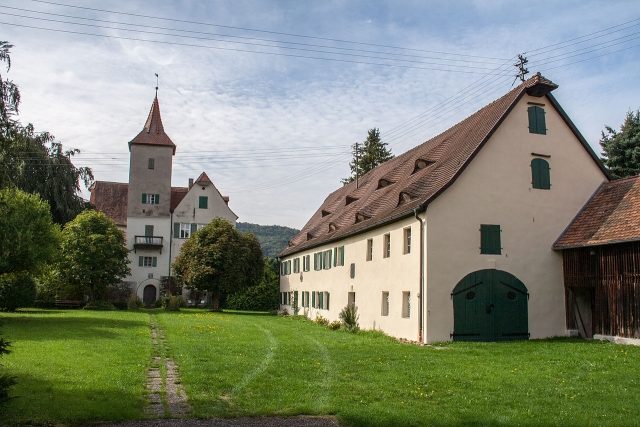
Eschenbach was originally imperial property and presumably belonged to the estates handed over by King Henry II to the newly founded Diocese of Bamberg in 1008/1011. The Prince-Bishopric of Bamberg was able to maintain its feudal rights over it until the end of the Old Empire, while its use was increasingly usurped by the bailiffs actually entrusted with the protection of the estates.
The early history of ownership of the castle in Eschenbach is only understandable against the background of the complicated multi-level medieval Vogt system: At the first level were the High Vogts, the Counts of Sulzbach, since 1188 the Staufer, after 1266/69 the Wittelsbachers. As their sub-vogts, the imperial ministeriales of Hartenstein-Neidstein appeared from the 13th century, and after their extinction in 1324, the Schenken von Reicheneck. To protect their rights in the locality, they had entrusted dependent vassals, who resided in the castle and named themselves after it, but also increasingly emancipated themselves. In Eschenbach, these were the Eschenbecken or Eschenbach from 1230/38, and after 1330, the Türriegel.
Similar to Burgthann, "Burghuten" (castle guards) existed at the moated castle of Eschenbach, which were directly granted by the High Vogts to their "Burgmannen" (castle men) and broke through the Vogt system. The Burghuten were not always tied to a permanent residency obligation or a right of residence in the castle. Thus, it becomes understandable that the holders of the Burghuten (appointed by the High Vogts) were not necessarily the same persons as the holders of the castle (feoffed by the sub-vogts), and Burghuten could be granted even if the use of the castle was in other hands. In the Palatine registers, a Markward von Eschenbach already appeared in 1230, after a long pause the Türriegel in 1339, the Kargel from 1341–1360, the Redwitz from 1343–67, a Heinrich Lochner in 1350, Heinrich Sittenbeck in 1357, the Schuler from 1358–1454, and finally the Brandner from 1407–1456.
In 1367, Dietrich Türriegel sold the "House Eschenbach with all other fiefs" to Hermann Erlbeck and renounced them to his liege lord Walter III. Schenk von Reicheneck. A little later, in 1382, Ulrich von Reicheneck lived with his brother-in-law Stephan von Wolfstein at Eschenbach Castle. Apparently, the Reicheneckers had in the meantime taken over the right of use of Eschenbach from the Erlbeck. After Ulrich's death before 1389, Eschenbach fell to his widow Margarethe von Wolfstein. In 1403, the brothers Hans, Wolf, and Wygleis von Wolfstein sold their "residence" in Eschenbach with all goods and rights to the Nuremberg citizen and mining entrepreneur Heinrich Harsdörfer and his wife Margarethe.
In the following decades, the Harsdorfer family expanded their position in Eschenbach by acquiring further estates, while divisions or sales of property always took place within the family. Their over one hundred years of local rule ended with the death of Hans Harsdorfer (1511). He had divided the castle and the associated estates among his three daughters. Hans Ebner, who had married Ursula Harsdorfer in 1508, was able to acquire the second third of the castle and lordship from Katharina, his wife's elder sister, in 1528, while the share of the younger sister Anna fell to the Volckamer family. The Ebner family - and the Harsdörfer family, with whom they were often related by marriage - were among the most important mining entrepreneurs of their time, also owning neighboring hammer mills.
While in the First Margrave War, the Palatine Vogt sovereignty had still protected Eschenbach from devastation by the Margrave, the Second Margrave War hit the castle all the harder on July 4, 1552. After Hans III. Ebner had refused the demanded payment of a ransom to the Margrave, his manorial seats in Eschenbach as well as in neighboring Hirschbach, in Artelshofen and in Enzendorf were destroyed. The total damage amounted to 15,000 guilders, of which 3,000 guilders were accounted for by the burned-down seat in Eschenbach.
Despite the immense damage and losses, Hans IV. Ebner – his father died in 1553 – was able to restore the manorial seat in Eschenbach as early as 1554, as it is preserved today, apart from the changes mentioned below. Since the strong surrounding walls of the previous building were probably incorporated, the masonry on the ground floor of the main wing may date back to the 13th century. The first and second upper floors were built entirely of stone, as was the three-story wing building attached to the northwest side. By 1559, the farm buildings in the forecourt were also completed, including a tenant's house. A five-story gate tower protected the access side, and a much higher defensive wall with round towers surrounded the castle and forecourt at that time.
In the following centuries, the castle was spared from destruction, so construction expenses were limited to normal maintenance. The castle and manorial lordship of the Ebner family were only interrupted from 1667–1676, when Maria Helena Ebner, née Fürer, and Margarete Ebner sold the entire property to Johann Friedrich von Wimpfen for 10,000 guilders and 200 guilders loan purchase. With the purchase of Eschenbach (as well as the manorial seats of Grünreuth and Hirschbach) and as a result of unfortunately unsuccessful mining ventures, Friedrich von Wimpfen overextended himself financially, embezzled municipal funds as a tax collector, was imprisoned in 1668, and died in prison the same year. Eschenbach was placed under the forced administration of the Council and could be reacquired by the Ebner family in 1676 for 12,000 guilders.
We owe a description of the castle's interior from 1675, when the seat was advertised for sale, to the forced administration of the Nuremberg Council. In the main building were "five rooms, a large kitchen ..., seven bedrooms, a small hall," and on the ground floor of the wing building "two beautiful vaults." In the forecourt, in addition to the Vogt's house, there were two rental apartments and a large barn, next to it "a beautiful large cattle stable for 10 head of cattle," adjoining which was "a horse stable for more than 14 horses, with servants' quarters."
It was not until the 18th century that significant construction measures took place, which, however, only insignificantly changed the appearance of the castle and initially concentrated on the farm buildings. Thus, a barn was built in the forecourt in 1711, and the drawbridge over the Hirschbach was renewed in 1726. From 1736 to 1740, in the course of a modernization, the living rooms were stuccoed in the late Baroque "Laub- und Bandwerkstil" (foliage and strapwork style), the moat was filled in, and the garden was newly laid out and adorned with two fountains.
The changes in the early 19th century were more significant. In 1817, the dilapidated stair tower was demolished and the stairs were moved indoors; in 1828/29, the equally dilapidated farm buildings in the forecourt were demolished. Usable building material was used to erect a horse stable and a carriage house. The outer ring with the four round towers was removed after 1830, except for the west tower ("Fuchsen-Turm"), which was restored in 1863 and formerly housed the prison.
In the years after 1831/32, a total of eight new rooms were furnished in the main building of the castle, and in 1837/38 in the side wing and the tower, to provide accommodation for the enlarged family. With the parallel establishment of an ancestral hall and an ancestral gallery, the work was essentially completed.
As one of the few manorial seats, Eschenbach has been in the uninterrupted possession of the same family, the Ebner von Eschenbach, for almost 500 years.
Take Mobile History with you
You are reading this text for free. Premium adds what matters on the road: descriptions read aloud, sites found through your camera, whole regions taken offline.
- Every description, including the ~17,700 Premium sites
- Audio guide: have descriptions read to you on location
- AR finder: see sites through your camera, with distance and bearing
- Unlimited saved sites
14 days free, then from €2.99 a month. Cancel anytime.
Source: Wikipedia · Licence: CC BY-SA 4.0 · Image: http://de.wikipedia.org/wiki/Datei:D-5-74-147-32_02.jpg
This description draws on the facts documented in the linked Wikipedia article; Wikipedia content is licensed under CC BY-SA 4.0. Wording and editing: Mobile History.
Location: 49.5293, 11.4900