To be privately owned
CastleSt. Gotthard-Eschelberg
Eschelberg Castle
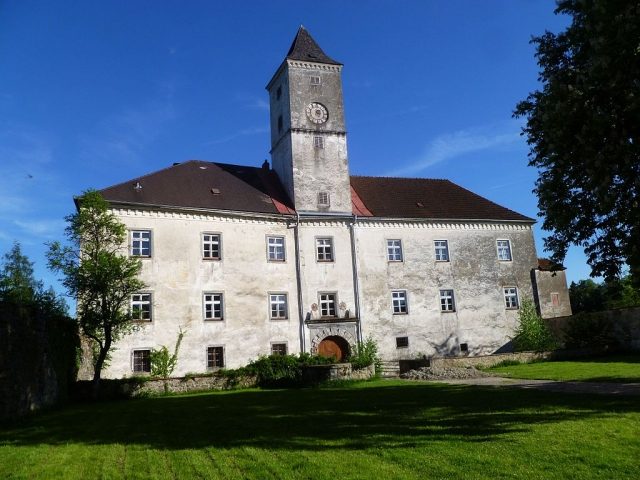
Eschelberg Castle is a castle in the municipality of St. Gotthard in the Upper Austrian Mühlviertel region. It emerged from a castle first mentioned in 1205, which was converted into a Renaissance-style castle around 1598. Today, it is owned by the Starhemberg family. It is located on a ridge that slopes steeply on both sides, at an elevation of 396 m above sea level.
The castle, built at the end of the 16th century, is a three-winged building whose courtyard is enclosed by a wall to the west. Parts of the medieval palas were incorporated into the building structure. To the north is the entrance wing. The Renaissance gate made of granite ashlar, above which the coats of arms of the Lords of Gera are still visible, is accessible via a bridge. The adjoining gate hall is topped by a tower with a tent roof. In the southeast of the castle complex is the castle chapel (dedicated to the Holy Spirit) with a barrel vault with lunettes. It is built on the foundations of a former tower.
On the way to the castle, one passes the former brewery on the left, which today serves as the studio of sculptor Magnus Angermeier. On the right are the buildings of the former Meierhof (manor farm).
South of the castle buildings lies the ruin of the medieval predecessor. The core of the hilltop castle, a rectangular block of buildings around a courtyard, was located on the outermost spur of the slope to the south, where high wall remnants still rise today.
In 1205, Eschelberg and its owner Hainricus de Esilberch were first mentioned in a document. Later, the spellings Eschelberch (1287), Eschelwerch (1378), and Eschelburg (1569) also appear in documents. Hainricus, presumably belonging to the noble family of Traun, was a vassal of the Bavarian Count of Leonberg, who owned the castle. In 1283, the ministerialis Otto von Traun was enfeoffed with Eschelberg. The feudal suzerainty changed to the Diocese of Passau in the 14th century. In 1560, the Lords of Gera, originally from Carinthia, received the fief, whose ownership had by then passed to the Austrian sovereign. Christoph von Gera, a representative of the noble estate of Austria ob der Enns, suffered a stroke during a session of the Landhaus in 1609.
In 1598, the Geras had the castle converted into a palace. Erasmus II von Gera, arrested as a Protestant rebel but later converted to Catholicism, sold the feudal rights in 1674 to Konrad Balthasar von Starhemberg. From then on, Eschelberg, together with Rottenegg, Oberwallsee, and Lichtenhag, formed an administrative unit and had a total of 313 subjects. Eschelberg remains in the possession of the Starhemberg family to this day.
After 1945, refugees were housed in the castle, and in 1962, the castle tower completely burned down due to a lightning strike. Currently, the castle complex is being renovated by its owners.
Take Mobile History with you
You are reading this text for free. Premium adds what matters on the road: descriptions read aloud, sites found through your camera, whole regions taken offline.
- Every description, including the ~17,700 Premium sites
- Audio guide: have descriptions read to you on location
- AR finder: see sites through your camera, with distance and bearing
- Unlimited saved sites
14 days free, then from €2.99 a month. Cancel anytime.
Source: Wikipedia · Licence: CC BY-SA 4.0 · Image: http://commons.wikimedia.org/wiki/File:Schloss_Eschelberg-1.jpg
This description draws on the facts documented in the linked Wikipedia article; Wikipedia content is licensed under CC BY-SA 4.0. Wording and editing: Mobile History.
Location: 48.3822, 14.1178