To be privately owned
CastleErnstbrunn-Dörfles
Ernstbrunn Castle
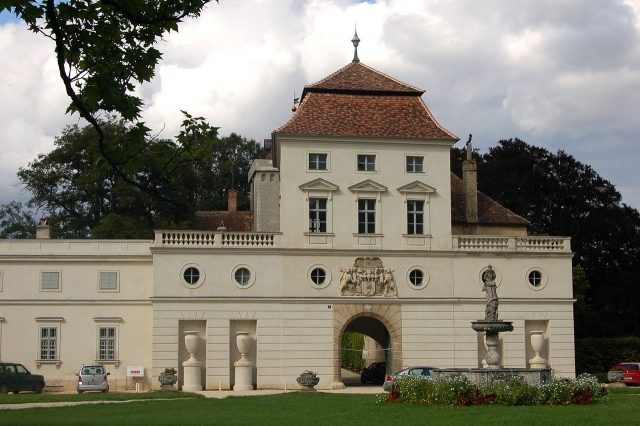
Ernstbrunn Castle is a castle in Dörfles in the market town of Ernstbrunn in Lower Austria. It is located in a forest northwest of the center of Ernstbrunn. The castle has been owned by the Princes Reuss since the 19th century, who still inhabit it today.
Around 1180, a Heinrich de Ernstbrunne is mentioned as a witness in a Klosterneuburg document. Ebran von Ernstbrunn was beheaded in 1254 because he sided against King Ottokar in a dispute with Bertold von Ernstbrunn. In 1313, Ulrich von Maissau inherited the lordship from Konrad I von Schaunberg. Around this time, the Gneusen family were the feudal tenants. In 1430, Ernstbrunn came into the possession of the sovereign, who pledged it to the Doss family until 1480. Through exchange, the Lords of Ebersdorf came into possession of the lordship from 1499 (until their extinction in 1556). Leonhard von Harrach sold it in 1592 to Joachim von Sinzendorf. He was a special envoy at the Sultan's court in Istanbul and had 13 children. His son Lorenz founded the Ernstbrunn line of his family. After 1654, Rudolf Graf von Sinzendorf carried out extensive renovations and new constructions in the Baroque style. Imperial Prince Prosper von Sinzendorf had the castle extensively expanded from the last quarter of the 18th century to the beginning of the 19th century. He employed Benedict Henrici as architect and sculptor. Jacobus Wanderl was active in the interior. With Prosper, the Sinzendorfs died out in 1822.
A lengthy inheritance dispute followed, which ended with Prince Heinrich LXIV. von Reuß-Köstritz taking over the lordship in 1828.
During the occupation, the castle was under USIA administration and was severely devastated and robbed of most of its inventory during this time. After the State Treaty, the castle was returned to its original owners. It has been continuously restored by them. During excavation work in 1984/1985, approximately 100 life-size baroque stone figures were found. The Wolf Science Center was temporarily housed in the castle's nearby kitchen garden until its definitive completion.
Construction+
The castle is an elongated building with four ascending courtyards on the northern slope of the Semmelberg above Dörfles. New groups of buildings were continuously added to the medieval core castle on the northern rock spur through extensions in the Late Renaissance, Baroque, and Classicism. The core castle from the 12th and 13th centuries, which surrounds the innermost courtyard, lies on a limestone rock freely standing on three sides, which slopes steeply towards the village of Dörfles. It forms an elongated octagon. The wall thickness of the ring wall is up to three meters. It is additionally reinforced in the southeast by the square keep. This originally had only three floors, but was extended by another floor in the 16th/17th century.
The show side of the castle is the 16-axis south front, which closes off the outer bailey. In the second courtyard there is a clock tower and a Protestant chapel (built around 1863), in the third courtyard a high castle, in the fourth courtyard a Catholic chapel, a knight's hall and a keep. As the coat of arms of Count Rudolf von Sinzendorf, held by lions, above the round arch portal shows, the outer bailey was already extended between 1672 and 1677. However, the facade was redesigned in a classical style at the end of the 18th century. In front of the gate is a baroque fountain. In the immediate vicinity there is a park, and further around the castle are outbuildings.
Castle Library+
It was only between 1910 and 1945 that a library was built up, which at the end of the Second World War comprised more than 40,000 volumes, mainly from the family's own possessions. Apart from the fact that the castle was in the middle of fighting for several weeks at the end of the war, the family had to leave the castle after the war due to the Soviet occupation. Parts of the library had already been relocated to Western Austria beforehand, but were later largely sold. Thus, the historical book collection now only comprises about 2,500 volumes.
Take Mobile History with you
You are reading this text for free. Premium adds what matters on the road: descriptions read aloud, sites found through your camera, whole regions taken offline.
- Every description, including the ~17,700 Premium sites
- Audio guide: have descriptions read to you on location
- AR finder: see sites through your camera, with distance and bearing
- Unlimited saved sites
14 days free, then from €2.99 a month. Cancel anytime.
Source: Wikipedia · Licence: CC BY-SA 4.0 · Image: http://commons.wikimedia.org/wiki/File:Schloss_ernstbrunn_07.JPG?uselang=de
This description draws on the facts documented in the linked Wikipedia article; Wikipedia content is licensed under CC BY-SA 4.0. Wording and editing: Mobile History.
Location: 48.5403, 16.3476