Museum
CastleSpitz an der Donau
Erlahof Castle
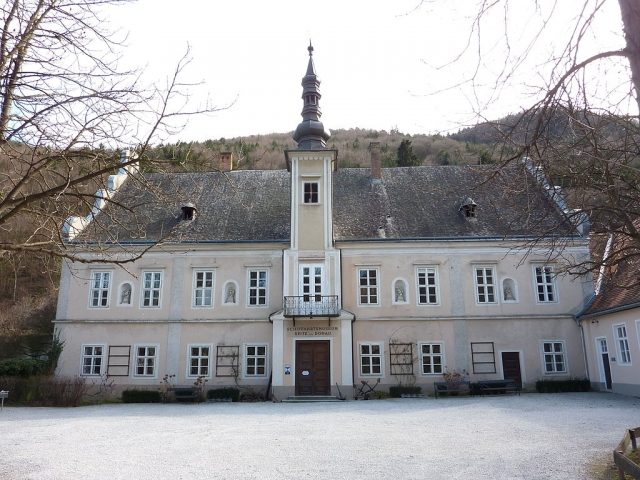
The Erlahof is located in the oldest settlement area of Spitz. It is believed that the Margarete Chapel, consecrated in 865 by Archbishop Adalwin of Salzburg, was located here. The name of the court derives from the free peasant family Erla. The brothers Hermannus and Pertholdus de Erla sold it in 1147 to the provisor of Niederaltaich Abbey, Conradus. In 1309, a new chapel was consecrated. The Erlahof remained in the possession of the Bavarian Benedictine monastery until its secularization in 1803 and served as the administrative center of the monastery's estates in the Waldviertel. It was also used as a tithe farm. In the 13th century, the Kuenringer, as feudal lords of the Bavarian dukes, exercised the Vogt rights over the monastic property. The farm was often visited by the abbots in summer and autumn as a place of recreation. In 1451, Abbot Erhard Reittorner was attacked and abducted here by Leopold von Neidegg, who resided at the neighboring Oberranna Castle. However, he had to atone for this misdeed with a high fine. When imperial troops captured and burned down the Protestant-minded Spitz in 1620, the Erlahof also suffered damage. Among other things, the chapel was plundered. Abbot Joscio Hamberger of Niederaltaich and his steward Bernhard Knopf were the driving forces in the first half of the 18th century for the expansion of the still fortified court into a baroque castle. After the secularization, the state cameral fund auctioned off the estate in 1808. It went to the Roman Count Alois Geniceo. The farm buildings at that time included a mill, a distillery, and extensive wine cellars. In 1835, the Erlahof became bourgeois. It first went to the Aggsbach shipmaster Josef Wimmer, followed in 1847 by Prof. Alois Weiß and in 1890 by Ludwig Wagner. In 1940, the market town of Spitz acquired the already somewhat dilapidated castle. As it served as a resettlement camp during and after the war and then as an apartment building, the structural condition continued to deteriorate. In the 1 960s, extensive restoration took place. In 1970, the Spitz Shipping Museum was opened in it. The last renovation took place in 2005/06.
The Erlahof is an extensive building complex somewhat outside the closed village development of Spitz. It consists of several freestanding buildings surrounding large courtyards. The nine-axis, east-facing entrance front of the two-story box-shaped main building is accentuated by a slender, barely protruding central tower. It is topped by a high baroque dome with a lantern. Architecturally more interesting, however, is the southeast front with its huge, multi-curved gable wall. Sculptures of cherubs stand in four round-arched niches. Since putti are also repeatedly found inside the castle, the Erlahof was formerly also called "Engelsburg" (Angel's Castle). In the upper part of the gable wall, three round wall fields can be seen. They are empty today, as the frescoes located here have not been preserved. The south wall below the ornamental gable is structured by three giant pilasters. Mostly empty figure niches and equally empty wall fields are also found on the other building fronts and the gatehouses of the individual courtyards. The former smoke kitchen in the southeast of the complex can still be recognized by its pyramid chimney. On the ground floor of the manor house was a two-aisled, six-bay hall, whose barrel vault with lunettes rested on massive, squat pillars. However, it was later divided by partition walls.
The reception rooms on the upper floor are magnificently furnished. The vestibule features a flat ceiling with strapwork and foliage stucco from the second quarter of the 18th century. The flat ceilings of the most important rooms were provided with rich stucco decorations around 1740. The particularly elaborately furnished Prelate's Hall is a three-axis room. Corinthian pilasters support a cornice under the coved flat ceiling. An oil painting embedded in it depicts the Assumption of Mary. The strapwork and volute stucco is polychromed and partly gilded. It shows the year 1731. The magnificent portals bear the coats of arms of the monastery, Bavaria, Austria, and Abbot Hamberger. The so-called Lion Portal is flanked by stuccoed Bavarian lions. In the supraporte, stuccoed trophies commemorate the victorious end of the Turkish Wars. The adjoining hall is similarly designed. During a restoration in 1967, fresco remnants from the 14th century were uncovered near the staircase on the upper floor, which allowed the location of the former chapel to be identified. This also makes it clear that parts of the medieval complex were built over during the expansion into a baroque castle. The Shipping Museum deals with Danube shipping, shipbuilding, and the not-so-safe work of the boatmen.
Take Mobile History with you
You are reading this text for free. Premium adds what matters on the road: descriptions read aloud, sites found through your camera, whole regions taken offline.
- Every description, including the ~17,700 Premium sites
- Audio guide: have descriptions read to you on location
- AR finder: see sites through your camera, with distance and bearing
- Unlimited saved sites
14 days free, then from €2.99 a month. Cancel anytime.
Source: Wikipedia · Licence: CC BY-SA 4.0 · Image: http://commons.wikimedia.org/wiki/File:Spitz_Erlahof_Museum1.jpg
This description draws on the facts documented in the linked Wikipedia article; Wikipedia content is licensed under CC BY-SA 4.0. Wording and editing: Mobile History.
Location: 48.3598, 15.4013