To be privately owned
CastleEnglburg
Englburg Castle
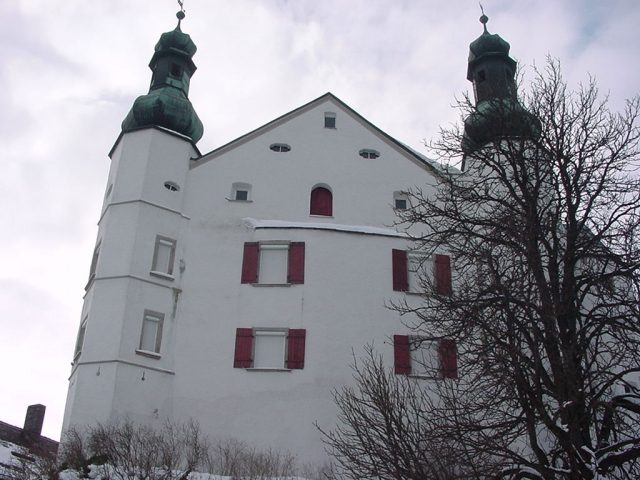
Englburg Castle is located in the municipality of Tittling in the Bavarian Forest, about 25 km north of Passau. It is one of the three castles that give the Dreiburgenland its name.
The castle is visible from afar on a ridge. There are numerous hiking trails around the castle, including to Lake Dreiburgensee. In spring 2006, the Danube-Ilz cycle path from Hengersberg to Kalteneck was opened, which runs below Englburg Castle.
The hilltop castle was built in 1396 by Wilhelm von Puchberg and named "Engelburch" by him. It came into the possession of the Schwarzensteins no earlier than 1426. After 1579, major additions were made by master builder Siegmund Aug. With the death of Hans Wolf von Schwarzenstein in 1599, married to a daughter of Wolf Dietrich von Maxlrain, and the marriage of his sister to Burghard von Taufkirchen in 1617, the Taufkirchen family, elevated to count status in 1684, became owners of the castle. In the 17th century, Englburg also received its characteristic ogee domes, and a brewery was established in the south wing, which existed until 1900.
In 1742, the Pandurs devastated the castle. In 1774, the Passau court master builder Anton Gärtler built the staircase, originally crowned by a magnificent fresco; at the same time, the elongated servants' wing was created. In 1844, Max Josef Karl von Taufkirchen left the castle. In 1857, Max Friedrich Graf von Taufkirchen sold the castle property for 4,474 guilders to the Hallertau estate owner Max Niedermayer. In 1870, a fire devastated the castle, which was restored in 1875 and received an added observation tower. In 1929, the Niedermayer family sold Englburg to the English Ladies, who converted it into a convalescent home.
Current Use+
Until autumn 2005, the home was run by the English Ladies. However, they had to sell Englburg due to a lack of new recruits. The castle found new owners in October 2006, who wanted to set up a guesthouse and a catering business. At the end of 2010, Englburg was sold to a company and is currently being renovated.
Complex+
The building is divided into the main castle, an east building (former well house), a south building, and the patrimonial court building in the north. The two onion domes with attached lanterns and the roof turret on top of the main castle give it its characteristic exterior. In the north, there is still a round tower from the medieval fortifications.
On the upper floor of the main castle is the castle chapel, consecrated to St. George, from the 14th century. It has a Rococo altar. A fresco painted after World War II by the Englburg artist Wilhelm Niedermayer is located on the outer wall of the forest chapel. This is located on a hill north of the castle.
Take Mobile History with you
You are reading this text for free. Premium adds what matters on the road: descriptions read aloud, sites found through your camera, whole regions taken offline.
- Every description, including the ~17,700 Premium sites
- Audio guide: have descriptions read to you on location
- AR finder: see sites through your camera, with distance and bearing
- Unlimited saved sites
14 days free, then from €2.99 a month. Cancel anytime.
Source: Wikipedia · Licence: CC BY-SA 4.0
This description draws on the facts documented in the linked Wikipedia article; Wikipedia content is licensed under CC BY-SA 4.0. Wording and editing: Mobile History.
Location: 48.7305, 13.3400