The Castle can be visited
Museum
CastleNeuwied - Engers
Engers Castle
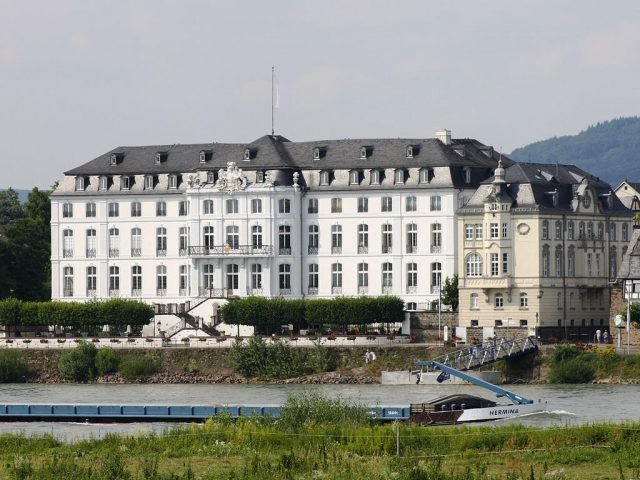
Engers Castle is located directly on the Rhine in the Engers district of Neuwied in Rhineland-Palatinate. The Archbishop and Elector of Trier, Johann Philipp von Walderdorff, had it built between 1759 and 1764 as a hunting, pleasure, and summer residence according to plans by Johannes Seiz.
The late Baroque castle building today houses the office of the Villa Musica State Music Foundation, a museum area with old musical instruments and paintings of the Electors of Trier, and a restaurant in the castle cellar.
The Archbishop of Trier, Kuno von Falkenstein, acquired the town of Engers in 1371 and built Kunostein Castle on the banks of the Rhine. His brother and successor Werner von Falkenstein moved the customs station from Stolzenfels Castle near Koblenz to Engers. Kunostein Castle thus became a customs castle. It survived the Middle Ages without major destruction.
In 1757, the then Archbishop and Elector of Trier, Johann Philipp von Walderdorff, decided to modernize the castle. This undertaking is interpreted as a reaction to the founding of the city of Neuwied. He changed his plan and had the castle demolished in 1758. Today, the Grey Tower of the old customs station is still preserved. The architect Johannes Seiz, a student of Balthasar Neumann, was commissioned with the planning of the work for a new castle. With the participation of the court stucco artist Michael Eytel, the Koblenz painter Januarius Zick, and the sculptor Ferdinand Dietz, the late Baroque Engers Castle, still well preserved today, was built from 1759 to 1762.
The Elector stayed at Engers Castle only during the hunting season in September of each year. For the rest of the time, the castle stood empty and was opened for visiting travelers. The Elector also had other pleasure palaces built in Wittlich and Molsberg. Johann Philipp von Walderdorff died in 1768. After the end of the Electorate, the castle was assigned to the Prince of Nassau-Weilburg as a summer residence in 1803. After the Congress of Vienna, Engers became Prussian, and the grounds were used as a military school between 1862 and 1914. During the wars of 1870/71 and between 1914 and 1917, it served as a reserve hospital.
Rhine promenade Engers (Neuwied) with a view of the ivy-covered Grey Tower, administration and cafeteria building Heinrich-Haus, Engers Castle and State Music Academy Rhineland-Palatinate
In 1928, the grounds were sold to the Josefs-Gesellschaft for disabled care for a residential, healing, and teaching institution. An orthopedic clinic was established, which existed until 1988. The hospital school developed into today's Christiane-Herzog-Schule, a school for physically disabled people. Today, the grounds are a workshop, residential, meeting, and educational center all at once.
In 1990, the castle building was taken over by the state of Rhineland-Palatinate and has housed the Villa Musica State Foundation since 1995.
Immediately adjacent to the castle upstream is the neo-Baroque residential building of the masters (the so-called Meisterhaus), built around 1900, who were trained at Heinrich-Haus. The building, renovated in 2003, houses the State Music Academy Rhineland-Palatinate.
Use and Events+
The Villa Musica State Foundation uses the building for the training of young musicians in chamber music ensemble playing.
In the Hall of Mirrors (Diana's Hall) on the 1st floor, which features wall paintings and ceiling frescoes by Januarius Zick, regular chamber music performances take place. In the adjacent Rose Cabinet, there are extraordinary stucco works by Michael Eytel.
The castle museum displays paintings of the Electors of Trier, Baroque furniture, and old musical instruments.
On May 19 and 21, 2005, special events commemorated the tenth anniversary of Villa Musica's move into Engers Castle.
Miscellaneous+
After 324 km, the Thuringia-Rhine hiking trail, which has existed since 1936 and was reopened in 1993, ends at Engers Castle. It leads from the Rennsteig at Großer Inselsberg via Oberellen, Bad Hersfeld, Alsfeld, Homberg (Ohm), Staufenberg, Herborn, Westerburg, Höhr-Grenzhausen, and Engers. Traditionally, hikers throw stones from the Thuringian Forest into the Rhine at Engers.
Take Mobile History with you
You are reading this text for free. Premium adds what matters on the road: descriptions read aloud, sites found through your camera, whole regions taken offline.
- Every description, including the ~17,700 Premium sites
- Audio guide: have descriptions read to you on location
- AR finder: see sites through your camera, with distance and bearing
- Unlimited saved sites
14 days free, then from €2.99 a month. Cancel anytime.
Source: Wikipedia · Licence: CC BY-SA 4.0 · Image: http://commons.wikimedia.org/wiki/File:Engers_Castle_from_SouthEast.JPG?uselang=de
This description draws on the facts documented in the linked Wikipedia article; Wikipedia content is licensed under CC BY-SA 4.0. Wording and editing: Mobile History.
Location: 50.4225, 7.5436