Nursing home
CastleSalzburg-Morzg
Emsburg Castle
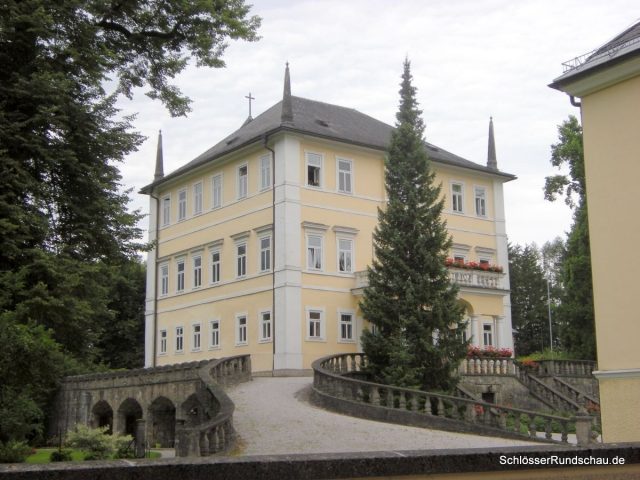
Emsburg Castle, also known as Kreuzhof, Ritterhof, or Lambergschloss, is located at Hellbrunner Allee No. 52 in Salzburg.
The castle was built almost simultaneously with Hellbrunn Palace in 1619 and 1620 with significant support from Archbishop Johann Sigmund von Mabon, the captain of Markus Sittikus's bodyguard, along with the associated mill and the elaborate castle garden with its eight bridges over the Hellbrunnerbach (Mühlbach). Although the castle was not completed at the time of Prince-Archbishop Markus Sittikus's death, Paris Lodron confirmed the promised further support for Johann Siegfried von Mabon. Soon, the Emsburg estate passed to the Barons von Rehlingen through the marriage of Ursula Maria von Mabon.
In 1701, Archbishop Johann Ernst von Thun bought it to donate it to the St. Rupert Order of Knights. At that time, all doors and window shutters were painted with the order's cross, from which the names Kreuzhof or Ritterhof originate. The Ruperti Order was dissolved in 1811, St. Peter inherited the land and sold the estate to the Salzburg governor Hugo Graf Lamberg.
Design and Current Use+
Since 1948, the castle has served as the motherhouse of the Hallein School Sisters. At that time, the outbuildings directly on Hellbrunner Allee were also raised by one floor and significantly altered, contrary to the original design concept.
The castle stands, (as it was once located in the former flood plain of the Salzach) elevated on a high plinth with surrounding terraces. The magnificent double-armed grand staircase to the east of the castle with its conglomerate balustrades leads up to the castle entrance, which was built over with columns in the 19th century. At the corners of the castle, with its high hip roof, there are four slender obelisks. The stair tower is attached to the west facade.
Many preserved paintings inside the castle commemorate the former commanderies of the Order of Knights.
Manor Farm and Mill+
The former mill, located at the very north of the castle garden, is kept in a rustic style. It was already established under Siegfried von Mabon.
The current Kreuzhof (Hellbrunner Allee 63), once the manor farm of the castle, is located opposite the castle on the east side of the avenue. The former stately dairy farm of the castle, which with its windows framed on all sides by conglomerate and its high hipped roof itself possesses castle-like features, was once also called Meierei Thunsfelden. The building, which was probably built at the same time as the castle itself, was already part of the donation to the St. Ruperti Order. It was rebuilt in 1961, at which time the stable part was demolished and the rest was converted for residential use.
The Kreuzhofweg is the remnant of an old landscape-defining avenue that led into the former riparian forest.
Take Mobile History with you
You are reading this text for free. Premium adds what matters on the road: descriptions read aloud, sites found through your camera, whole regions taken offline.
- Every description, including the ~17,700 Premium sites
- Audio guide: have descriptions read to you on location
- AR finder: see sites through your camera, with distance and bearing
- Unlimited saved sites
14 days free, then from €2.99 a month. Cancel anytime.
Source: Wikipedia · Licence: CC BY-SA 4.0 · Image: http://schloesserrundschau.de/salzburg/schloesser/salzburg29.html
This description draws on the facts documented in the linked Wikipedia article; Wikipedia content is licensed under CC BY-SA 4.0. Wording and editing: Mobile History.
Location: 47.7713, 13.0614