Local Authorities
Youth hostel
Museum
CastleEllwangen
Ellwangen Castle
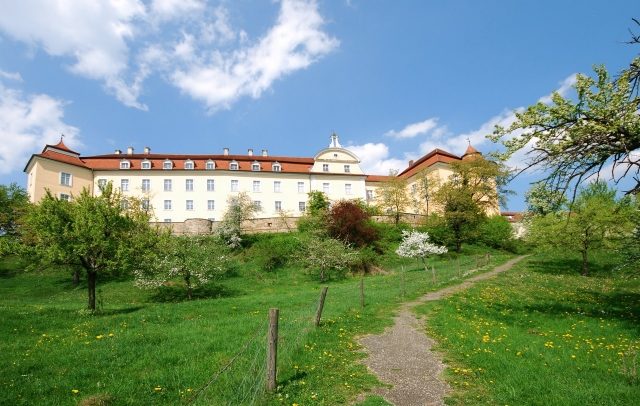
Schloss ob Ellwangen is the baroque former residence and seat of power of the Prince-Provosts of the Prince-Provostry of Ellwangen. The extensive complex is located at approximately 505 m above sea level on a hill above the city center of Ellwangen in eastern Württemberg, amidst orchards. Together with the Schönenbergkirche, the "Schloss" forms a widely visible landmark of Ellwangen.
The castle complex dates back to a medieval castle built around the year 1200 by Abbot Kuno I (1188-1221). The "castrum Ellwangen" was first mentioned in a document in 1266. From 1460, the building served as a residence and dwelling, characterized by the secular court life of the Provosts, who had risen to Imperial Princes. Prince-Provost Johann Christoph von Westerstetten had the complex redesigned as a Renaissance castle between 1603 and 1608. The arcaded inner courtyard and the four corner towers date from this period.
In 1720, a devastating fire occurred. Prince-Provost Franz Ludwig von der Pfalz (1664–1732), Archbishop of Trier, as well as Bishop of Trier and Worms and Grand Master of the Teutonic Order, commissioned the Teutonic Order master builders Franz Keller and Franz Josef Roth to rebuild the castle in the Baroque style. This resulted in the staircase completed in 1726 with a double-flight staircase, the uniform mansard roof of the main buildings, and the magnificent throne room.
From 1802/1803, Elector Friedrich, in the course of secularization, made the representative building his residence. Friedrich I, who had risen to King of Württemberg, had a throne room furnished, and between 1803 and 1806, the government of New Württemberg even met in the castle building. In 1815 and 1816, further alterations were made to the premises. The exiled Westphalian King Jérôme Bonaparte, brother of Napoleon, and his wife Katharina, the Württemberg king's daughter, had several rooms in the castle furnished as a residence and had the windows and galleries glazed.
Finally, from 1842, a definitive change in the use of the buildings took place: an agricultural school and several state authorities moved in.
In 2012, a Stauferstele was inaugurated on a meadow in front of the castle, commemorating Abbot Kuno I of Ellwangen, who was an important advisor to the Staufer dynasty and prepared the imperial coronation of Frederick II in Rome.
Current Use+
Even today, Schloss ob Ellwangen still houses several state and district authorities. The east wing contains a youth hostel and apartments. Schloss Ellwangen is one of the state-owned monuments and is managed by the State Palaces and Gardens of Baden-Württemberg institution. The castle museum is open to visitors.
The Castle Museum
In 1967, Schloss ob Ellwangen became known nationwide after the Deutsche Bundespost issued a 50-Pfennig definitive stamp. The castle museum, established in 1908, was created from the former living quarters of the Prince-Provosts. From the museum's throne room, which is still frequently used for concerts today due to its excellent acoustics, one has a unique view of the city of Ellwangen. Among the treasures of this museum are Baroque nativity scenes, the Ellwangen cabinet, stove plates from the Wasseralfingen foundry, works by the local painter Karl Stirner, and valuable faience produced in the nearby Schrezheim manufactory.
Regular Events
Today, the castle provides an ideal backdrop for theater performances, which take place annually in the first week of the summer holidays.
It also offers a good backdrop for the annual local heritage days and countless other cultural events.
A medieval spectacle with a large historical market and many historical groups has also been held in and around the castle walls every year since 2009.
Take Mobile History with you
You are reading this text for free. Premium adds what matters on the road: descriptions read aloud, sites found through your camera, whole regions taken offline.
- Every description, including the ~17,700 Premium sites
- Audio guide: have descriptions read to you on location
- AR finder: see sites through your camera, with distance and bearing
- Unlimited saved sites
14 days free, then from €2.99 a month. Cancel anytime.
Source: Wikipedia · Licence: CC BY-SA 4.0 · Image: Peter Schneider
This description draws on the facts documented in the linked Wikipedia article; Wikipedia content is licensed under CC BY-SA 4.0. Wording and editing: Mobile History.
Location: 48.9642, 10.1389