To be privately owned
CastleLiebenau
Eickhof Castle
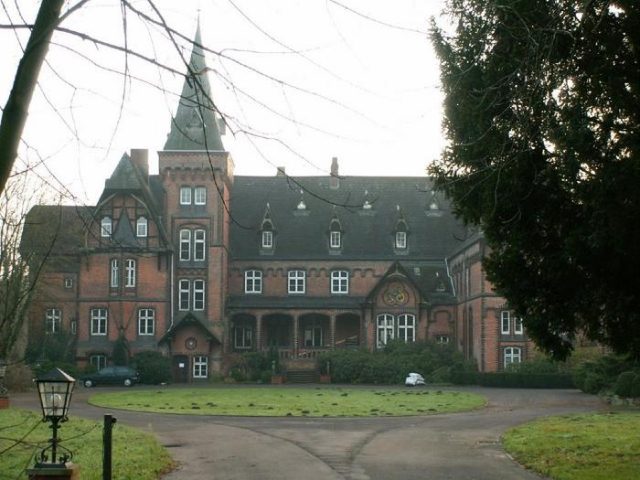
Eickhof Castle (occasionally also Schloss Eickhoff) is a castle near Liebenau in Lower Saxony, located at a bend of the Große Aue river.
After the division of the "Common Forest," the Eickhof estate underwent a profound change. It had previously come into the possession of Marbod von Kalm, the Chief Huntsman of Braunschweig, through purchase. At that time, Eickhof was an agricultural estate. Most of the land was located in the Wesermarsch. In 1860, the estate had a livestock population of 8 horses, 40 cattle, 390 pigs, and 800 sheep. Herr von Kalm expanded his property by acquiring two former feudal estates and by purchasing the two farms Vilkmann and Hesterberg in Hemmeringhausen. The new Herr von Kalm was not a friend of agriculture. He sold the estate lands in the Wesermarsch and, in return, acquired large heath areas of the "Liebenauer Forest" from the domain administration, which he had reforested.
The district, which was called "Eickhofer Heide" on older maps, thus became a large forest estate. There was no longer any room for sheep herds – the new owner disliked them, and they were sold. He had the farms in Hemmeringhausen demolished, as well as the brickworks built by his predecessors near the Jewish cemetery. On the foundations of the old manor house, the new Eickhof Castle was built after 1870, complete with a castle garden, nursery, and outbuilding. The Chief Huntsman was often in Braunschweig – he was friends with the Duke. It is said that when he once gambled away his Eickhof estate and lost it, the Duke returned it to him the next morning – with a slap for his recklessness. This explains why the von Kalm family was Welf-minded and, after the events of 1866 (war between Prussia and Austria), anti-Prussian.
In the estate cemetery lie members of the von Kalm family who served as officers in the Austrian army. The cemetery, idyllically located near Eickhof Castle, was laid out around 1870 by Marbod von Kalm. The cemetery is a protected monument. Particularly noteworthy are centuries-old gravestones and crypt slabs incorporated into the outer wall. After Marbod von Kalm's death in 1895, the estate came into the possession of railway president Reitzenstein through purchase, who later called himself "von Eickhof-Reitzenstein." Until 1938, the castle was the seat of the noble family – the Eickhof cemetery was also used by the family until 1938. After 1938, "Montan GmbH" bought the Eickhofer Heide from the noble family von Eickhof-Reitzenstein for the purpose of building an ammunition factory. At that time, Eickhof Castle housed an HJ leadership school. After 1945, the British requisitioned the factory, parts of the factory accommodations, Eickhof Castle, and a number of houses in Liebenau. They set up an officers' mess in the castle.
In 1986, Wolfgang and Marianne Hess bought Eickhof Castle to settle there in a quiet environment. In the course of growing enthusiasm for Japanese gardens, increasingly larger areas of the park were redesigned in Japanese style. Finally, in 2006, the castle, which until then had been used exclusively as a residence, became a Zen monastery with seminar offerings. In addition, a horticultural company has its business headquarters in the castle.
Take Mobile History with you
You are reading this text for free. Premium adds what matters on the road: descriptions read aloud, sites found through your camera, whole regions taken offline.
- Every description, including the ~17,700 Premium sites
- Audio guide: have descriptions read to you on location
- AR finder: see sites through your camera, with distance and bearing
- Unlimited saved sites
14 days free, then from €2.99 a month. Cancel anytime.
Location: 52.5955, 9.0922