Hotel
Restaurant
CastleGernsbach
Eberstein Castle
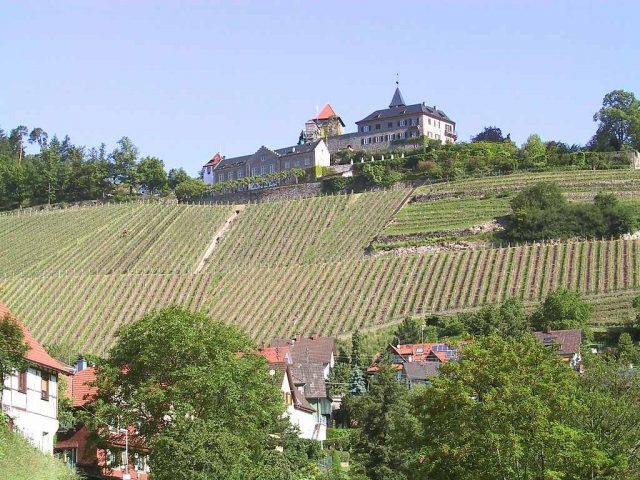
Eberstein Castle, also known as Neu-Eberstein or Neueberstein, is a castle near Gernsbach, Rastatt district, in Baden-Württemberg. It was originally a spur castle of the Counts of Eberstein with a shield wall facing the slope, reinforced on the mountain side by a rectangular keep. The complex was expanded several times and converted into a country castle by the Baden ruling family in the early 19th century. Today, Eberstein Castle serves as a hotel, restaurant, winery, and private residence.
The castle is located on a mountain spur north of Obertsrot, 130 meters above the Murg valley floor. A road connection exists via district road 3701, which leads from Gernsbach to the castle and further to Müllenbild and Baden-Baden-Oberbeuern. The building can be reached by public transport via the Stadtbahn stop Obertsrot of the Murgtalbahn, which is about 1.5 kilometers away on foot.
Neu-Eberstein was first mentioned in 1272 as Novum Castrum Eberstein and served alongside Alt-Eberstein Castle as the seat of the Counts of Eberstein. Otto I von Eberstein (1207–1279) is considered the builder and first lord of the castle. Among the oldest parts of the building are the shield wall and the stump of the keep. The complex underwent a significant expansion in the 16th century under Wilhelm IV von Eberstein (1497–1562), who had a well, stair towers, the upper floor of the residential building, an archive building, a castle chapel, and various curtain walls erected. In the early 17th century, under Philipp III von Eberstein († 1609), the new gatehouse, the outworks to the east and west, and additional curtain walls were added.
After the extinction of the Eberstein family with the death of Count Casimir (1639–1660), their possessions fell partly to the Margraviate of Baden and partly to Württemberg-Neuenstadt. The complex was no longer used as a noble residence but only as a dwelling for the Baden and Württemberg administrators. During the War of the Palatine Succession, the castle was a safe place for Prince Leopold Wilhelm, the Baden-Baden archive, and for the nuns of the Holy Sepulchre. In 1691, part of the complex burned down. Subsequently, the castle was only used as a workshop and storage.
Over time, the Württemberg shares of the former Eberstein possessions gradually passed to Baden. In 1798, the Margrave Karl Friedrich of Baden handed over the complex to his son Friedrich. From 1802, the latter had the castle converted into a palace in the Neo-Gothic style by the Karlsruhe master builder Friedrich Weinbrenner.
Under Grand Duke Leopold, from about 1830, the buildings were also redesigned internally in Neo-Gothic style. According to plans by Weinbrenner's pupil Heinrich Hübsch, the current restaurant building was also built in place of the old stables. The executing master builder Johann Belzer was also responsible for further alterations in the late 19th century. Grand Duke Leopold also acquired numerous art treasures, which he had exhibited in the castle, including historical stained glass from the parish churches in Düren and Ottersweier, a Gothic crucifixion group from 1464 from the former Cistercian monastery Herrenalb, and Romanesque reliefs from the 12th century from the demolished monastery church in Petershausen. Leopold had the house chapel furnished with paintings by Moritz von Schwind and the court painter Albert Gräfle.
The local poet, gardener, and farmer Heinrich Würtenberger served as castle administrator at Eberstein Castle in the late 19th and early 20th centuries. In 1902, Grand Duke Friedrich I appointed him Oekonomierat (Economic Councillor).
The keep received its current form in 1951 according to plans by Otto Linde.
In 2000, Max Margrave of Baden sold the castle to Gerd Overlack, a businessman from Cologne originally from Gernsbach, who also acquired Gymnich Castle at auction in 2012. He had the listed building extensively restored. The south-facing vineyard was also newly terraced and expanded to five hectares. The vineyard had been cleared by the Margrave in 1994 because cultivation no longer seemed profitable. The clearing had led to considerable resentment in Gernsbach and Obertsrot, as the vineyard is a defining feature of the landscape.
Current Use+
Werners Restaurant, a gourmet restaurant that has been awarded a Michelin star since 2006, and a 4-star hotel are located in the castle. The castle is also a popular destination for hikers and day-trippers, partly because of the Schloss-Schänke with its associated plane tree terrace beer garden and the associated view into the middle Murg valley. Due to the ownership structure, there are no castle tours.
The new owner and his brother also revived viticulture on the slope below the castle, which had been discontinued only a few years earlier after centuries of operation. The winery belongs to the Ortenau wine region and is located on the Ortenauer Weinpfad hiking trail. The arboretum Schloss Eberstein, a dendrological educational trail, runs around the castle hill. The castle is a stop on the Gernsbacher Runde hiking trail and the Gernsbacher Sagenweg (Gernsbach Legend Trail).
On the winding road ascent from the Gernsbach Murginsel, the local motorsport club Automobilclub AC Eberstein e.V. held the Schlossbergrennen motorsport event 14 times between 1970 and 1989. Since 2004, a meeting for vintage and youngtimer vehicles has been held annually under the name Schlossberg–Historic, in homage to these races.
Eberstein Castle was named Monument of the Month January 2008 by the Denkmalstiftung Baden-Württemberg (Baden-Württemberg Monument Foundation).
Take Mobile History with you
You are reading this text for free. Premium adds what matters on the road: descriptions read aloud, sites found through your camera, whole regions taken offline.
- Every description, including the ~17,700 Premium sites
- Audio guide: have descriptions read to you on location
- AR finder: see sites through your camera, with distance and bearing
- Unlimited saved sites
14 days free, then from €2.99 a month. Cancel anytime.
Source: Wikipedia · Licence: CC BY-SA 4.0
This description draws on the facts documented in the linked Wikipedia article; Wikipedia content is licensed under CC BY-SA 4.0. Wording and editing: Mobile History.
Location: 48.7494, 8.3431