To be privately owned
CastleEberstein
Eberstein Castle
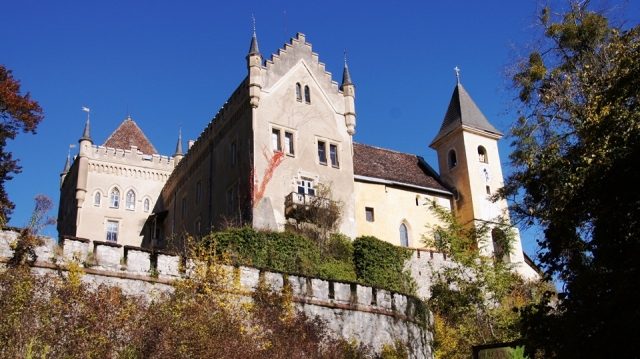
Eberstein Castle stands on a steeply rising rock above the Görtschitztal valley in the northeast of the Austrian state of Carinthia. It gave its name to the municipality of Eberstein, to whose municipal area the castle rock belongs today.
The original Eberstein Castle, first mentioned in the 11th century (1078), no longer exists today. The fortified complex, already described as dilapidated in the 17th century, was located higher up on the mountain (Gutsche) and has probably fallen victim to the dolomite works today. The lower castle, today's Eberstein Castle, was a collection of residential buildings grouped around an inner courtyard. The castle dates back to a dispute between the Archbishop of Salzburg and the Emperor. Eberstein and Friesach were Salzburg strongholds. In 1223, a distinction was made between a fortified tower (Alt - Eberstein) and the lower house (Kirchhof). In 1433, Eustach von Eberstein, the last Ebersteiner, died.
In the 14th century, the castle was owned by Görz ministerial families, who named themselves "Lords of Eberstein" after it. After their extinction, Moritz Welzer acquired their dominion and seat in 1457. Under the Welzers, the lower castle was expanded in the second half of the 16th century. The Welzers, being Protestants, were forced to emigrate during the Counter-Reformation and had to sell. The castle passed to the Counts Christalnigg in 1630.
Under the mining family Christallnigg, who had become rich through mining in Hüttenberg, the dominion of Eberstein experienced its greatest prosperity. At the end of the 18th century, their possessions included Gillitzstein, Hornburg, Waisenberg, Mittertrixen, Hagenegg near Eisenkappel, a city palace in Klagenfurt, smelting plants in Eberstein, Brückl, Rechberg, Obere and Untere Vellach, to which Schloss Schletterhof in St. Donat and Schloss Meiselberg were later added.
In 1851 and 1868, under the guidance of Count Alfred Christian Carl Christalnigg, extensive renovations transformed it into the present-day Eberstein Castle in historicizing, Neo-Gothic forms ("Tudor Gothic"). Since its renovation in the 19th century, the castle consists of nested building complexes, with stepped gables, crenellated crowns, and turret-like extensions. On the south side, the Church of St. George is attached to the complex; it was first mentioned in a document in 1252 and was for a long time also a parish church.
With the decline of Carinthian mining and the rise of the bourgeoisie, the extensive lifestyle of the rural nobility was no longer financially viable. Most of the Christalnigg castles stood virtually empty in the second half of the 19th century. Until 1935, Eberstein was owned by the Christallnigg family. Today, the castle is in private hands.
The first wife of the last Count of Eberstein, Oskar Christalnigg, Countess Lucy Bellegarde, became known for her selfless relief efforts in the First World War. On August 10, 1914, at the beginning of the First World War, she drove a car to pick up goods for the Red Cross. In Brezovo, near Sprenica in the Soca Valley (Isonzo Valley), she was shot – possibly by accident. The Christalnigg family crypt is in St. Georg am Weinberg, with some family members also buried in St. Michael am Zollfeld.
Take Mobile History with you
You are reading this text for free. Premium adds what matters on the road: descriptions read aloud, sites found through your camera, whole regions taken offline.
- Every description, including the ~17,700 Premium sites
- Audio guide: have descriptions read to you on location
- AR finder: see sites through your camera, with distance and bearing
- Unlimited saved sites
14 days free, then from €2.99 a month. Cancel anytime.
Source: Wikipedia · Licence: CC BY-SA 4.0 · Image: http://www.wehrbauten.at/ktn/kaernten.html
This description draws on the facts documented in the linked Wikipedia article; Wikipedia content is licensed under CC BY-SA 4.0. Wording and editing: Mobile History.
Location: 46.8082, 14.5570