Priest's office
CastleEberschwang
Eberschwang Castle
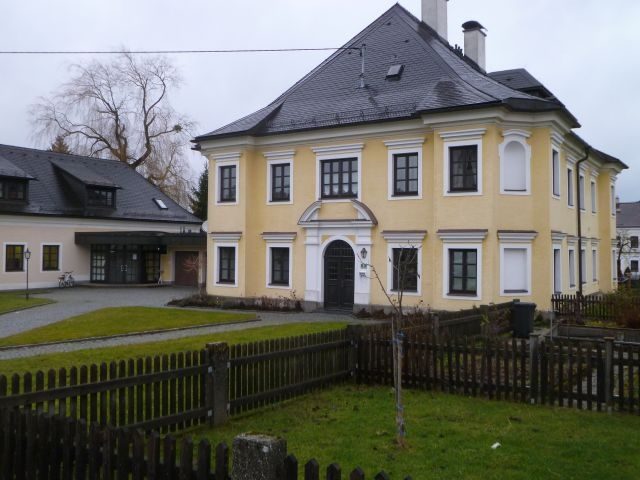
The former moated castle Eberschwang now serves as the rectory of the municipality of Eberschwang in the district of Ried im Innkreis in Upper Austria.
Eberschwang Castle was probably a seat of the Kirchsteiger family in the 13th century. This family died out towards the end of the 14th century, and Eberschwang became the ancestral seat of the knightly family of the Pewntner (Peutner), who are only documented from 1447. Georg Peuntner was the last of this lineage; he died in 1527, and his widow and two daughters first sold half of the Hofmark in 1503 and then the second half in 1530 to Hanns Marschalk, who came from a bourgeois family from Peuerbach, who in turn were in the service of the Schaunberger. In 1542, Hans Caspar Marschalk had the estate rebuilt. In 1557, the family was elevated to the lower Bavarian nobility. Afterwards, Eberschwang was united with the lordship of Schloss Mayrhof, also located in the municipality of Eberschwang.
Hans Caspar Marschalk was the last male of the family, and the property came into the possession of the Barons von Tattenbach, who were related to the Marschalks. Around 1600, they were enfeoffed with Eberschwang, Maierhof, and Mühring. In 1668, Count Gottfried Wilhelm von Tattenbach-Reinstein had the wooden predecessor building demolished and replaced by the brick castle. In 1684, the castle was made available to the newly built pilgrimage church of the village as a benefice house. During the War of the Spanish Succession, Eberschwang was conquered and plundered in 1704 by Austrian hussars under the command of Lieutenant Colonel Razghay. In 1735, Maximilian Franz Reichsgraf zu Tattenbach-Rheinstein took over Eberschwang and combined it with his domain Aurolzmünster. After the Peace of Teschen in 1779, Eberschwang, along with the Innviertel, came to Austria. The benefice was abolished in 1785. On October 3, 1821, Heinrich Graf von Rheinstein-Tattenbach died in Munich, and Eberschwang was for a long time in the possession of the Counts Arco-Valley zu Aurolzmünster. In 1858, the parish priest of Eberschwang, Johann Schuster, acquired the estate and set it up as a rectory; it is now owned by the Diocese of Linz.
Schloss Eberschwang Today+
The former moat has been drained and is no longer present. The roof construction dates from the Biedermeier period. The formerly existing four corner turrets have been removed since 1542, but can still be discerned at the concavely recessed corners of the building. Figure niches are attached to the house, but they are empty. The round-arched entrance portal indicates the former noble owners; it is framed by pilasters and bears a broken round gable. The gable field is empty and was probably formerly filled with the coat of arms of the noble former owners.
The building has been completely renovated and stands in a small, well-maintained park; the parish center and the library of the Eberschwang parish are attached to it.
Take Mobile History with you
You are reading this text for free. Premium adds what matters on the road: descriptions read aloud, sites found through your camera, whole regions taken offline.
- Every description, including the ~17,700 Premium sites
- Audio guide: have descriptions read to you on location
- AR finder: see sites through your camera, with distance and bearing
- Unlimited saved sites
14 days free, then from €2.99 a month. Cancel anytime.
Source: Wikipedia · Licence: CC BY-SA 4.0 · Image: http://commons.wikimedia.org/wiki/File:Schloss_Eberschwang_mit_Pfarrbibliothek.jpg?uselang=de
This description draws on the facts documented in the linked Wikipedia article; Wikipedia content is licensed under CC BY-SA 4.0. Wording and editing: Mobile History.
Location: 48.1555, 13.5621