The remains of the castle, which was after 1945 senselessly destroyed, can be visited.
CastleSassnitz
Dwasieden Castle
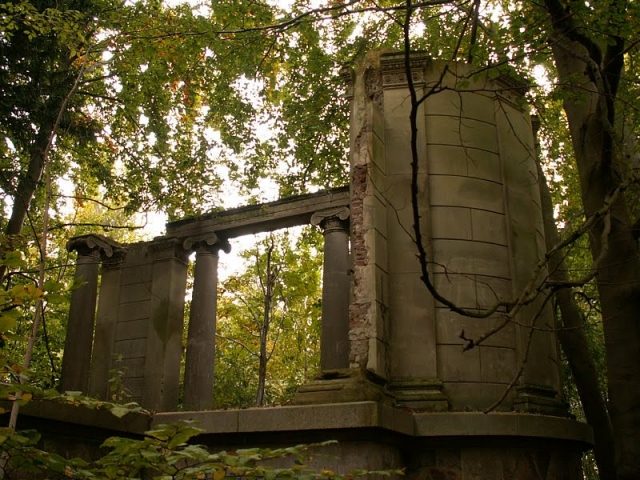
The manor house Schloss Dwasieden was located near Sassnitz on Rügen, in the immediate vicinity of the Baltic Sea.
It was built between 1873 and 1877 on behalf of Adolph von Hansemann, owner of the Disconto-Gesellschaft in Berlin and one of the richest men of the Bismarck era. The architect of the manor house was Friedrich Hitzig, a student of Friedrich Schinkel. The architecture was based on the spa architecture that is characteristic of the Baltic Sea coast of Vorpommern. Due to its demolition in 1948, only ruins and the stables, which burned down in 1997, remain of the magnificent building.
The remains of the ensemble are located on a hill above the Baltic Sea, which directly adjoins the city harbor of Sassnitz to the southwest. The Schlossallee to Schloss Dwasieden branches off from the road to Mukran (coming from Sassnitz).
The construction of the castle and the design of the 102-hectare park cost four million Marks, an enormous sum at the time. The castle was the only building in Northern Germany built of solid sandstone, granite, and real marble.
The castle was a square, two-story building with colonnades on its sides, ending in open, temple-like pavilions. Striking features of the castle were the two observation towers arranged at the corner sides with pillar-like protruding wall strips that towered over the building.
Not only the high-quality materials used for its construction made it a magnificent building, but also its valuable interior:
“The rooms that foreigners are allowed to view are on the ground floor of the castle. All these numerous salons and boudoirs, these music and library rooms, as well as the reception halls are furnished with equally fine taste and great luxury. The furniture is mostly Gobelin and dates back to Mr. von Hansemann's father. On the walls hang magnificent original oil paintings – mostly landscapes, genre scenes, and animal pieces by our foremost masters, and the ceilings are also adorned with drawings and paintings by renowned artists. The old Venetian mirrors and chandeliers (the latter are movable and each piece can be removed), the valuable ebony carvings, the antique fireplaces of white marble, the precious carpets from the Schmiedeberg industry, and all the numerous art objects that, due to their rarity and beauty, already represent a great fortune in themselves – all this made an overwhelming impression on me.”
– Adolph Kohut: Am Dünenstrand der Ostsee, 1887
The Dwasieden Park was also a very well-maintained facility and was already described as one of the most beautiful parks in Northern Germany upon its completion.
Gert von Oertzen, Hansemann's grandson and heir, sold the castle to the city of Sassnitz in the 1930s, from which the Kriegsmarine took it over in 1935 and made it part of its naval artillery school (rangefinding school).
Today, only the remains of the pavilions and the stables belonging to the castle still exist. In 1948, the castle was blown up due to SMAD Order No. 209, like other former noble residences, as part of the land reform in the Soviet occupation zone, with the "aggravating" factor that the castle had been used militarily. In the last years of the war, there was a military base in the castle park, and the castle was used as an officers' mess.
Reconstruction Plans
Already in 1993, there were plans for a "Dwasieden spa area" including the historic castle - the facade was to be faithfully reconstructed and integrated into a modern spa operation with a hotel. These plans were not implemented.
Much more far-reaching plans from 2007 envisioned the construction of a "spa town" with 3000 beds, incorporating the remains of Dwasieden. A faithful reconstruction was not planned; for example, castle towers up to 50 m high were to be built; Danish investors Axel W. Lodberg and Steffen Flensborg wanted to invest up to 300 million Euros in the south of Sassnitz. These plans also failed.
Take Mobile History with you
You are reading this text for free. Premium adds what matters on the road: descriptions read aloud, sites found through your camera, whole regions taken offline.
- Every description, including the ~17,700 Premium sites
- Audio guide: have descriptions read to you on location
- AR finder: see sites through your camera, with distance and bearing
- Unlimited saved sites
14 days free, then from €2.99 a month. Cancel anytime.
Source: Wikipedia · Licence: CC BY-SA 4.0 · Image: http://schloesser-um-dresden.de
This description draws on the facts documented in the linked Wikipedia article; Wikipedia content is licensed under CC BY-SA 4.0. Wording and editing: Mobile History.
Location: 54.5047, 13.6250