Restaurant
Cultural Events
CastleDroyßig
Droyßig Castle
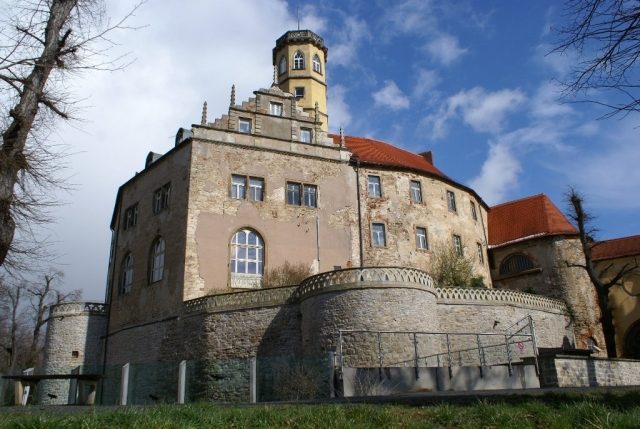
Droyßig Castle is located in the center of the municipality of Droyßig in the Burgenlandkreis, Saxony-Anhalt, Germany.
Droyßig Castle has its origins in a medieval castle complex, which was built at the beginning of the 13th century by crusaders to secure an important road junction. The crusaders, who had brought their expertise in castle construction from the Orient, built a castle in Droyßig under the leadership of a master builder who possessed all knowledge of modern fortifications. Although not outstanding in size in Germany, its practical arrangement is unparalleled in Germany.
The complex originally consisted of a double ring wall surrounded by a moat. The outer wall was reinforced by six semi-circular towers. In the middle, as late as 1605, stood a "large strong round tower". Access to the castle was provided by a drawbridge, which led from the east between two towers into the courtyard. With the invention and development of firearms, the castle gradually lost its importance as a defensive structure, and the nobility sought representative residences. The fundamental conversion of the castle into a palace took place under Christian Julius von Hoym at the beginning of the 17th century. Since he essentially placed the new buildings on the mighty walls of the castle, the original layout is still clearly visible today.
Castle Church+
A building of supra-regional importance is the castle church. It was built in 1622 after the demolition of part of the former fortification over the former moat, but the interior was not completed.
The simple building body does not reveal its purpose from the outside. The three window floors rather follow the facade scheme of Renaissance palaces. Plastic forms, curved and broken window gables announce the approaching Baroque. The stonework of the wall articulation and gallery are of high quality. The church authentically represents North German-Dutch Mannerism.
Under the nave is the imposing crypt with its basket-arch vaults.
Bear Enclosure+
In 1852, Prince Hugo von Schönburg-Waldenburg had a bear enclosure built in the castle moat. The offspring of the bear pair living there were distributed to various zoos in Europe around the turn of the century. Until World War II, the enclosure served as a popular destination for locals and tourists alike. From the beginning of the war until 1955, no bears were housed in the enclosure. It was not until 1955 that a bear pair moved in again.
In 1999, the last descendant of this bear pair died. Since the enclosure no longer met animal welfare requirements, no new bears could move in for the time being. Through an association founded in 1999, the renovation and new construction of the enclosure were planned and implemented between 1999 and 2003. In 2003, the new enclosure, which now occupied a large part of the castle moat and was fenced with glass walls, was inaugurated. In the same year, the bears Toni and Aiko were housed in the new enclosure, which now offers a bathing pool, natural ground, several sleeping caves, and play and exercise facilities on an area of 470 m².
Current Use+
The Cavalier House of the castle now houses the Droyßig municipal library and a restaurant serving German-Spanish cuisine. Wine is pressed in the castle cellars. Annual community events, concerts, and historical markets take place in the castle park. A forest stage can be found in the castle park. Concerts, cabaret, and theater events are regularly held in the castle church.
Take Mobile History with you
You are reading this text for free. Premium adds what matters on the road: descriptions read aloud, sites found through your camera, whole regions taken offline.
- Every description, including the ~17,700 Premium sites
- Audio guide: have descriptions read to you on location
- AR finder: see sites through your camera, with distance and bearing
- Unlimited saved sites
14 days free, then from €2.99 a month. Cancel anytime.
Source: Wikipedia · Licence: CC BY-SA 4.0 · Image: Roland Neubert, Halle (Saale)
This description draws on the facts documented in the linked Wikipedia article; Wikipedia content is licensed under CC BY-SA 4.0. Wording and editing: Mobile History.
Location: 51.0431, 12.0298