To be privately owned
CastleLudweis-Aigen-Drösiedl
Drösiedl Castle
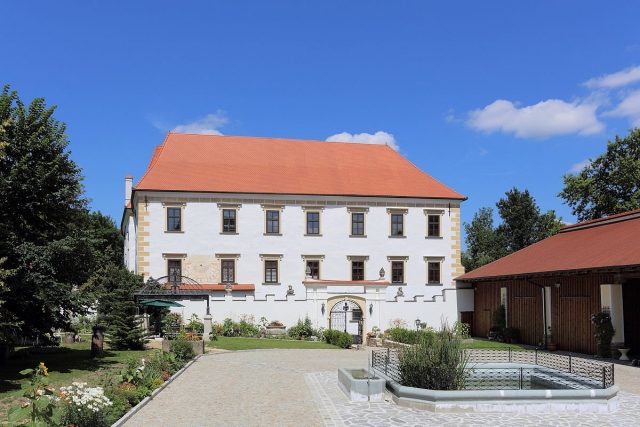
In 1283, Nikolaus de Dreyzidler is documented as the owner of Drösiedl. The Drösiedlers were vassals of the Lords of Maissau. The castle itself is first mentioned in 1369.
In 1395, Wenzel II von Drösiedl sold his ancestral castle to the brothers Rudolf and Ludwig von Tyrna. Just seven years later, they returned Drösiedl. When Georg von Drösiedl died in 1427, he had no male descendants. His heiress daughter Barbara married Johann I von Hofkirchen around 1435. In 1439, Drösiedl had been conquered by Janus von Leuchtenburg zu Vöttau, but he and his troops were soon expelled. A large part of the current building fabric dates back to the Hofkirchen family.
From 1560, Wilhelm II von Hofkirchen transformed the late Gothic moated castle into a comfortable and largely unfortified Renaissance country estate. Under Wilhelm and his sons, Drösiedl developed into the center of his possessions in the Waldviertel. Wilhelm's son Hans Adam Freiherr von Hofkirchen, who had taken over Drösiedl in 1590, was involved in the murder of his neighbor Niclas von Puchheim a year later and subsequently had to flee to Bohemia. His castle was confiscated and initially managed by administrators. However, it returned to his brother Wolfgang II in 1596, who continued the expansion of Drösiedl.
Shortly before the Battle of White Mountain in 1620, a troop of Bohemian rebels was quartered in Drösiedl. When they were expelled by imperial soldiers under Maximilian von Bayern, the castle's roof structure was severely damaged. Since Wolfgang's brother Georg Andreas had to flee abroad after the battle, his sister Elisabeth von Strein von Schwarzenau took over the already heavily indebted family property. Her dominion was first placed under forced administration due to high tax debts and finally expropriated.
In 1634, Lieutenant Colonel Christoph von Echtzell bought the estate. The next lord of the manor was Baron David Christian Haffner, who had the damage from the Thirty Years' War repaired. After 1683, when the Turkish threat was finally averted, all defensive structures in Drösiedl were abandoned. In 1692, David Ernst Freiherr von Haffner sold his dominion to Altenburg Abbey. Drösiedl thus became a purely economic estate without a representative residential function. With the abolition of manorialism in 1848, Drösiedl became increasingly uninteresting for the abbey. From 1892, the estate was leased and in 1939 sold to the Hardt family. In 1977, Reinhard Hütter inherited the property and gradually began to renovate the buildings. In 2000, Werner Zlabinger bought the castle. In the last ten years, it has been completely restored.
Take Mobile History with you
You are reading this text for free. Premium adds what matters on the road: descriptions read aloud, sites found through your camera, whole regions taken offline.
- Every description, including the ~17,700 Premium sites
- Audio guide: have descriptions read to you on location
- AR finder: see sites through your camera, with distance and bearing
- Unlimited saved sites
14 days free, then from €2.99 a month. Cancel anytime.
Source: Wikipedia · Licence: CC BY-SA 4.0 · Image: http://de.wikipedia.org/wiki/Liste_der_denkmalgesch%C3%BCtzten_Objekte_in_Ludweis-Aigen#mediaviewer/Datei:Dr%C3%B6siedl_-_Schloss.JPG
This description draws on the facts documented in the linked Wikipedia article; Wikipedia content is licensed under CC BY-SA 4.0. Wording and editing: Mobile History.
Location: 48.7885, 15.4926