Restaurant
Cultural Events
CastleHart-Purgstall
Dornhofen Castle
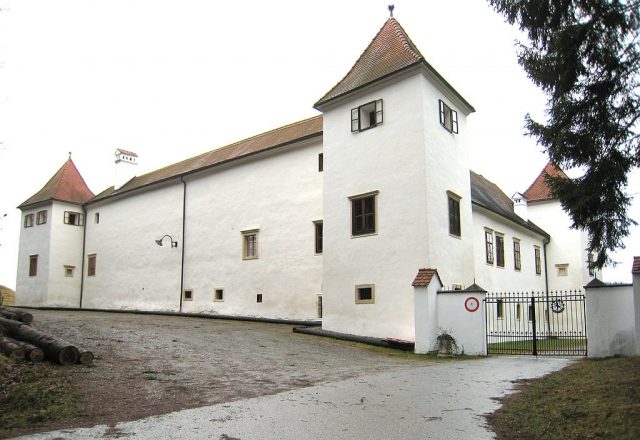
Dornhofen Castle is located in the municipality of Hart-Purgstall in the district of Graz-Umgebung in Styria. It is a protected monument along with its associated Meierhof (manor farm).
Until the 17th century, two agricultural farmsteads stood on the current site of the castle. The then owner, Maria von Wilfersdorf, sold them to Otto von Radmannsdorf, who had them demolished and a castle built in their place. The property was already seized during the shell construction phase and acquired by Gottfried von Falbenhaupt. The castle was completed in 1624. Subsequently, the owners changed several times until it came into the possession of the Viennese Archbishop Ladislaus von Kollonitsch in 1746. During this heyday of the castle, the cardinal bequeathed it to his adopted nephew, and Dornhofen Castle remained in his family until 1870. After many changes of ownership, the premises temporarily served as a guesthouse or children's home. After the Second World War, it stood empty for a long time and began to decay. It was not until 1972 that Dornhofen Castle was acquired by the Strahl family and used as a chicken coop (even in living rooms with parquet floors). It was only in the 1990s that a change of heart occurred. The castle was saved from complete decay, extensively restored, and made accessible to the public as an event center with an attached restaurant.
Architecture+
The Renaissance castle is situated on a hillside terrace of a ridge between the Rabnitz and Raab rivers. It is a three-winged building with four corner towers around an almost square inner courtyard, which is enclosed on the mountain side by a narrow connecting wing. Below the main building stands the Meierhof, which consists of three wings and has two towers. A formerly existing defensive wall can only be seen in an engraving by Georg Matthäus Vischer from 1681. Remains of bastions and two fish ponds are preserved to this day. Above the west portal is a small bell tower with an onion dome. Instead of the original wooden galleries, there are two-story arcaded walkways on the courtyard sides. In the southeast wing is the castle chapel from the end of the 17th century with a depiction of the Lamentation of Christ.
Take Mobile History with you
You are reading this text for free. Premium adds what matters on the road: descriptions read aloud, sites found through your camera, whole regions taken offline.
- Every description, including the ~17,700 Premium sites
- Audio guide: have descriptions read to you on location
- AR finder: see sites through your camera, with distance and bearing
- Unlimited saved sites
14 days free, then from €2.99 a month. Cancel anytime.
Source: Wikipedia · Licence: CC BY-SA 4.0 · Image: http://commons.wikimedia.org/wiki/File:Me_1001b.jpg
This description draws on the facts documented in the linked Wikipedia article; Wikipedia content is licensed under CC BY-SA 4.0. Wording and editing: Mobile History.
Location: 47.1430, 15.5592