To be privately owned
Apartments
CastleDorfheim
Dorfheim Castle
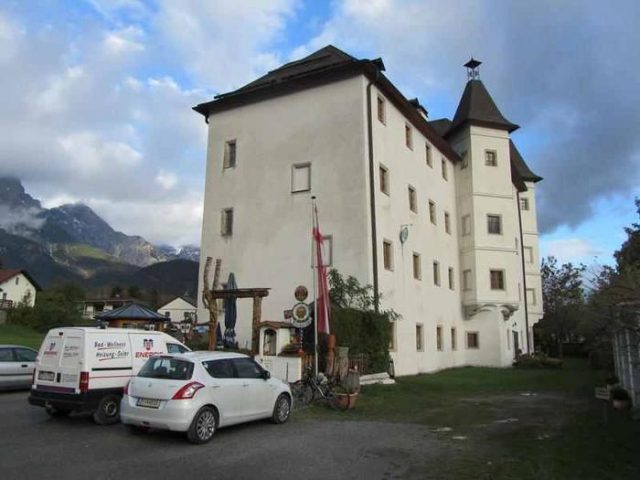
Dorfheim Castle is located on the western edge of Saalfelden on the road to Leogang. The building now only outwardly retains the character of a castle, with a high hip roof and the two remaining corner towers facing south.
The origin of Dorfheim Castle is completely unknown. The stately residence was first mentioned in a document in 1331 in connection with the Vogtturm in Zell am See. The Hunt family, bastards of the Counts of Plain, were also mentioned, who subsequently – at least since 1369 – made Dorfheim Castle their seat of power.
Towards the end of the 14th century, the Hunts began to call themselves "von Dorf". Hans Hunt, zu Dorf († 1380) was administrator of Lichtenberg. In 1399, his son – also Hans Hunt zu Dorf – succeeded him as administrator of Lichtenberg, after previously being a judge in Lofer. In 1449, the castle passed to Wolfgang Hunt, who became administrator of Mittersill in 1469. The most significant member of this dynasty was probably Wiguleus Hund von Sulzemoos und Lauterbach. In 1582, he published the first printed history of Salzburg in Latin under the title: Metropolis Salzburgensis.
In 1601, Josef Hunt thoroughly rebuilt the castle. He had no male descendants, which is why Dorfheim Castle (together with Rettenwörth Castle, today Lackenschlössl) passed to his daughter Maria Jakobe Hunt. Her husband, Johann Albert von Savioli from Rovereto, purchased the castle in 1628.
The Savioli family became impoverished, and so in 1660, a Stadlmayr family from Feldkirchen in Carinthia bought both Dorfheim Castle and Rettenwörth Castle. In 1719, a niece of the last Stadlmayr inherited Dorfheim. She was married to Friedrich Ignaz Lürzer von Zechenttal. The Lürzers remained owners of the estate, with its kitchen garden, orchard, and two fish ponds, until 1860.
During this time, from 1811 to 1815, Dorfheim was the seat of the district court (after the devastating fire in the market town of Saalfelden). From 1843, the Imperial and Royal District Building Authority was also housed there.
Around 1902, the Imperial and Royal Agricultural Society of the Duchy of Salzburg acquired the castle. An agricultural school was to be established, but the project could not be carried out as the building burned down almost completely in 1901. In 1912, the farmer and "castle farmer" Martin Hartl acquired the ruin and began reconstruction. Dorfheim Castle became a farm with tenants and leaseholders.
Take Mobile History with you
You are reading this text for free. Premium adds what matters on the road: descriptions read aloud, sites found through your camera, whole regions taken offline.
- Every description, including the ~17,700 Premium sites
- Audio guide: have descriptions read to you on location
- AR finder: see sites through your camera, with distance and bearing
- Unlimited saved sites
14 days free, then from €2.99 a month. Cancel anytime.
Source: Wikipedia · Licence: CC BY-SA 4.0 · Image: http://www.wehrbauten.de/thread.php?threadid=1284
This description draws on the facts documented in the linked Wikipedia article; Wikipedia content is licensed under CC BY-SA 4.0. Wording and editing: Mobile History.
Location: 47.4313, 12.8357