Museum
Condominium apartment
CastleVierkirchen - Döbschütz (Dobšicy)
Döbschütz Castle
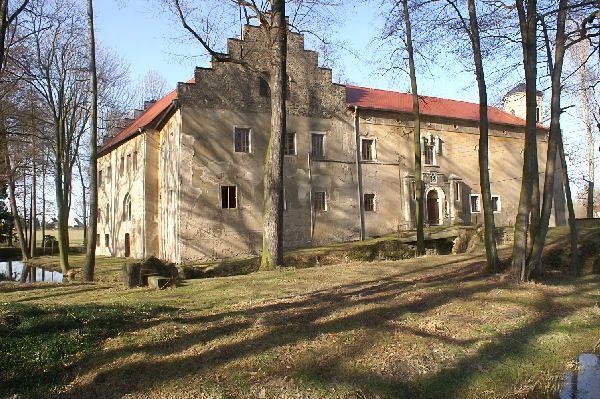
Surrounded by two waterways, Döbschütz hides in a small forest. The moated castle of Döbschütz is one of the oldest complexes in Upper Lusatia. Its exterior behind shady trees already suggests that history was written here very early on. Nevertheless, its beginnings are largely unknown.
The history of the noble seat dates back to the 1 2th century. In 1174, the Bohemian King Vladislaus II is said to have found refuge here with his sons Premyslav and Vladislaus, after he had fallen out with the then German Emperor, Frederick Barbarossa, over the succession to the throne. Even today, a hall is referred to as the "King's Room".
This royal estate later gave rise to a knight's seat, which the noble family von Debschitz is said to have owned in 1218. The family, who later settled in Silesia, probably received their name from their manor. In the 16th century, Döbschütz passed to the von Gersdorff family and in 1581 to the von Fürstenau family. In a hall on the upper floor, the names of Caspar II von Fürstenau, who acquired Döbschütz in 1581, and Alexander von Fürstenau, who inherited the property in 1594, point to the former owners.
The 17th century was marked by various changes of ownership. Finally, in the 18th century, the Lusatian Estates bought Döbschütz Castle and established a correctional and workhouse here. But soon the plan to employ male and female prisoners in field work had to be abandoned, as inmates repeatedly escaped. Thus, Döbschütz Castle was sold again after only a few years.
The current appearance of the castle dates back to the Prussian Field Marshal Albrecht Graf von Roon, who acquired Döbschütz in 1876. The castle received a stepped gable and a richly decorated portal. Together with Krobnitz, Döbschütz became part of a family foundation. Nevertheless, Döbschütz had to be sold in 1830 for financial reasons. The estate inspector Paul Daniel, who had managed the estate earlier, acquired the property for his son Dr. Alfred Daniel. In 1945, the owners were expropriated and expelled by the communists. The castle rooms were subsequently used as refugee accommodation. In the following years, the former noble seat fell into disrepair more and more. Today it is privately owned.
Originally, the moated castle of Döbschütz consisted of a closed complex with an inner courtyard surrounded on all four sides. Two drawbridges led over a moat, but these were demolished in 1800 and replaced by stone bridges. In the three-story south wing, the old kitchen and a bakery have been preserved in the cellar. The narrower two-story east wing once contained the gatehouse, which reached into the roof and had a half-timbered upper floor. Today, there is a round-arched entrance portal between pilaster strips. Above the entrance proudly displays the coat of arms of the noble family von Debschitz. To the north, a rectangular tower with an octagonal tower top adjoins in the lower area. The north wing fell victim to flames as early as 1874. It was rebuilt only as a single story. The west wing was already demolished around 1800, so that the inner courtyard now opens to the park grounds. East of the castle extends an extensive estate with numerous farm buildings.
Take Mobile History with you
You are reading this text for free. Premium adds what matters on the road: descriptions read aloud, sites found through your camera, whole regions taken offline.
- Every description, including the ~17,700 Premium sites
- Audio guide: have descriptions read to you on location
- AR finder: see sites through your camera, with distance and bearing
- Unlimited saved sites
14 days free, then from €2.99 a month. Cancel anytime.
Source: Wikipedia · Licence: CC BY-SA 4.0 · Image: http://www.heykodehn.de/doebschuetz.htm
This description draws on the facts documented in the linked Wikipedia article; Wikipedia content is licensed under CC BY-SA 4.0. Wording and editing: Mobile History.
Location: 51.1898, 14.7570