Museum
CastleDoberlug
Doberlug Castle
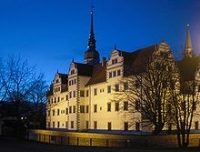
Doberlug Castle is a four-wing complex built in the Renaissance style in Doberlug-Kirchhain, Brandenburg, whose origins date back to a 12th-century monastery.
The complex has a slightly shifted, rectangular floor plan. The castle, surrounded by a dry moat, is dominated by the uniformly light-colored facades and the red tiled roofs. The dormer windows with their striking volute gables particularly shape the appearance. In the inner courtyard, there are two stair towers, whose slender spires represent the highest part of the castle. Furthermore, one finds here the round courtyard fountain under a stone gallery on the north facade. Its broken pediment is decorated with lions and the Saxon coat of arms. Forged dragon heads, which function as gargoyles, crown the inner courtyard.
The history of the castle begins with the founding of the Cistercian monastery "Dobrilugk" in 1165 under Dietrich von Landsberg, the Margrave of Ostmark.
The monastery existed for almost 400 years until it was occupied and dissolved in 1541 by Elector Johann Friedrich of Saxony. In 1551, Heinrich von Gersdorf took over the monastery property and built a castle in place of the abbot's house.
In 1623, Elector Johann Georg I of Saxony bought Dobrilugk for 300,000 thalers and continued the expansion of the castle two years later. Among other things, he completely rebuilt the south wing in 1628. His plan was to use the castle as a hunting residence. However, this project was only put into practice by his son Duke Christian I of Saxony-Merseburg.
He inherited Dobrilugk in 1657, whereby the castle fell to the Saxony-Merseburg sideline. Christian I was able to complete the castle in 1676. In 1682, he used it as his seat of power for one year, as the plague was raging in Merseburg. It was also Christian I who founded the town of Dobrilugk in 1661.
In 1738, Heinrich von Saxony-Merseburg, the last Duke of the Principality of Saxony-Merseburg, died at Doberlug Castle. Since Moritz Wilhelm von Saxony-Merseburg had also died seven years earlier and thus the Saxony-Merseburg sideline had died out, Dobrilugk reverted to Electoral Saxony in 1738 and became the widow's residence for the Duchesses of Merseburg.
Since 1773, when the castle rooms were prepared for officials and employees of the Dobrilugk office, the castle served as an administrative seat. By resolution of the Congress of Vienna, Lower Lusatia became Prussian in 1815. The Prussian court, forest, and tax office were established in the castle. Finally, the castle served as a prison. From 1857, prisoners were housed on the ground floor of the east wing. In other parts of the castle were the service rooms of the prison. The first monument preservation work was carried out from 1906.
In 1929, during this work, paintings from the 16th century were found under the plaster of the ceiling in the district court rooms. In 1937, both the castle and the town were renamed Doberlug.
After the turmoil of war, the Red Army occupied the castle. From 1950, the castle served as a barracks for the barracked People's Police, and from 1959 for the Railway Pioneer Training Regiment of the NVA. During this time, the entire castle grounds were built with barracks. In 1980, eight years before the NVA withdrew, restoration work took place again.
In 1994, the Federal Property Office transferred the castle to the city of Doberlug-Kirchhain. Three years later, the Förderverein Schloss Doberlug e.V. (Friends of Doberlug Castle Association) was founded.
A first major restoration phase ended in 1998 with the completion of the demolition of all extraneous buildings, the paving of the inner courtyard, and a new installation of the lighting system. At the same time, clean-up work and renovations of the castle moat began.
In 1999, Brandenburgische Schlösser GmbH began renovation work on the roofs and facades. In 2008, an exhibition by the Friends' Association about the castle is located in the already prepared rooms of the south wing.
Take Mobile History with you
You are reading this text for free. Premium adds what matters on the road: descriptions read aloud, sites found through your camera, whole regions taken offline.
- Every description, including the ~17,700 Premium sites
- Audio guide: have descriptions read to you on location
- AR finder: see sites through your camera, with distance and bearing
- Unlimited saved sites
14 days free, then from €2.99 a month. Cancel anytime.
Source: Wikipedia · Licence: CC BY-SA 4.0
This description draws on the facts documented in the linked Wikipedia article; Wikipedia content is licensed under CC BY-SA 4.0. Wording and editing: Mobile History.
Location: 51.6102, 13.5462