Kindergarten
CastleDippach
Dippach Castle
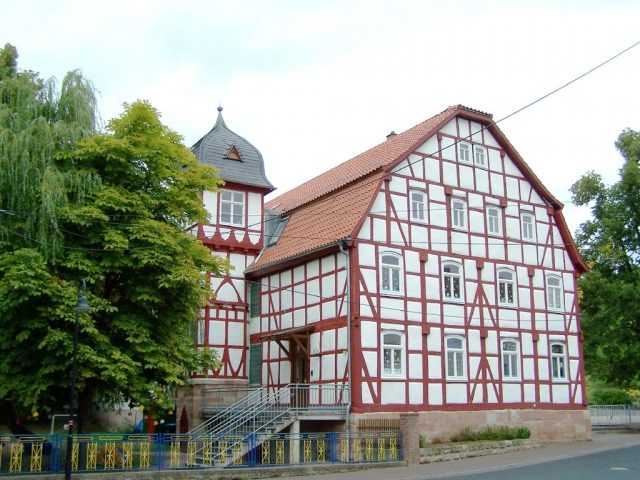
Dippach Castle is a listed building in the municipality of Dippach in the Wartburg district and is located on Schlossplatz in the eastern part of the village, near the church.
Dippach Castle was built as a four-winged courtyard complex in Franconian-Thuringian half-timbered style. The current four-story main building with the slate-covered stair tower extension projecting into the courtyard forms the remainder of the overall complex, which was gradually demolished and finally damaged by a fire in 1927. Since the GDR era, the castle has been used as a municipal administration and, under public ownership, also as a school, daycare center, and after-school care facility. The entire complex was originally secured by a protective surrounding wall, and the castle covered the main access to the village. The outbuildings, barns, and stables served functions required for the estate's operation. A short distance from the castle is the village church, which still displays an epitaph stone from the time of the Boyneburg patronage family. In the inner courtyard, a family coat of arms of the Vultejus family serves as a decorative detail on the facade.
The history of the castle is closely linked to that of the village: in 1226, Dippach belonged to the knights of Heisenbach, later to the lords of Linsingen. During the Peasants' War, the neighboring monasteries of Frauensee and Kreuzberg were stormed by the rebellious peasants of the Werra valley. Subsequently, the Werra group also gave the local nobility the choice of joining them or being dispossessed. Only cities like Hersfeld or Eisenach were able to withstand the overwhelming force at that time. After the defeat at Frankenhausen, the Hessian Landgrave Philipp I also held court over the villages in the Gerstungen and Vacha area. High penalty orders were issued, and even the lower landed gentry had to "pay" for their involvement in the Peasants' War. Some of the impoverished noble families thus lost their possessions. As evidenced by the rich stock of ornate half-timbered houses in the historic village, a better time began in the late 16th century. During this phase, the current castle building was also erected on a massive basement made of local red sandstone. Between 1660 and 1715, a branch of the von Boyneburg family acquired it, from whom the von Vultejus family acquired it before 1723. The village initially belonged to the Amt Hausbreitenbach for centuries, then to Friedewald. Only in 1816 did Dippach become part of the Duchy of Saxe-Weimar.
As a temporary measure, rooms in the castle were used for the school in 1914. A major fire in 1927 destroyed the outbuildings of the castle estate. This was converted into a school from 1930 to 1933. Since the early 1990s, the daycare center has also been housed in a part of the building. The last renovation of the castle began in 2009.
Take Mobile History with you
You are reading this text for free. Premium adds what matters on the road: descriptions read aloud, sites found through your camera, whole regions taken offline.
- Every description, including the ~17,700 Premium sites
- Audio guide: have descriptions read to you on location
- AR finder: see sites through your camera, with distance and bearing
- Unlimited saved sites
14 days free, then from €2.99 a month. Cancel anytime.
Source: Wikipedia · Licence: CC BY-SA 4.0 · Image: http://de.wikipedia.org/wiki/Datei:WAK_DIPPACH_SCHLOSS.jpg
This description draws on the facts documented in the linked Wikipedia article; Wikipedia content is licensed under CC BY-SA 4.0. Wording and editing: Mobile History.
Location: 50.9196, 10.0462