School
CastleHochstetten - Dhaun
Dhaun Castle
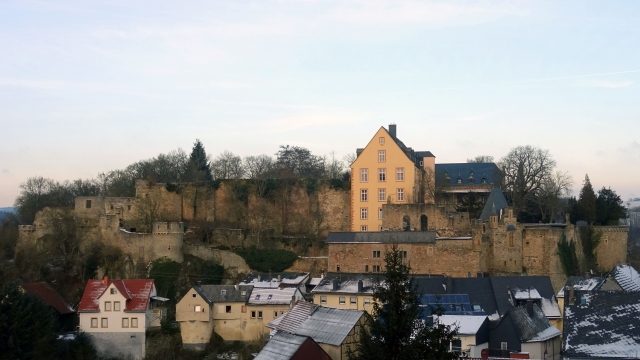
Dhaun Castle is a castle ruin in the Hunsrück region, located in the municipality of Hochstetten-Dhaun. The castle and the district are situated high above the Kellenbach Valley. It is considered the largest complex of its kind in the Nahe Valley.
Built in the 12th century as a castle by the Counts of Nahegau, it was first documented in 1215 as "castrum de Dune" (the castle on the height) and was a fief of the Imperial Abbey of St. Maximin in Trier. In the Middle Ages, the complex protected the territory of the Wildgraves, the successors of the Counts of Nahegau.
In 1340, the castle was besieged during the so-called "Dhaun Feud" by troops of Archbishop Balduin of Trier. He was in dispute with the lord of the castle, Johann I of Dhaun, over the Schmidtburg. The Archbishop of Trier won the feud. Johann ultimately had to grant him the right of access to Dhaun Castle. In connection with the "Dhaun Feud," a veritable ring of castles was formed, which included the outer bailey Brunkenstein, the castles Rotenberg and Martinstein, the siege position Geiersley, and the castle on Johannisberg.
Johann I died in 1350 without leaving male heirs, and so the complex passed to his nephew, Rhinegrave Johann II vom Stein, a son of Johann's sister Hedwig. With him began the long era of the Wild- and Rhinegraves of Dhaun.
In the 15th and 16th centuries, the castle was further expanded and fortified. The barbican of the upper castle, built in 1526, dates from that period. The still-preserved three-story underground system of passages and chambers also dates to these centuries. The passages lead to an exit at the foot of the castle, in its neck ditch.
In 1729, the transformation of the former castle into a baroque palace was completed under Wild- and Rhinegrave Karl von Dhaun and his wife Luise, née Countess von Nassau-Saarbrücken. The palas in the west was converted into a residential palace, to which a multi-story wing was added on the south side. Together with a slightly older building in the north, the complex thus acquired a horseshoe-shaped floor plan. The wide circle of the upper castle became a palace park with a coach house. However, Count Karl could not enjoy his converted property for long, as he died in 1733, only four years after the completion of the construction work.
A year later, the castle complex was threatened with destruction during the War of the Polish Succession, and thus a similar fate to the neighboring Kyrburg, but Karl's widow Luise managed to prevent this.
In 1794, French revolutionary troops conquered the Nahe region and with it Dhaun Castle. It was transferred to French state ownership and its remains were auctioned for demolition in 1804. Thus, for about 1200 francs, it came into the possession of Andreas van Recum, the sub-prefect of the Simmern arrondissement, who was in French administrative service and had all usable building parts brought to Kauzenburg in Bad Kreuznach.
The further decay of the ruin was only stopped in the 19th century, when in 1850 a doctor from Trier acquired part of the complex and began with repairs. His construction measures were characterized by romanticized ideas of castles and had little to do with medieval reality. The current building elements at the castle's entrance gate date from this period.
Further changes of ownership followed until, around the turn of the 19th to the 20th century, the Kirn manufacturer Simon acquired Dhaun Castle and carried out various redesigns and renovations in the upper castle.
For example, he had the present Knights' Hall built in place of the ruin of the north wing, using still-preserved building parts. Its old entrance and the family crest of the builders from the 16th century are still recognizable. The Simons also acquired the figure of Prometheus, which the Kreuznach sculptor Robert Cauer the Elder had created in Rome in 1888.
From the Simons, the castle passed in 1954 to the "Zweckverband Schloss Dhaun" (Special Purpose Association Dhaun Castle), which was formed by the city of Kirn, the then Amt Kirn-Land, and the district of Bad Kreuznach. It is still the owner of the castle today.
The Castle Today+
Of the medieval castle complex, ruins of the St. George's Chapel, consecrated in 1661, and the kitchen house, as well as two bastions and the curtain wall with defensive towers and gate system, are preserved in the area of the upper castle.
In the west wing, the former palas, the entrance portal is preserved. The building was rebuilt by the Special Purpose Association and has housed the "Heim-Volkshochschule Schloss Dhaun" (Residential Adult Education Center Dhaun Castle), a youth and adult education institution, since 1957, whose long-time pedagogical director was Werner Vogt. Since 1991, the Kommunalakademie Rheinland-Pfalz (Municipal Academy Rhineland-Palatinate) has also been located in the castle.
In the outer bailey/lower castle, the district of Bad Kreuznach maintains a youth education center in place of the guardhouse, and the Knights' Hall is available for festivities.
Take Mobile History with you
You are reading this text for free. Premium adds what matters on the road: descriptions read aloud, sites found through your camera, whole regions taken offline.
- Every description, including the ~17,700 Premium sites
- Audio guide: have descriptions read to you on location
- AR finder: see sites through your camera, with distance and bearing
- Unlimited saved sites
14 days free, then from €2.99 a month. Cancel anytime.
Source: Wikipedia · Licence: CC BY-SA 4.0 · Image: Jörg Heldt
This description draws on the facts documented in the linked Wikipedia article; Wikipedia content is licensed under CC BY-SA 4.0. Wording and editing: Mobile History.
Location: 49.8161, 7.4999