Museum
CastleKoblenz-Altstadt
Deutschordenskommende Castle
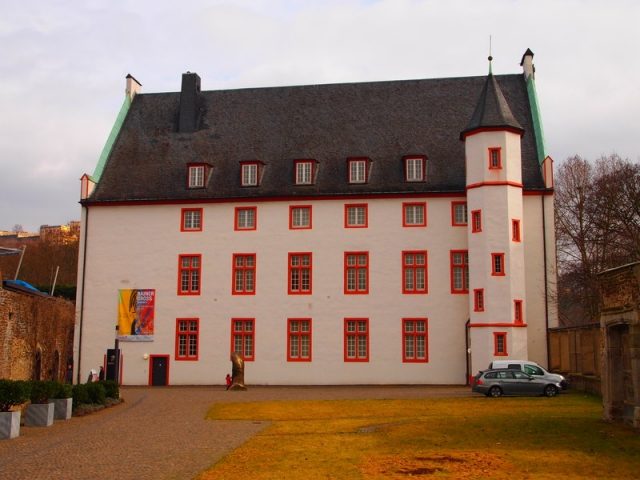
The Deutschordenskommende Koblenz was a branch (Kommende) of the Teutonic Order at the confluence of the Moselle and Rhine in Koblenz, which rose to become a Kammerballei in the 15th century. The complex, only partially preserved, is now located between the Kaiser Wilhelm I Monument and the Basilica of St. Castor. The Rhine building, now called Deutschherrenhaus, houses the Ludwig Museum.
The Deutschordenskommende in Koblenz was the first branch of the Teutonic Order in the Rhineland and was one of the most important locations in the west. Archbishop Theoderich von Wied called the Knights of the Teutonic Order to Koblenz in 1216 and donated to them a part of the grounds of St. Castor's Church, including the St. Nicholas Hospital located there. A motivation for the settlement of the Order was its suitability for nursing the sick.
Immediately at the corner where the Moselle flows into the Rhine, a Teutonic Order settlement soon emerged. In the mid-13th century, the importance of the knightly order in the city grew strongly, and the Order's complex was further expanded with the support of the Archbishops of Trier. Since this settlement of the Teutonic Order, this site was initially called "Deutscher Ordt" and then "Deutsches Eck". With the construction of the Kaiser Wilhelm I Monument in 1897, the name "Deutsches Eck" shifted from the grounds of the Teutonic Order settlement to the area of the monument.
In the 15th century, the importance of the Teutonic Order settlement continued to increase, as it became the seat of one of four Kammerballeien, which were directly subordinate to the Grand Master of the Order. The Ballei Koblenz possessed widely scattered landholdings, since 1263 also the village and church in Elsen in today's Rhein-Kreis Neuss. Elsen was the only immediate imperial territory owned by the Kammerballei Koblenz. This gave the Landkomtur a say in the organs of the Holy Roman Empire of the German Nation. Countess Mechthild, widow of Count Heinrich III. von Sayn (1202–1246), bequeathed the already existing parish of Waldbreitbach (Neuwied district) to the Teutonic Order after her husband's death. After 1313, the Kommende Breitbach came under the jurisdiction of the Komtur zu Horneck (on the Neckar). Until its dissolution in 1803, the parish then remained with the Ballei Koblenz.
Around 1600, the Landkomtur of the Ballei Koblenz moved his seat to Cologne to the Kommende St. Katharina, which had existed there since 1218. In 1619, Morsbroich Castle came into the possession of the Teutonic Order, which after 1794 became the sole seat of the Landkomtur.
After French revolutionary troops conquered Koblenz in 1794, the left bank of the Rhine was fundamentally reorganized by the French. The onset of secularization from 1802 meant the end of ecclesiastical rule and also the end for the Deutschordenskommende in Koblenz. It was dissolved in 1809 and sold into private ownership. After the French period and with the construction of the Prussian fortress of Koblenz, the buildings of the Deutschordenskommende housed the provisions magazine from 1821. In the course of the new construction of the city fortifications, the still existing casemate building, which bears the cross of the Teutonic Order, was built at the mouth of the Moselle in front of the Rhine building.
From 1897 to 1941, the former complex of the Teutonic Order housed the Prussian State Archives Koblenz. In World War II, the complex was largely destroyed during the air raids on Koblenz in 1944. Afterwards, only the Rhine building was rebuilt and used by the road administration. The city of Koblenz bought the building from the state of Rhineland-Palatinate in 1988 and converted it into the Ludwig Museum from 1990 to 1992. In 2002, a modern building was erected on the ruins of the former archive servant's house. During the preparations for the Bundesgartenschau 2011, the area is part of the core area "Blumenhof am Deutschen Eck", further evidence of the knightly order was uncovered and secured.
Buildings+
The area of the Deutschordenskommende consisted of a main building, the Rhine building (erected in 1279) and several outbuildings, which were grouped in a horseshoe shape around a courtyard that was open to the south. In addition, there was an Order church attached to the west building, which was consecrated in 1306 and demolished in 1811.
As a result of the destruction after the air raids on Koblenz in 1944 and the subsequent demolition work, only parts of the residential and courtyard buildings have been preserved. The east wing (formerly the Komtur's residence) on the Rhine side was rebuilt. This is a three-story rectangular building with a polygonal stair tower at the southwest corner and steep stepped gables. The hall on the ground floor had been altered in the Baroque period and reconstructed at the end of the 19th century; after the destruction of World War II, the interiors were modernized. Two vaulted ground-floor halls supported by columns still exist from the west wing. The south wall of the demolished Teutonic Order church with magnificent vault consoles still exists. To its south, a small Gothic chapel (built 1354/1355) was attached, which was destroyed in World War II. The ruin, parts of the outer walls, still showed traces of wall paintings in the 1960s, but these almost completely weathered away because no protective measures were carried out. The portal in the western boundary wall leading to the Basilica of St. Castor comes from the former orphanage, which had been built under Elector Franz Ludwig von der Pfalz. The Blumenhof is located behind the main building and is now a garden.
Kommenden of the Kammerballei Koblenz+
The following Kommenden were subordinate to the Kammerballei Koblenz:
- Kommende Koblenz (headquarters)
- Kommende Beeck
- Kommende Berk
- Kommende Dieren
- Kommende Ibersheim, (approx. 1250 until sale in 1465)
- Kommende Judenrode (Gürath), later: Kommende Elsen
- Kommende Köln (St. Katharina)
- Kommende Muffendorf, (Bonn-Bad Godesberg)
- Kommende Pitsenburg (Mechelen)
- Kommende Rheinberg, Wesel
- Kommende Vier Ambachten (1235-1241)
- Kommende Waldbreitbach (since 1602)
Ludwig Museum+
The Ludwig Museum is the fifth art collection initiated by the collector couple Peter and Irene Ludwig in Germany and was opened on September 18, 1992, with the exhibition "Atelier de France". The museum's focus on 20th-century French art, primarily developments after 1945 up to current positions, is unique in Germany.
In addition to its exhibition rooms on four floors, the Ludwig Museum also uses the adjacent "Blumenhof", which offers itself as an exhibition space for striking three-dimensional works. The museum's holdings here include "Le Pouce" by César and the installation "Site of Memory and Forgetting" by Anne and Patrick Poirier, who developed this work specifically for this location for the museum's founding.
Take Mobile History with you
You are reading this text for free. Premium adds what matters on the road: descriptions read aloud, sites found through your camera, whole regions taken offline.
- Every description, including the ~17,700 Premium sites
- Audio guide: have descriptions read to you on location
- AR finder: see sites through your camera, with distance and bearing
- Unlimited saved sites
14 days free, then from €2.99 a month. Cancel anytime.
Source: Wikipedia · Licence: CC BY-SA 4.0 · Image: http://www.wehrbauten.de/thread.php?threadid=614
This description draws on the facts documented in the linked Wikipedia article; Wikipedia content is licensed under CC BY-SA 4.0. Wording and editing: Mobile History.
Location: 50.3628, 7.6050