Educational Institution
CastleFürstenberg
Dahmshöhe Castle (Fürstenberg)
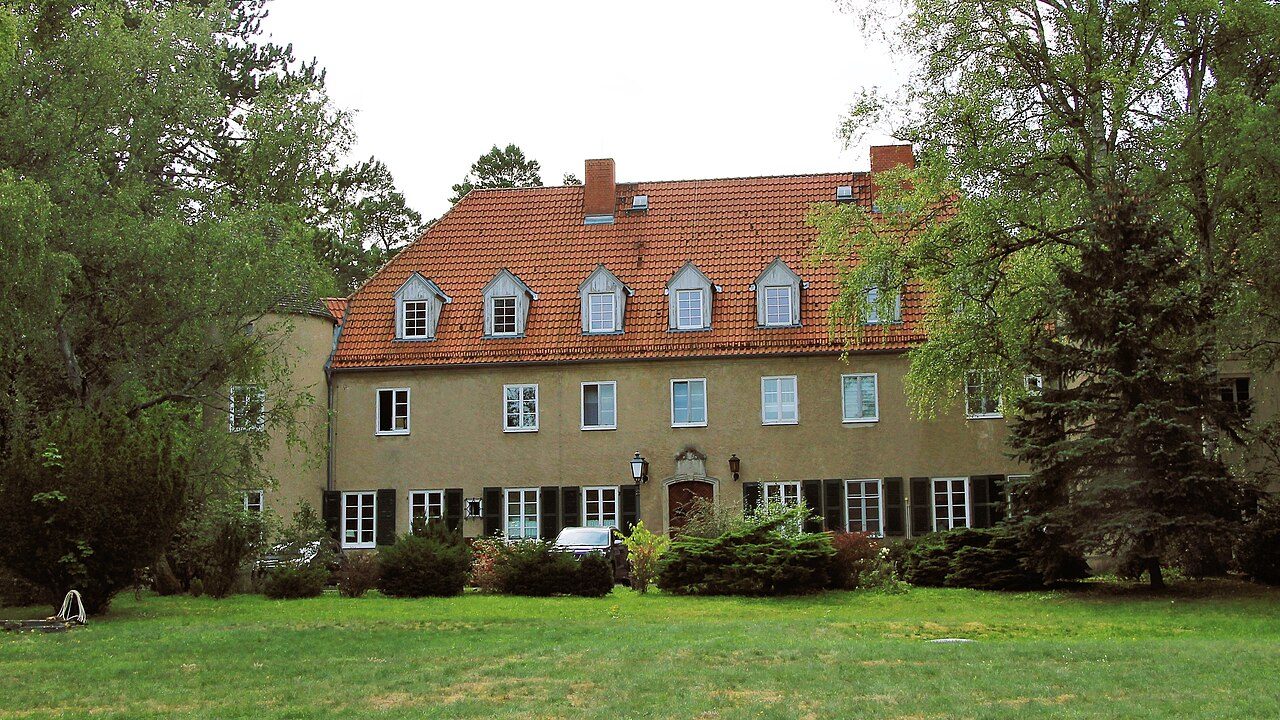
The manor house Schloss Dahmshöhe (also known as Waldschlösschen) is located about eight kilometers north of the town of Fürstenberg/Havel near the district of Altthymen.
In 1929, the Berlin banker and art collector Siegfried Bieber acquired the 235-hectare Dahmshöhe estate near Altthymen from Privy Councillor Richard Weber from Berlin. By far the largest part of the area then, as now, consisted of forest, 30 hectares were designated as arable land, 40 hectares as grassland. The livestock consisted of 5 horses and 22 cattle.
Bieber had an exclusive country estate built at some distance from the old estate complex with its simple farm buildings. He entrusted Paul Schultze-Naumburg with this task, who was then one of the most renowned architects in Germany. Since Schultze-Naumburg primarily designed representative villas and manor houses, clients from the circles of the Jewish upper middle class were also among his customers. After the First World War, however, Schultze-Naumburg had increasingly moved towards racist and anti-Semitic positions. In 1928, his book "Art and Race" was published, and two years later he became a member of the NSDAP. Siegfried Bieber cannot have been unaware of these views of his architect, which apparently, in his eyes, took a back seat to their shared preference for traditional, landscape-integrated building.
When Siegfried Bieber moved into the new house in 1930, he was 57 years old and at the peak of his professional career. He and his wife Josephine were dedicated art collectors. Their interest was particularly in 17th-century Dutch painting. The rooms in Schloss Dahmshöhe are also likely to have housed part of their art collection. Siegfried Bieber had the 56,000 m² park laid out according to his own detailed plans. In addition, there was a botanical garden with a small tropical house.
In 1939, Bieber, who had fled to Switzerland with his wife in 1935, was forced to sell Dahmshöhe to Nazi sympathizers. A little later, prisoners from the Ravensbrück women's concentration camp, among others, built a barracks camp for the cavalry division of the Waffen-SS on the estate.
After 1945, the barracks were used as emergency shelters for the liberated prisoners of the former concentration camp and for refugees from the German eastern territories.
From 1947 to 1990, the castle was a children's sanatorium, where, among other things, recuperation cures were offered, and children and adolescents suffering from cystic fibrosis were treated.
Currently, the castle houses the education and meeting center of the Lebenshilfe Landesverband Brandenburg e.V. As an open house of encounter, people with and without disabilities can spend their time here today.
Take Mobile History with you
You are reading this text for free. Premium adds what matters on the road: descriptions read aloud, sites found through your camera, whole regions taken offline.
- Every description, including the ~17,700 Premium sites
- Audio guide: have descriptions read to you on location
- AR finder: see sites through your camera, with distance and bearing
- Unlimited saved sites
14 days free, then from €2.99 a month. Cancel anytime.
Source: Wikipedia · Licence: CC BY-SA 4.0 · Image: S. John, Elsterwerda / CC BY-SA 4.0 via Wikimedia Commons
This description draws on the facts documented in the linked Wikipedia article; Wikipedia content is licensed under CC BY-SA 4.0. Wording and editing: Mobile History.
Location: 53.2296, 13.1381