To be privately owned
CastleCressier
Cressier Castle
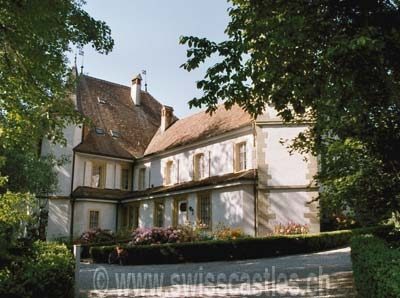
Cressier was formerly a small lordship, extending over the territory of the current municipality of the same name for approximately 8 km southeast of Murten. The family of the Lords of Cressier, confirmed in the 12th century, died out as early as the 14th century. After a marriage, the lordship became the property of the Bubenbergs of Bern, who had to cede it to the Lombard bankers established in Murten, named Asinari. In 1403, the indebted family had to sell their estate.
A series of transfers - the sources speak of Willi Praroman and Jean Folli, the Oguey of Freiburg - led the castle into the hands of the family of Pancraz Python and his wife Helena von Reynold in the 17th century. In 1661, their only daughter, Elisabeth Python, married Ferdinand von Diesbach. He died in 1696, without descendants. In 1708, the widow of Diesbach bequeathed it to Francois von Reynold Cressier, whose descendants managed the property until 1980. The most famous member of the family was the historian and writer Gonzague von Reynold, who even wrote a number of his works here.
The castle stands on the site of the old fortress of the lords of Cressier, as evidenced by the remains of a watchtower. Its current appearance was given to it around 1665, when Ferdinand von Diesbach had the old building renovated. Around 1780, the manor house to the west received a lower wing, a conversion comparable to that experienced by the slightly older country residence of Balliswil. The similarities do not end there, as the architectural similarities, in particular, are visible at first glance.
As in Balliswil, we discover richly painted rooms inside the castle. The hall on the ground floor shows allegorical figures under a series of Corinthian columns. The large salon is uniformly decorated with grey ornaments painted on lime. It is a holistic play of frames, in which pilasters, leaf crowns and garlands mix, emphasizing the contours of the panels with trophies, vases, cornucopias and busts. Even the chimney was painted: it bears the date 1691. A few years earlier, the small salon received its wall decoration, assuming that the paintings date from the same time as the stove, which was dated 1665. On the walls, surrounded by a universe of ornaments and fabulous creatures, it is an extensive display of images, of parks and castles in courtly decor, interrupted by a depiction of a naval battle, below which one recognizes the portrait of the Diesbach couple on the door. On the ceiling, the boards reflect the hermetic world of baroque emblems. The arcature and the frieze, which extend to the base of the stove, are much older and date back to the beginning of the century.
Take Mobile History with you
You are reading this text for free. Premium adds what matters on the road: descriptions read aloud, sites found through your camera, whole regions taken offline.
- Every description, including the ~17,700 Premium sites
- Audio guide: have descriptions read to you on location
- AR finder: see sites through your camera, with distance and bearing
- Unlimited saved sites
14 days free, then from €2.99 a month. Cancel anytime.
Source: Wikipedia · Licence: CC BY-SA 4.0
This description draws on the facts documented in the linked Wikipedia article; Wikipedia content is licensed under CC BY-SA 4.0. Wording and editing: Mobile History.
Location: 46.8987, 7.1397