Museum
CastleChemnitz - Schloßchemnitz
Chemnitz Castle
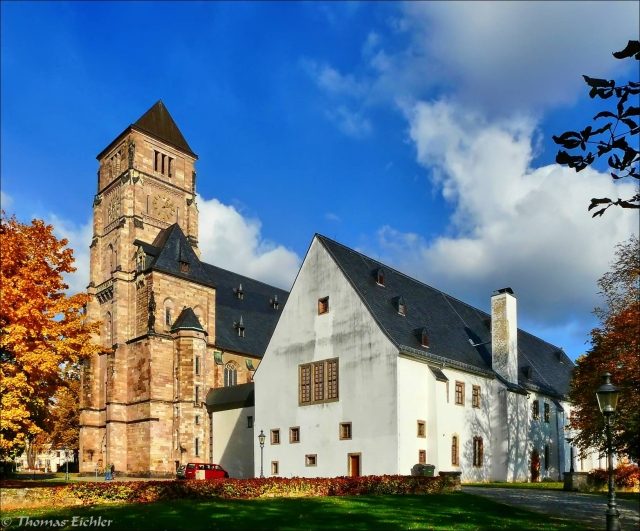
The Schloßbergmuseum is the museum of urban history for the city of Chemnitz. It is located in the Schloßchemnitz district on the grounds of an old Benedictine monastery, which Emperor Lothar III had built around 1136 on a hill near the Chemnitz river.
The monastery "St. Marien" existed for almost 400 years and was repeatedly rebuilt. The last renovation in the late Gothic style took place under the penultimate abbot Heinrich von Schleinitz between 1488 and 1522. The monastery was dissolved as one of the consequences of the Reformation. Around 1540, the Benedictines left the building, which fell to the Saxon Elector. Under Moritz, extensive renovations were again initiated, and the building became a regional administration and hunting lodge.
At the beginning of the 18th century, the buildings passed into private ownership. Due to its attractive location, it developed into a popular excursion destination with a beer garden and bowling alleys.
In 1928, after extensive restorations, the city of Chemnitz handed over the castle to the "Verein für Chemnitzer Geschichte" (Association for Chemnitz History), founded in 1872, as an exhibition venue for the association's collection. In 1931, the new city museum was opened.
In 1945, the Schloßkirche suffered bomb damage to its neo-Gothic spire, roof, and north facade. Damage repair and a simplified tower completion took place from 1946 to 1949, and the interior was restored from 1950 to 1957. All other facilities survived World War II almost undamaged, but were closed in 1979 due to outstanding renovation work.
It was not until 1995 that the Chemnitz City Museum reopened its doors.
Selected Exhibits+
Holy Sepulchre
Holy Sepulchres are cenotaphs of Christ. In the Schloßbergmuseum Chemnitz, there is a Holy Sepulchre from the city church of St. Jakobi, which is modeled after a Gothic cathedral. It was made around 1500 for the Jakobikirche. On it stand fully sculpted figures on consoles: Joseph of Arimathea, Nicodemus, Mary, her sister Mary Cleopas, Mary Magdalene, and the two apostles John the Evangelist and Peter. The figures on the corner consoles are not preserved. Also missing is the body of Christ, which was equipped with movable arms and legs so that it could be symbolically crucified, taken down from the cross, and buried. This was probably originally mobile and could be moved from its location, presumably in one of the side rooms, into the main church space for the Holy Week liturgy.
Epitaph of Captain Peter Pfefferkorn
Peter Pfefferkorn was a captain active in the mid-16th century, who was ennobled by Emperor Charles V for his services in the Turkish Wars. His epitaph is one of the art-historically significant Renaissance sculptures in the Free State of Saxony. It is made of Chemnitz porphyry tuff and shows Pfefferkorn in a full-figure relief as a field captain. The slab is 180 cm high, 97 cm wide, and 22 cm deep. Pfefferkorn is depicted as a self-confident, bearded, old man in armor. At his feet, on the bottom right, stands the removed visor helmet with a plume. The figure emerges from a round arch executed in relief with Renaissance ornamentation. The left hand reaches for the dagger hilt, the right rests on the sword pommel. At the top left of the "portal" is the coat of arms of the deceased, which shows an eagle, crescent moon, and three stars with a crest, thus referring to his elevation to the nobility.
The work is comparable in its urban and art-historical significance to the slab of Mayor Matthes Arnold. Here, too, the good quality of the sculpture, which points to an above-average sculptor, should be emphasized. Stylistic comparisons can be made with the tomb slab of Thomas Pflugk in the Laurentiuskirche in Pegau and that of Andreas Pflugk in Knauthain, which also shows a full-figure "knight" with a visor helmet at his feet. Art historical research therefore mostly attributes the work to the Saxon court sculptor and master builder Paul Speck.
Take Mobile History with you
You are reading this text for free. Premium adds what matters on the road: descriptions read aloud, sites found through your camera, whole regions taken offline.
- Every description, including the ~17,700 Premium sites
- Audio guide: have descriptions read to you on location
- AR finder: see sites through your camera, with distance and bearing
- Unlimited saved sites
14 days free, then from €2.99 a month. Cancel anytime.
Source: Wikipedia · Licence: CC BY-SA 4.0 · Image: Thomas Eichler
This description draws on the facts documented in the linked Wikipedia article; Wikipedia content is licensed under CC BY-SA 4.0. Wording and editing: Mobile History.
Location: 50.8452, 12.9150