To be privately owned
CastleButtenheim
Buttenheim Castle
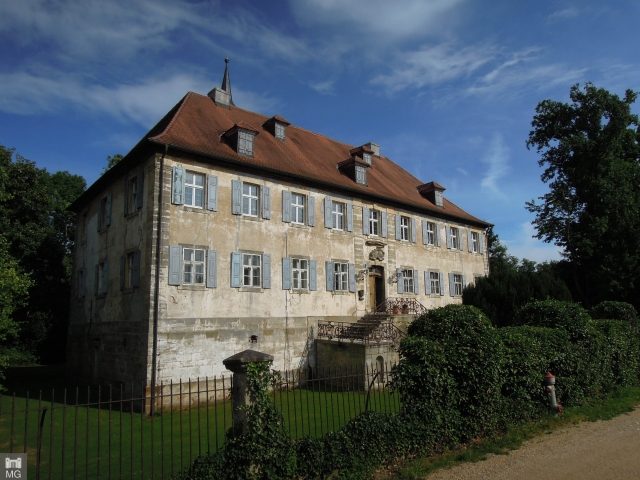
In Buttenheim, two castles were once to be found: the Oberes Schloss (“Upper Castle”, also called Deichselburg) and the Unteres Schloss (“Lower Castle”). Both were owned by the Imperial Barons of Stiebar, who further owned three others in Aisch, Pretzfeld and Ermreuth. The Stiebar noble family can be traced back to 1253 and belonged to the former knighthood of the canton of Gebürg, which was under direct Imperial authority, and which stretched among Kronach, Nuremberg, Buttenheim and Kulmbach. This noble family put many abbesses, Teutonic Knights and capitulars in the High Monasteries of Bamberg and Würzburg. Between 1377 and 1560, at least fourteen members of this family were capitulars in the High Monasteries of Bamberg and Würzburg.
The Oberes Schloss (square with wall and four corner towers) was burnt down during the German Peasants' War in 1525 and never built again.
The castle that still stands today in Buttenheim is the so-called Unteres Schloss, which originally served the von Lichtenstein family as a bower, was taken over by the Stiebars, along with other pieces of real estate in Buttenheim in 1438.
The Stiebars had at their disposal in Buttenheim at that time jurisdiction over life and death, having inherited this from the von Schlüsselbergs. Under the Stiebars’ ownership, the Lower Castle was burnt down several times: in 1492 in “bloody feud between Albrecht Stiebar the Younger and Prince-Bishop Heinrich III of Bamberg”, in 1525 by “rebellious people from out of town” and once again in 1561 through a castle servant’s carelessness when he went to bed, forgetting to put the light in his room out. Hans Joachim von Stiebar, who in 1574 was elected to the First Knightly Council (Erster Ritterrat) of the canton of Gebürg for the Bamberg and Forchheim area, thereby enjoying great prestige, repaired the damage.
The Stiebars embraced the Lutheran faith quite early on, as witnessed by, among other things, the appointment of an Evangelical preacher at Schloss Buttenheim, which was mentioned in a document as early as 1591.
In 1630, the Stiebars were stripped of their holdings at Imperial behest for having taken part in the Protestant Union’s struggles, putting Buttenheim, and thereby the Lower Castle, under Prince Georg Ludwig von Schwarzenberg’s ownership. The Stiebars, however, got their belongings back in 1648 under the Peace of Westphalia.
In 1741, the chapel, which still stands today, was built next to the rubble of the castle, which had been destroyed by war. The castle lords, however, had to live in a side building.
In 1762, with Imperial Baron Johann Georg Christoph Wilhelm von Stiebar’s death, this noble family’s main Franconian line died out. Their fiefdom went to the High Monasteries of Bamberg and Würzburg, and also partly back to the Duchy of Saxe-Coburg. Ownership stayed with the heirs, the widow and the daughters.
In 1761 the Kammerjunker (variously translated as “page” or “chamberlain”) Wilhelm Christian Friedrich von Seefried wed Elisabeth Sofie von Stiebar, whom he had come to know while he was a student of jurisprudence in Erlangen. A few years later, they moved to Buttenheim. Since the Lower Castle “...had been destroyed or wiped out by fire (down to) the mediaeval, massive, square tower topped with a mansard roof...”, Wilhelm Christian Friedrich von Seefried built the current Baroque castle in 1774 onto the one tower that still stood, and in which is still found the Evangelical castle chapel.
Wilhelm Christian saw to it that the Evangelical castle parish was newly confirmed. In 1790, Wilhelm Christian, who had set himself all his life to strengthening the Evangelical faith, was raised to the Imperial Barony. In 1814, a “Protestant castle parish” from the “Castle Chaplaincy” was consecrated, and on 27 August 1826, the castle chapel was consecrated as a communal House of God.
Even today, the castle chapel still serves the Buttenheim Evangelical parish, which since that time has been put in the care of the parish of Hirschaid, as a House of God.
Since Wilhelm Christian’s time, the castle has been occupied almost uninterruptedly by his descendants.
Take Mobile History with you
You are reading this text for free. Premium adds what matters on the road: descriptions read aloud, sites found through your camera, whole regions taken offline.
- Every description, including the ~17,700 Premium sites
- Audio guide: have descriptions read to you on location
- AR finder: see sites through your camera, with distance and bearing
- Unlimited saved sites
14 days free, then from €2.99 a month. Cancel anytime.
Source: Wikipedia · Licence: CC BY-SA 4.0 · Image: Mobile Geschichte
This description draws on the facts documented in the linked Wikipedia article; Wikipedia content is licensed under CC BY-SA 4.0. Wording and editing: Mobile History.
Location: 49.8007, 11.0306