Museum
CastleBurgtreswitz
Burgtreswitz Castle
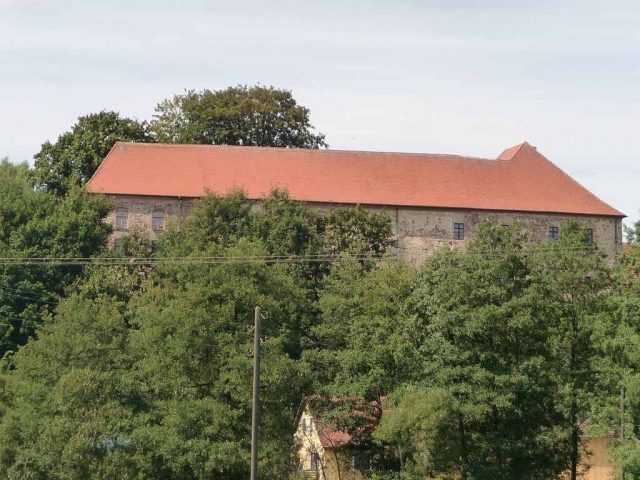
The locality of Burgtreswitz was first mentioned in a document in 1218 with the naming of the knight Pernoldus von Draeswitz as a ministerialis of the Counts of Ortenburg-Murach. Slavic activity is reported even before that, and the founding of the place is probably attributable to it. In 1272, the castle came into the possession of the Wittelsbachs; it was founded in the 12th century by the Sulzbachs. Before the Wittelsbachs, the knights of "Draeswitz" ruled in the 12th and 13th centuries. For the following 300 years, Treswitz was assigned to the "Palatinate by the Rhine". During this time, Treswitz was expanded into a mighty castle.
In 1304, Konrad II von Paulsdorf is named as the first administrator (Pfleger) in Burgtreswitz. The Treswitz office encompassed the areas around Moosbach, Eslarn, and Waidhaus. In 1410, Treswitz received lower jurisdiction, and in 1585, high jurisdiction. In 1594, the administrative offices of Treswitz and Tännesberg were merged, with its seat in Burgtreswitz. Only in 1628 did Treswitz become Bavarian again and consequently an electoral Bavarian administrative and judicial district.
During the Thirty Years' War, the castle was destroyed in 1634 by imperial troops. The reconstruction took place in several stages over decades. In 1690, the first Holy Mass was celebrated in the new castle chapel "Of the Immaculate Conception".
The Lichtenstern administrators brought a great boom to Treswitz in the 18th century with the creation of a district court as a highlight. The catchment area included the towns of Vohenstrauß, Moosbach, Pleystein, Eslarn, Waidhaus, Tännesberg, Waldthurn, and Leuchtenberg. In 1809, nearby Vohenstrauß became the seat of the court, and the importance of the village and the castle diminished.
From 1734 to 1735 and again from 1779 to 1786, renovations took place, during which the tower was demolished and a new gate vault was erected.
The Castle in its Current Form
In the mid-18th century, the economic properties belonging to the castle and the Treswitz office were sold. Despite some renovation work in 1786, the castle building visibly deteriorated. Frost and storm damage in 1786 and 1788 were only hastily repaired, in view of a possible later relocation of the office to Friedrichsburg in Vohenstrauß.
Between 1810 and 1813, the municipality of Burgtreswitz acquired the castle, but sold the northwest wing and the castle chapel to Prelate Magnus Singer. He took advantage of the situation and sold valuable inventory items from the church as well as his share.
In the following years, the building served as an agricultural enterprise, inn, and brewery; the new use also brought a new upswing:
The castle brewery supplied sixty inns in the surrounding area with beer; the cold stone cellar two floors below the castle was a location advantage and guaranteed consistently cool beer. In 1938, the Schön family business ceased brewing operations.
In 1942, the building experienced another change of ownership: the Berlin engineer Egon Krüger became the new lord of the castle. Finally, in 1983, the market town of Moosbach acquired the complex with 4867 square meters of land through the right of pre-emption for only 9000 Marks.
Unfortunately, this reflected the actual value: the roof was leaky, the roof truss severely damaged, and, like the walls, infested with rot and fungus.
Furthermore, the outer walls shifted downhill, so that the statics were no longer sound, and large parts of the castle had already collapsed or were at least endangered. To stop further decay, immediate securing work began.
The Support Association
A comprehensive renovation of the castle, with estimated costs of well over five million euros, was simply not feasible for municipal bodies. In 1985, with the help of the municipality of Moosbach, the support association was founded. To date, the members of the association have contributed more than 30,000 hours of unpaid work.
Its statutes list the following specific goals:
- Promotion of the preservation and restoration of the castle
- Preservation of public ownership
- Bringing the castle into cultural and local history use
- Intensification of historical research
- Awakening public interest in the concerns of the castle
The "construction team" of the support association is particularly noteworthy. Through their unpaid working hours, they have created the conditions that make the use of the castle possible today. The construction team cleared out the entire castle and the property. They built wooden walkways in the attic, installed stairs and new floors, put in new windows, renovated the tavern, painstakingly laid the granite paving in the gatehouse, built a toilet facility, created the museum rooms, and much more.
Through these efforts, the support association succeeded in bringing the castle back to life. Today it is considered the cultural center of the market town of Moosbach.
The association has also received various awards and honors:
- The "Förderverein Schloss Burgtreswitz e.V." was awarded the Culture Prize of the Neustadt a.d. Waldnaab district in 2006.
- In 2008, the Prime Minister's Badge of Honor for services in voluntary work was awarded to the construction team by the Neustadt District Administrator.
- On July 28, 2009, the support association was honored with the Monument Prize of the Hypo-Kulturstiftung.
The castle houses a local history museum, a hunting and fishing museum, and an information point for the Northern Upper Palatinate Forest Nature Park with a permanent exhibition. Since 1997, open-air theater has taken place annually at Burgtreswitz Castle.
Furthermore, numerous events have been established at the castle, including various festivals, historical markets, guided tours, and concerts of all kinds in the event calendar.
Take Mobile History with you
You are reading this text for free. Premium adds what matters on the road: descriptions read aloud, sites found through your camera, whole regions taken offline.
- Every description, including the ~17,700 Premium sites
- Audio guide: have descriptions read to you on location
- AR finder: see sites through your camera, with distance and bearing
- Unlimited saved sites
14 days free, then from €2.99 a month. Cancel anytime.
Source: Wikipedia · Licence: CC BY-SA 4.0
This description draws on the facts documented in the linked Wikipedia article; Wikipedia content is licensed under CC BY-SA 4.0. Wording and editing: Mobile History.
Location: 49.5946, 12.3901