To be privately owned
CastleBurgrain
Rurgrain Castle
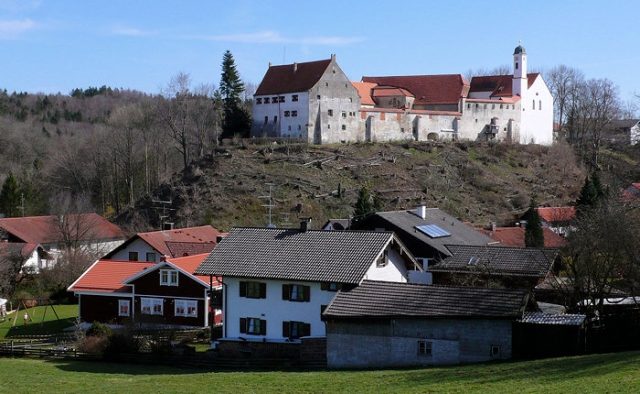
Burgrain Castle is a stately multi-winged castle building, once the seat of the Freising lordship, and is located on a projecting spur of land in the upper Isen valley, 2.5 km south of Isen in Upper Bavaria.
From 784 to 811, a first fortress was built under Bishop Atto of Freising, which was occupied from 1140 to 1290 by the Lords of Burgrain, Freising ministerials. Around 1200, the "current" medieval castle complex was built, a four-winged complex with a free-standing keep and neck ditch, as well as other outworks. In 1227, the castle became the princely-Freising burgrave's seat of the Burgrain lordship. In the conflict with the Counts of Haag, the castle was captured in 1317. In the first half of the 15th century, extensive additions and alterations were made under Bishop Nikodemus, creating the Prince's Wing with a large hall. In 1639, there was a fire in the castle, and as a result, further alterations were made. Prince-Bishop Johann Franz Eckher von Kapfing had the large castle church of St. George built in 1723. Due to secularization, the castle was auctioned off in 1804 and subsequently had several owners, during which the keep was reduced by about 40%. A castle owner had a brewery installed in the west wing at the end of the 19th century. In 1906, the building was converted into a home for the blind. Since 1919, it has been used again as a private residence, and the west wing has since been removed down to the outer walls.
Description+
Burgrain Castle is an elongated three-winged castle building on a spur, on a castle hill steeply sloping to the northwest (40 m above the Isen). In the middle of the south wing stands the roof-high keep with 250 cm thick walls (Nagelfluhquader cladding). The east wing is a long, narrow three-story residential tract. To the north is the 28 m long Prince's Building. Up to the 1st floor ceiling height, the outer wall of the west wing is still present, to form a closed trapezoidal inner courtyard (54.5 × 37.5 m). At the southwest corner is the castle church of St. George (internal length 19 m).
Castle Church of St. George
The floor level of the church is on the first floor, as there is an early Gothic crypt below it; a staircase leads from the inner courtyard up to the church entrance. On the outside, a Rococo roof turret sits at the church's northwest corner. The interior of the three-bay nave and the strongly recessed choir (2-bay, semicircular end) are richly decorated with delicate Rococo stucco. The ceiling painting in the nave depicts Maria Immaculata. In the right side altar painting (Johann Caspar Sing, 1723), one can see the canonized Empress Kunigunde walking over glowing plowshares in an ordeal. This is said to have happened in Burgrain. The painting of the high altar, which occupies the entire width of the choir, depicts St. George on horseback, also by J. C. Sing.
Take Mobile History with you
You are reading this text for free. Premium adds what matters on the road: descriptions read aloud, sites found through your camera, whole regions taken offline.
- Every description, including the ~17,700 Premium sites
- Audio guide: have descriptions read to you on location
- AR finder: see sites through your camera, with distance and bearing
- Unlimited saved sites
14 days free, then from €2.99 a month. Cancel anytime.
Source: Wikipedia · Licence: CC BY-SA 4.0
This description draws on the facts documented in the linked Wikipedia article; Wikipedia content is licensed under CC BY-SA 4.0. Wording and editing: Mobile History.
Location: 48.1880, 12.0490