Museum
CastleFreital - Burgk
Burgk Castle
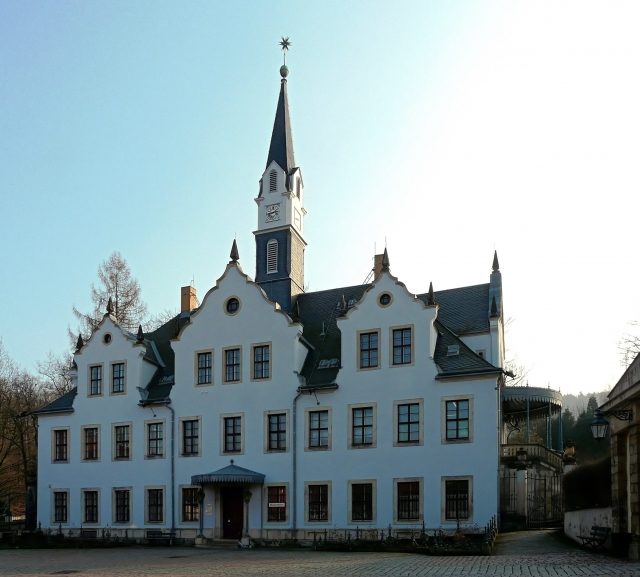
Burgk Castle is a former manor house in the Burgk district of Freital in Saxony. Today it houses the Freital City Museum "Haus der Heimat" with the "Freital Municipal Collections". The castle is located at the foot of the Windberg on the edge of the Döhlen Basin in the Großburgk district and is a protected monument.
Based on confirmed building findings of the castle, parts of the ground floor and the cellar vaults can be dated to the Renaissance period. The noble family von Zeutsch(en) acquired the castle and exercised judicial rule in Großburgk from 1507 to 1742. On June 26, 1707, the entire manor burned down, but was rebuilt in 1708 and 1709 by Caspar Heinrich von Zeutzschen. Afterwards, a Dresden senator bought the manor due to the rich coal deposits in the region. Coal mining in Burgk has been documented since the 16th century. The manor house and the surrounding buildings were rebuilt around 1800. The Freiherrlich von Burgker Steinkohlen- und Eisenhüttenwerke (Baronial Burgk Coal and Ironworks), founded in 1819 under the direction of Carl Friedrich August Freiherr Dathe von Burgk, who had acquired the manor including its associated coal shafts, led to a modernization and expansion of coal mining in the Döhlen Basin. The coal mines were based at Burgk Castle until the company's bankruptcy in 1930.
After the founding of Freital in 1921, the city parliament decided in 1923 to establish a museum. The painter Karl Hanusch was involved in the establishment of the museum. After the museum's location changed several times, the premises of Burgk Castle were occupied in 1946 after the end of World War II. Previously, the estate had been expropriated as a result of the land reform in the Soviet occupation zone.
Current Use+
The "Freital Municipal Collections" contain information on the city's history and life at Burgk Castle, as well as the Municipal Art Collections, which document art developments in the Dresden region between 1890 and 1950. Part of the collection includes nine classical paintings by Otto Dix, as well as works by artists Willy Kriegel, Wilhelm Lachnit, Wilhelm Rudolph, Pol Cassel, Otto Lange, Curt Querner, Christoph Voll, and Ewald Schönberg. The long-time director of the city museum and art collections was Hellmuth Heinz, who donated his private art collection to the city before his death. Since 1993, Friedrich Pappermann's art collection has been housed in the castle, which the Dresden artist donated to the museum in 1993 and for which he received honorary citizenship of Freital in 1994.
From the castle park, it is possible to enter the "Tagesstrecke Oberes Revier Burgk" visitor mine. An associated exhibition on mining in the Plauen Ground features, among other things, "Dorothea", the world's first electrically operated mine train. It was built in 1882 by Siemens & Halske for the Oppelschacht in Zauckerode. The mining exhibition includes a technology garden that displays the equipment required for mining in the immediate post-war period.
Burgk Castle can be used as a conference and event center; for example, there is the "Steigersaal" with space for about 100 people and the smaller "Knappensaal" for about 50 people. There is a wedding hall for weddings at Burgk Castle. In August, the "Burgker Schlossnacht" takes place in the castle courtyard, and at Easter, the "Burgker Mittelalterspektakel" (Burgk Medieval Spectacle). During Advent, there is a Christmas market on the castle grounds.
Castle Park+
The castle park, with a small pond surrounded by larches, plane trees, and ginkgo trees, is located south and east of the manor house. The mouth of the current visitor mine is also located in the castle park. In addition to many sculptures, the Rotkopf-Görg-Denkmal (Red-Head Görg Monument), inaugurated in 1861, is also located in Burgk Castle Park.
It is dedicated to the legendary figure Rotkopf Görg, to whom a mountain spirit is said to have appeared on the Windberg. This spirit asked Rotkopf Görg, a poor musician, to play for a dance in the mountain spirit's castle, hidden in the nearby Windberg. He agreed, and as a reward, the mountain spirit filled his hat with coal. Rotkopf Görg, however, did not know what to do with it and poured it out in front of his house. The next day, he noticed that a small lump of coal had gotten caught in his hat, which had turned to gold overnight. The other coals he had thrown away, however, had turned to ash.
In 1904, the monument was mentioned by Cornelius Gurlitt in the Descriptive Representation of the Older Architectural and Art Monuments of the Kingdom of Saxony as follows: A curious work [...] is the larger-than-life group of a minstrel and the gnome tempting him with money scattered into his hat.
Take Mobile History with you
You are reading this text for free. Premium adds what matters on the road: descriptions read aloud, sites found through your camera, whole regions taken offline.
- Every description, including the ~17,700 Premium sites
- Audio guide: have descriptions read to you on location
- AR finder: see sites through your camera, with distance and bearing
- Unlimited saved sites
14 days free, then from €2.99 a month. Cancel anytime.
Source: Wikipedia · Licence: CC BY-SA 4.0 · Image: Thomas Eichler
This description draws on the facts documented in the linked Wikipedia article; Wikipedia content is licensed under CC BY-SA 4.0. Wording and editing: Mobile History.
Location: 51.0034, 13.6692