City Archives with scientific library
City Library
Museum
CastleBurgfarrnbach
Burgfarrnbach Castle
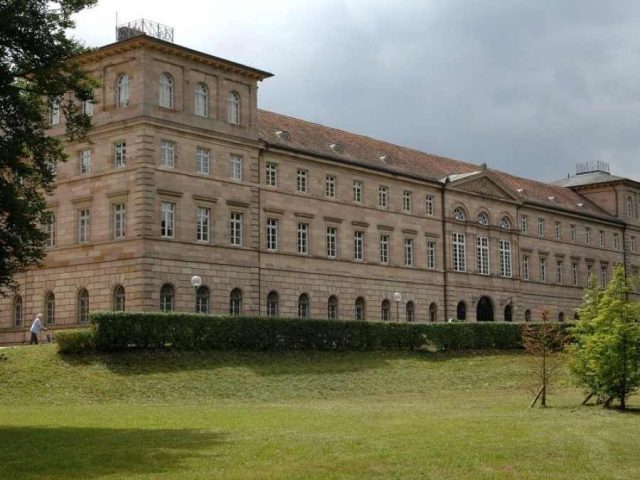
Already in the 14th century, a noble family settled in Burgfarrnbach. When Karl Franz Pückler von Groditz married Anna Cordula Freiin von Kresser in 1676, there was a moated castle in the western part of today's castle park, close to the Farrnbach riverbank, which his father-in-law had built in 1658 in place of the building burned down by the Croats in 1632. After Karl Franz's death, the first inheritance disputes began over the Burgfarrnbach estate, which included the moated castle at that time. In 1709, the young Count Christian Wilhelm Carl obtained a feudal letter for the Lower Seat in Ansbach. Three years later, the Upper Seat was also acquired as a fief from the Bamberg Cathedral Provostry.
Count Christian, the second Franconian Pückler, like many 18th-century princes, suffered from the "building bug" and thus plunged into considerable debt. To him we owe the baroque stables from 1734, the gate entrance on Würzburger Straße, and the so-called Schneiderhäuschen, the baroque garden pavilion east of the present castle. But Count Christian also extended his building plans to the two newly acquired knightly estates of Brunn and Tanzenhaidt near Emskirchen, as the new castle in Brunn from approx. 1734 proves. Count Christian's eldest son Friedrich Philipp Karl finally erected the New Castle in Limpurgian Gaildorf in 1778/79, which was unfortunately completely destroyed in the last weeks of the Second World War.
But it was not until 1834 that the Counts Pückler-Limpurg, with their new castle complex, created a special splendor that radiated far into the region. By the beginning of the 19th century, the fourth generation of the Franconian Pücklers had grown tired of living in the damp Burgfarrnbach moated castle. The dilapidated castle, whose renovation costs would have far exceeded the cost of a new building, was completely demolished. In its place, at some distance from the Farrnbach, the present castle was built between 1830–1834 by the Royal Bavarian Building Inspector Leonhard Schmidtner. It has an impressive length of 70 meters and, with its more than 80 rooms, is a regionally significant architectural monument and, moreover, the largest neoclassical castle complex in Southern Germany.
In strict symmetry, originally planned as a domicile for the three comital brothers Pückler-Limpurg, the castle with its two wings became the seat of the Friedrich and Ludwig lines after the eldest brother withdrew from all official business. Each family occupied its own wing; only the ballroom in the middle was used jointly by both families. Separate coach houses and washhouses adjoin the respective residential wings. The rooms in the three-story complex are of modest dimensions, and the interior design also reflects neoclassical restraint. The construction costs for the new castle amounted to approximately 113,000 guilders, which exceeded the initial estimates by about 60 percent, although several materials and components, such as doors from the old moated castle, were reused.
In the extensive castle park, the baroque stables are preserved as the oldest building. The ground floor had space for 28 horses; the representative bel étage was the dowager's residence for the countesses, as well as accommodation for guests and comital officials. Two pavilions in the castle park invited the comital family to linger in the 19th century. Even today, they are cozy places and atmospheric quiet zones for strollers and visitors.
After a checkered history in the post-war period, e.g., as a refugee camp and transitional home, the city of Fürth bought the castle and the associated lands and had it renovated in the 1980s. Since then, it has housed the City Archive with its Scientific Library. The castle is also a popular venue for festive occasions.
Burgfarrnbach Castle is not only a charming architectural monument and a tourist attraction, but also a historically preserving and vibrant cultural center of the city of Fürth.
Take Mobile History with you
You are reading this text for free. Premium adds what matters on the road: descriptions read aloud, sites found through your camera, whole regions taken offline.
- Every description, including the ~17,700 Premium sites
- Audio guide: have descriptions read to you on location
- AR finder: see sites through your camera, with distance and bearing
- Unlimited saved sites
14 days free, then from €2.99 a month. Cancel anytime.
Source: Wikipedia · Licence: CC BY-SA 4.0
This description draws on the facts documented in the linked Wikipedia article; Wikipedia content is licensed under CC BY-SA 4.0. Wording and editing: Mobile History.
Location: 49.4860, 10.9275