Administration department
Museum
CastleBurgdorf
Burgdorf Castle
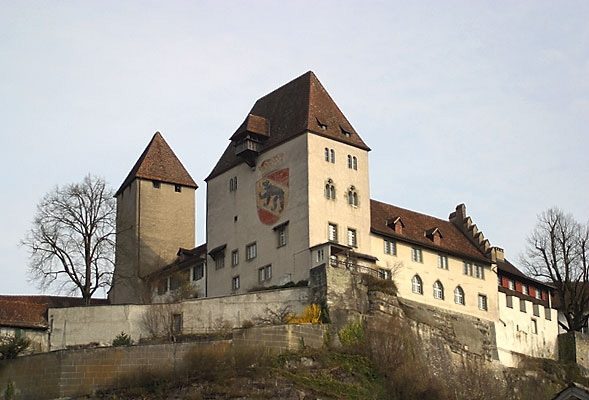
Burgdorf Castle is an 11th-century castle located at the highest point of the city of Burgdorf in the canton of Bern, Switzerland. As one of the largest high-nobility castles of the Hohenstaufen era, it is, along with Thun Castle and a few other sites in Switzerland, the secular counterpart to the great Romanesque churches, and thus a monument of national importance.
The unique topographical situation led to fortifications in prehistoric times and later to the formation of legends. The high medieval fortress was first mentioned in a document in 1130. Together with the High Burgundian demesne, the castle passed to the Counts of Rheinfelden in the 11th century and to the Dukes of Zähringen in 1090.
Berchtold V of Zähringen's major expansion of the castle around 1200 into a palatial residence aimed to make the castle the southern center of the planned Zähringen territorial state, straddling the Rhine. With Berchtold's death in 1218, the state disintegrated; the inheritance south of the Rhine passed to the Counts of Kyburg. Burgdorf Castle became the center of their western possessions; the decline of the counts led to the siege of Burgdorf by Bern and the Confederates in 1383 - with the first use of artillery in Switzerland.
In 1384, Bern bought the castle and lordship of Burgdorf from the impoverished Kyburgs. For 623 years, the castle has been the seat of the Bernese district administration, interrupted only from 1798 to 1804, when Johann Heinrich Pestalozzi ran his internationally renowned educational institute here. Until 1798, it was the seat of the Bernese bailiff, including Friedrich Bondeli (1705–1761), the father of Julie Bondeli. Since 1885, it has been the seat of the Castle Museum, making the most important rooms and towers permanently accessible to the public.
As the main seat of the Zähringen ducal family, which was decisive for the founding of the state of Bern and immortalized itself at the castle with a famous inscription, Burgdorf Castle played a central constitutive role in the formation of the state of Bern. The city of Bern was founded from here.
The castle, divided into the main and outer bailey, has preserved all essential parts from its main construction period. The rational, systematic distribution of the main volumes created around 1200 has remained dominant, and the combination of cubic structures in a commanding elevated position is effective to this day. The outer bailey consists of the gate tower, a curtain wall with a battlement, and a 45 m deep well. The main castle consists of a square keep, a tall residential and defensive tower, a south and north wing, which are surrounded by massive curtain walls with two half-shell towers on the north side.
Two freestanding tall defensive towers and a massive defensive wall from the 13th century, flanked by a moat, rampart, and smaller towers, protect the castle plateau to the north. To the south are the representative large buildings of the four-story palas and the hall, which contained a total of three large halls, of which the smallest, today called the Knights' Hall, has been preserved in its original state. The volume of the largest hall in the main building was divided into two floors and numerous individual rooms in the 16th century (today the court and governor's office). There were two castle chapels, of which the smaller one, including Gothic frescoes, has been preserved. In the palas, there is a Romanesque Knights' Hall and a chapel with frescoes from around 1330, which show scenes from the life of John the Baptist and parts of the Passion story.
The keep and the palas from the second half of the 12th century are among the earliest brick buildings in Switzerland. The Zähringen main construction phase of the castle initiated post-Roman brick production in Switzerland. The quality of the brickwork, originally visible both externally and internally, is astonishing; the dominant red coloring of the main buildings externally was a princely symbol. Bern built on this splendor when, around 1430, the palas received a new roof structure and its huge roof surfaces were given geometric patterns with glazed tiles. The careful handling that characterized Bernese building policy in Burgdorf and is evidence that Bern saw itself as the legal successor to the princely houses, preserved this main monument of medieval secular architecture in Switzerland for centuries.
Take Mobile History with you
You are reading this text for free. Premium adds what matters on the road: descriptions read aloud, sites found through your camera, whole regions taken offline.
- Every description, including the ~17,700 Premium sites
- Audio guide: have descriptions read to you on location
- AR finder: see sites through your camera, with distance and bearing
- Unlimited saved sites
14 days free, then from €2.99 a month. Cancel anytime.
Source: Wikipedia · Licence: CC BY-SA 4.0
This description draws on the facts documented in the linked Wikipedia article; Wikipedia content is licensed under CC BY-SA 4.0. Wording and editing: Mobile History.
Location: 47.0550, 7.6292