Cultural Events
The Castle can be visited
CastleDüren - Niederau
Burgau Castle
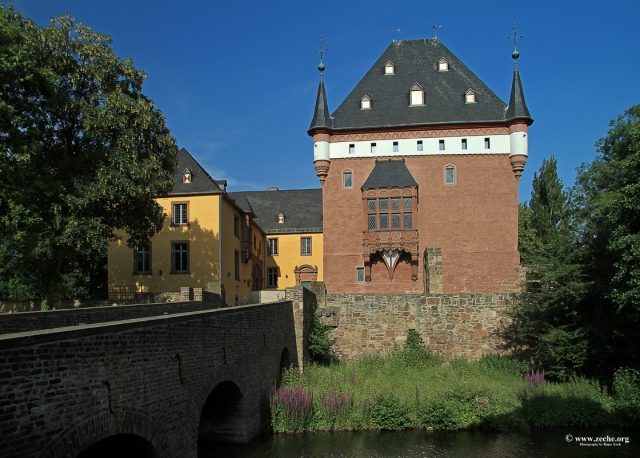
Schloss Burgau (pronounced: Burg Au) is a moated castle located in the Burgau Forest on the edge of the Düren district of Niederau.
Lords and Owners
The Lordship of Burgau was a fief of Heinsberg, which passed to the Duchy of Jülich in 1484, where it formed one of 43 sub-lordships. Amilius von Auwe is considered the first documented owner in the 13th century. The castle, standing on a hill, was first mentioned on November 19, 1313, when Wilhelmus de Barchowe appeared as a witness during a Heinsberg enfeoffment.
In 1475, ownership passed from the von Auwe family to the von Elmpt family through inheritance, who originally had their seat at a castle near Erkelenz. Towards the end of the century, the von Binsfeld family also partially came into possession, but members of the von Elmpt family remained the dominant lords of the castle. In the second half of the 17th century, the Metternich family joined, who quarreled with Count Schaesberg in 1718. Afterwards, the Lords of Elmpt regained possession.
Around 1900, Countess von Keyserlingk inherited the castle. In 1915, the von Keyserlingks moved to Bohlschau in West Prussia, ending a centuries-long tradition of family heritage. Margarete Countess von Keyserlingk sold Burgau to Rittmeister Ernst Nienhausen, knight estate owner at Haus Nienhausen near Rotthausen. Since this time, the castle was no longer inhabited and was left to decay. A design for the "restoration" of the castle by the Gelsenkirchen architect Josef Franke, presumably commissioned by Nienhausen, is known from 1917. The city of Düren acquired Schloss Burgau with all its possessions from Ernst Nienhausen in 1917 for 600,000 Marks. The purchase price was financed, among other things, with funds from the industrialist Benno Schoeller. This included a mill in Niederau, a forester's lodge, and several hundred hectares of forest. In the 1920s, Burgau was redesigned as an excursion destination and opened up for tourism.
Possessions of the Lordship of Burgau
The possessions of the Burgau nobility extended far beyond the castle. These included farms in Niederau, Stockheim, and Stepprath. In 1816, lands with a total area of 1200 Morgen were designated.
The Niederauer Hof can no longer be located today. The Brockhof in Stepprath (also called Germersheimer or Meisenberg-Hof) was a Burgau sub-fief. In 1813, the farm was sold to farmers from Stockheim. Also in Stockheim ownership came in 1792 the plots of the Mirbachshof, which had burned down several times. The hereditary leasehold farm was the third farm in Stepprath owned by the von Elmpt and Heidgen families. The Große Hof at the Stockheim church was demolished in the mid-19th century. The Kleine / Neue Hof of Stockheim was enfeoffed together with the Mirbachshof. It burned down several times and today belongs to a farmer. Further Burgau possessions were the free estates in Kallerbend and Vossenack, Haus Kombach near Kinzweiler, the Zehnthof in Eschweiler, farms in Kommern and Dürwiß, and the Merlenbroicher Hof in Vaals. Regarding the usage rights to the forest, there were repeated disputes between Burgau and Kreuzau.
In 1590, revenues from the possessions included approximately 930 Malter of grain, 130 capons, dozens of other animals, 300 eggs, and about 200 Gulden. In addition, there were proceeds from hunting, fishing, and various services. The real estate assets of the House of Burgau were valued at 11,365 Reichstaler in 1792. Additionally, the two Stockheim farms were estimated at around 13,500 Reichstaler each.
Reconstruction since 1974
Due to the destruction in World War II, subsequent looting, and weather influences, the castle increasingly fell into disrepair. Initially, there were no comprehensive efforts for reconstruction. After the incorporation of Niederau into the city of Düren, the St.-Cyriakus-Schützenbruderschaft launched the citizens' initiative "Rettet Burgau" (Save Burgau). The commitment met with great interest among the population. From 1974 to 1991, the marksmen collected donations totaling 275,000 Euros for the salvation of the castle, and the initiator Albert Müller received the Federal Cross of Merit.
The restoration was based on old pictures and drawings to restore the buildings as faithfully as possible. In 1981, under pressure from the population, the city of Düren decided to approve a total of eight million DM for reconstruction. Special effort was needed for the oriel. In the 1980s, more and more associations used the castle, where a café also opened, for concerts and other events. In 1991, the work reached a climax with the inauguration of the Winkelsaal.
Architecture+
The earliest traces date back to approximately 1100. The superstructures were located on a motte. Even today, the manor house stands on an island with a diameter of fifty meters. The residential tower also dates from the Middle Ages. Afterwards, the south, east, and north wings of the main castle were built. The oriel, built in 1551, is located on the residential tower. The four by 6.6 meter and 1.75 meter deep projection is decorated with numerous reliefs that refer to a wedding and ancient literature. In 1675, Daniel von Elmpt decided to have the damaged castle renovated. Around 1730, it was converted into a baroque three-wing complex.
In 1685, Anna Maria Catharina von Elmpt initiated the construction of a new outer bailey. The three-winged building, which, like the main castle, is surrounded by a moat, served as an economic building. Today, the Winkelsaal is located in the northwestern part of the outer bailey.
Current Use+
Since its reconstruction, Schloss Burgau has served as a tourist attraction and event venue. Many associations use the premises.
As an excursion destination, it is known for its pond and the surrounding forest. Since 1981, a café has provided culinary services for visitors. Concerts and festivals by various associations are regularly held in the Winkelsaal and in the inner courtyard of the outer bailey. Kaca Celan established the TAS Theater, including a theater school, in the main castle. In addition, the building offers 450 m² of space for exhibitions. The Düren registry office offers weddings in the oriel room on certain dates.
The building is registered under No. 2/001 in the monument list of the city of Düren.
Legend of the Hackefey+
The legend of the Hackefey gained supra-regional fame. According to the legend, the witch Sophia had made a pact with the devil against the count and countess living in the castle. The devil could not stand that the count and countess living in the castle loved each other so much. Therefore, he commissioned the villager Sofia Hack, called Hackefey, to sow discord between the couple. She told the countess that her husband had hair on his neck that disfigured him. She should shave it off at night. But she told the count that his wife wanted to murder him. When the countess tried to shave off the hair on her husband's neck, he saw it as confirmation that she wanted to murder him. The resulting quarrel estranged the couple forever, and Hackefey received golden slippers from the devil as a reward.
Hackefey is depicted on several reliefs in the castle. The Düren dialect poet Joseph van der Giese wrote a play about this legend in 1840, and Johann Walter Neumann adapted the story into a ballad in 1909. Martin Luther mentioned it in his Table Talk.
Take Mobile History with you
You are reading this text for free. Premium adds what matters on the road: descriptions read aloud, sites found through your camera, whole regions taken offline.
- Every description, including the ~17,700 Premium sites
- Audio guide: have descriptions read to you on location
- AR finder: see sites through your camera, with distance and bearing
- Unlimited saved sites
14 days free, then from €2.99 a month. Cancel anytime.
Source: Wikipedia · Licence: CC BY-SA 4.0 · Image: http://www.zeche.org/
This description draws on the facts documented in the linked Wikipedia article; Wikipedia content is licensed under CC BY-SA 4.0. Wording and editing: Mobile History.
Location: 50.7671, 6.5006