The Castle can be visited
CastleSchliengen - Obereggenen
Bürgeln Castle
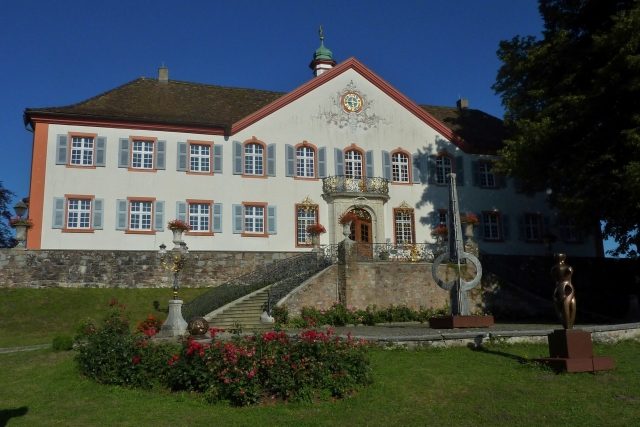
Bürgeln Castle is located at 665.4 m above sea level on a wooded hill above the Schliengen district of Obereggenen. Politically, the area today belongs to the municipality of Schliengen in the district of Lörrach in Baden-Württemberg.
In 1762, construction was begun by Franz Anton Bagnato at the instigation of the Provost of Bürgeln, Aloysius Mader, and Prince-Abbot Meinrad Troger of St. Blasien Monastery, to which the provostry belonged, in the early Classicist style with Rococo furnishings, and completed in 1764 under Prince-Abbot Martin Gerbert.
The Lords of Kaltenbach
It is assumed in literature that since ancient times there stood a small church dedicated to Saint John, served by a secular priest. In old documents, the names Búrgilon, Burgilun, Burgelun are found. Around 1120, Knight Wernher von Kaltenbach the Elder entered St. Blasien Monastery under the influence of the Bishop of Constance, Gebhard III, who had fled to the monastery. Around 1125, his unmarried son Wiprecht, with the consent of his father and his brother Wernher, who also lived in St. Blasien Monastery, bequeathed all Kaltenbach possessions to the monastery. This also included the Bürgelnberg, on which the church of the village of Obereggenen stood, which served as a burial place for the Kaltenbach family.
Provostry of Bürgeln of St. Blasien Monastery until the Reformation
In 1126, Abbot Berthold I of St. Blasien first founded a cell with only three brothers and shortly thereafter a provostry, whose first provost was Wernher von Kaltenbach the Younger. In 1267, a fire destroyed the church and monastic cells. Abbot Arnold II oversaw the reconstruction, which culminated in the consecration of the new altar in 1277. The provostry had both secular duties (administration of St. Blasien's property in Markgräflerland; collection of taxes) and spiritual duties as a monastic cell and had to ensure the spiritual care of the nearby Sitzenkirch convent, as well as the communities of Obereggenen, Kaltenbach, and Marzell. During the Peasants' War of 1525, the provostry was plundered.
Provostry of Bürgeln of St. Blasien Monastery after the Reformation until Secularization
While St. Blasien Monastery and its large possessions belonged to Further Austria, the sovereign of the Bürgeln Provostry was the Margrave of Hachberg-Sausenberg and later that of Baden-Durlach. With the new church order, the Reformation was introduced in the Margraviate on June 1, 1556. The provostry thus lost its spiritual duties, as the Margrave dissolved the Sitzenkirch convent and appointed Protestant pastors in the communities previously served by Bürgeln.
In 1689 – during the War of the Palatine Succession – French troops severely damaged the provostry. From 1692 to 1698, the provostry building remained uninhabited due to its poor structural condition. The structural condition remained unsatisfactory even after repair work, and various provosts entertained plans for new construction. However, it was not until 1762 that Aloysius Mader succeeded with his abbot, Meinrad Troger. "The new provostry had to be more than just an administrative building in terms of construction. It was about representation and the display of Catholic power."
The old building was demolished down to its foundations in 1762, and the new construction began under the direction of Franz Anton Bagnato. In 1764, the early Classicist building was completed. The two-story main facade faces west and features a central gable. On the north side, a chapel is integrated into the building.
In 1782, Prince-Abbot Martin Gerbert of St. Blasien successfully resisted the Josephinism of the Austrian sovereign Joseph II and was initially able to prevent the secularization of St. Blasien Monastery and its provostries.
In the Peace of Lunéville (1801) between France and Austria, as well as the German Empire, France definitively received the German territories on the left bank of the Rhine occupied since 1795. The Empire was obliged to compensate the princes affected by territorial losses. In the Imperial Deputation Main Resolution of 1803, it was stipulated that the secular princes should be compensated through the secularization of ecclesiastical property and the mediatization of smaller imperial estates. The Order of Malta, with its Grand Priory in Heitersheim, was assigned the possessions of St. Blasien Abbey. However, the House of Austria refused the handover. After the Peace of Pressburg, the entire Austrian Breisgau then fell to Baden on April 15, 1806. With the Confederation of the Rhine Act of July 12, 1806, the Maltese Principality of Heitersheim also fell to the Grand Duchy of Baden, whereby the Bürgeln Provostry was definitively assigned to Baden.
Bürgeln Castle from Secularization to Today
The Grand Duchy sold the castle as early as 1809 to a farmer. In 1822, the Catholic Religious Fund in Freiburg bought the north wing with the chapel. Subsequently, there were a number of other owners of the castle or parts thereof. The nearby spa town of Badenweiler suggested a gastronomic use for the excursion destination, Bürgeln Castle. In 1912, however, Elisabeth Baroness von Gleichenstein took over the castle, who on the one hand expanded the castle with an annex and on the other hand restricted public access.
When she wanted to sell Bürgeln to Consul Felix Schleyer in 1920, communities and citizens of Markgräflerland united in the Bürgeln-Bund to preserve the castle for the public. The Baden state exercised its right of pre-emption and thus prevented the private sale. The Bürgeln-Bund provided the purchase price to the (then still independent) municipality of Obereggenen, and in return, the municipality contractually transferred the rights and obligations of land ownership to the Bürgeln-Bund.
After the purchase, the funds of the Bürgeln-Bund were exhausted, and they sought a private tenant for maintenance and expansion, whom they found in Richard Sichler, who was staying in Badenweiler for a cure. From 1922, Sichler was the general director of Lingner-Werke AG in Dresden. For the redesign of the buildings, Sichler chose the architect Theodor Veil, who created the terrace in front of the west side and set back the staircase. Inside, the castle had to be completely and fundamentally renovated. On September 19, 1926, the lengthy renovation work, which Sichler financed from private funds, was completed, and a four-day opening celebration began.
In 1957, after Sichler's death, the lease ended, and the Bürgeln-Bund took over the maintenance of the castle under its own management.
Current Use+
Today, numerous events take place at Bürgeln Castle, especially in summer. These include conferences, seminars, concerts (with the Freiburg University of Music), and festivals.
In the mid-1980s, the castle was the filming location for a ZDF series titled Lorenz & Söhne. The plot was the story of the Lorenz family and their winery.
Take Mobile History with you
You are reading this text for free. Premium adds what matters on the road: descriptions read aloud, sites found through your camera, whole regions taken offline.
- Every description, including the ~17,700 Premium sites
- Audio guide: have descriptions read to you on location
- AR finder: see sites through your camera, with distance and bearing
- Unlimited saved sites
14 days free, then from €2.99 a month. Cancel anytime.
Source: Wikipedia · Licence: CC BY-SA 4.0 · Image: Joachim Schneeleopard
This description draws on the facts documented in the linked Wikipedia article; Wikipedia content is licensed under CC BY-SA 4.0. Wording and editing: Mobile History.
Location: 47.7502, 7.6777